
Houseplant
Congo Marantochloa Prayer Plant
Marantochloa congensis
Also known as Marantochloa congensis
How to grow Marantochloa congensis, a stout reed-like prayer-plant relative of the Congo basin forest, and how to site, water and feed it under cover.
At a glance
- Difficulty
- Easy
- Water
- When the top few centimetres of mix have dried
- Light
- Bright indirect light to light shade
- Temperature
- Warm; keep above about 13 deg C
- Humidity
- Average to high
- Hardiness
- USDA 10-12, RHS H1b, hardy to 13 C
- Type
- Perennial
- Height
- 1-2 m
- Native to
- tropical Africa
A tender tropical foliage plant from tropical Africa, growing in warm, humid, shaded to filtered light. It needs warmth, humidity and bright indirect light, and it cannot take frost or chill. It is safest above about 13 deg C, and cold, wet compost or dry air spoils it.
Hardiness zones describe winter cold alone. Summer heat, humidity, rainfall and the length of the growing season decide as much, so treat the range as the outer limit rather than as a recommendation.
Not known to be toxic
Marantochloa congensis, the congo marantochloa prayer plant, is not recorded among the seriously toxic plants, and related plants in its group are not listed as toxic by the ASPCA or the RHS. A pet or child that chewed a leaf would be unlikely to have more than a mild stomach upset.
Sources: ASPCA toxic and non-toxic plants, RHS potentially harmful garden plants
A forest reed, not a showy pot plant
Set your expectations before you go looking for Marantochloa congensis. It is a big, vigorous, reed-like herb of the African rainforest, grown by botanists and keen collectors instead of sold as a patterned windowsill plant. There are no painted stripes or metallic sheens here. It is grown for a tall, leafy, cane-bearing clump of broad green blades, and for its kinship with the prayer plants, whose leaf habits it shares. Anyone who wants a compact, jewel-leaved specimen should look to a calathea; anyone with the room and warmth for a large tropical foliage plant may find this more useful.
What the plant looks like
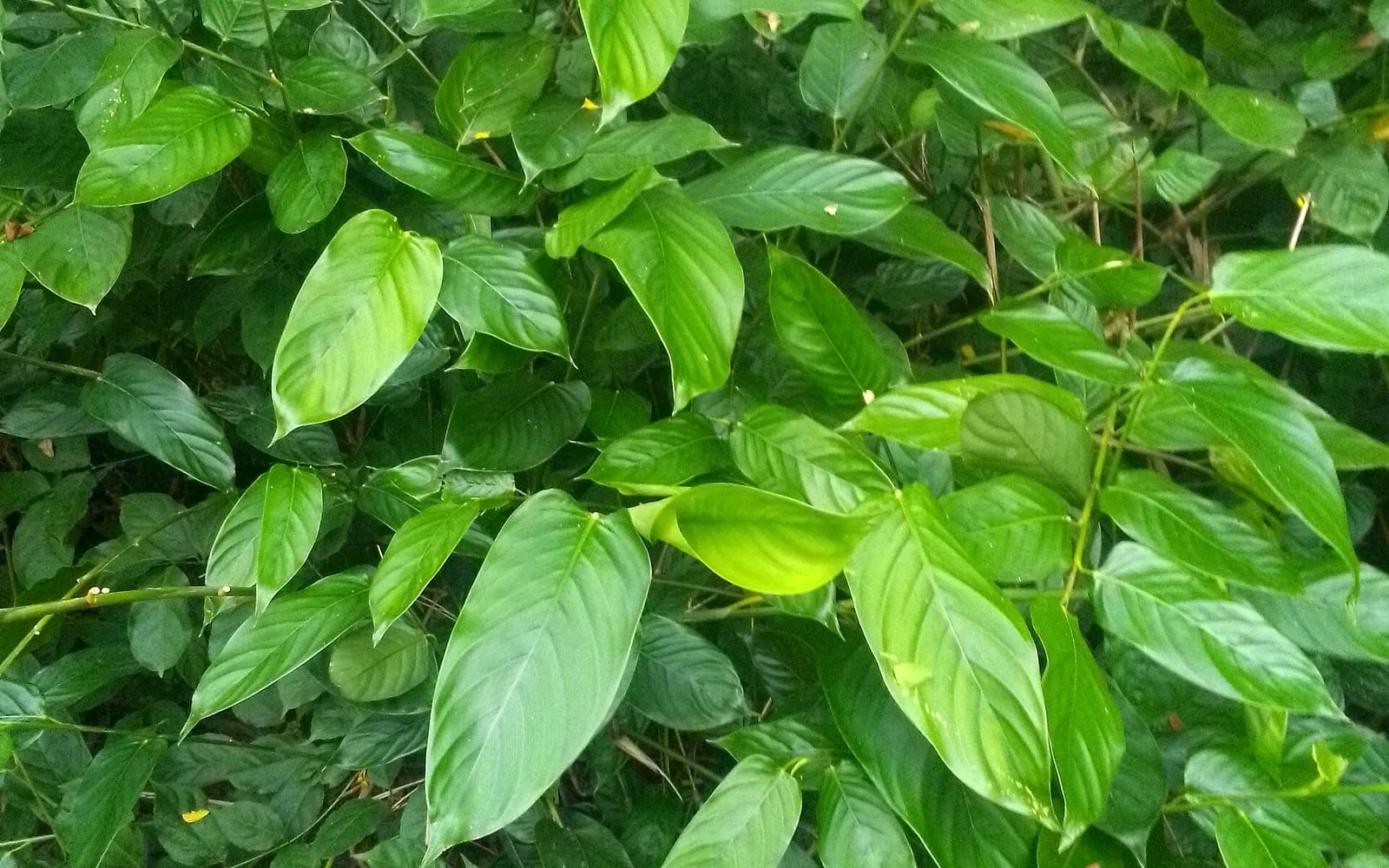
From a creeping underground rhizome the plant produces slender, jointed, reed-like stems that carry broad, oval to oblong leaves on branching stalks. In the wild those stems can reach well over head height and form dense leafy stands, though a plant kept under cover stays smaller according to its pot size and light. The foliage is a plain, fresh green, thinner and more papery than a calathea’s, and the small flowers that follow are modest, giving way to little fruits. The plant forms an airy, bamboo-like clump instead of a low rosette of decorated leaves.
The Congo basin home
The species belongs to tropical Africa and takes its name from the Congo region, where it grows through the forests of the central African basin. It favours wet ground, including swampy hollows, stream sides and river margins, along with clearings and forest edges with filtered light. Rain is heavy and frequent across much of its range, humidity stays high, and temperatures remain warm all year with no cold season. In parts of the Congo forest, prayer-plant relatives like this one carpet the ground so thickly that ecologists speak of Marantaceae forest, a habitat used by forest elephants and gorillas as they browse the soft stems.
Light and space under cover
Give it the bright, filtered light of a forest edge instead of direct sun. A position lit strongly but shielded from direct beams suits it, and light shade is tolerated better than a dark corner, where the stems grow thin and weak. Direct midday sun bleaches and scorches the leaves. Because the plant spreads and grows tall, it suits a conservatory, a heated glasshouse or a large, warm room with head height to spare, instead of a crowded sill. A wide, heavy pot keeps a leafy clump from toppling.
Watering the clump
Keep the compost evenly moist while the plant is growing, watering once the top few centimetres have dried and letting the surplus drain right through, since this is a species of wet ground that dislikes drying out hard. It is equally unhappy standing in cold, stagnant water, which rots the rhizome, so use a free-draining mix in a pot that empties freely. Hard tap water leaves scale and salts that can mark the foliage, so use rainwater or filtered water where the mains runs limy. Through the cooler, darker months growth slows and the roots use noticeably less water, so water more sparingly then.
Warmth, humidity and feeding
Keep the plant above about thirteen degrees C at all times, and give it the ordinary warm range of eighteen to twenty-six degrees C, away from draughts and cold glass. It comes from a place where the air is rarely dry, so it needs humidity, which a damp gravel tray, a group of plants or a humidifier will supply; dry indoor air browns the leaf edges. Feed a fast, leafy grower like this every two or three weeks through spring and summer with a balanced fertiliser at half strength, easing off entirely in winter. Repot in spring when the rhizome fills its container, moving up into a roomy pot of open, moisture-holding, peat-free compost.
The leaf movement
Marantochloa congensis is a member of the prayer-plant family, Marantaceae, and has the family’s leaf movement. At the top of each leaf stalk sits a swollen band of tissue, the pulvinus, which works like a hinge by shifting water in and out of its cells, raising the blade towards evening and lowering it again by day. The motion is subtler than on a well-grown calathea, but the mechanism is the same, and a plant that stops responding is usually cold, dry or root-bound.
Uses in its homeland
Across its African range this plant and its close relatives have practical uses. The broad, tough leaves are cut to wrap food, line cooking pits and thatch, and the long, pliant stems are split for tying, weaving and simple basketry. Several Marantochloa species also feature in local herbal traditions. None of that affects growing the plant under glass, but it explains why a plain green forest herb is well known and widely gathered where it grows, and why it appears in botanical collections that document useful plants.
Common problems
Brown, crisping leaf margins usually mean the air is too dry or hard water has left salts behind, so raise the humidity and switch to rainwater. Yellowing leaves standing over cold, sodden compost point to waterlogged, rotting roots; dry the mix and improve drainage. Pale, drawn stems with widely spaced leaves mean the light is too weak. In warm, dry rooms spider mites may stipple the undersides and spin fine webs, and mealybugs may gather as white woolly tufts at the leaf joints; sponge the plant down and treat pests early with dilute alcohol on a cotton bud.
Quick answers
Is this a good beginner’s houseplant? It is easy to keep alive but big and plain, so it suits a collector or a large warm space more than a first windowsill plant.
How large does it get? In the wild its reed-like stems can grow well overhead, but under cover it stays in proportion to its pot and light, often far smaller.
Does it fold its leaves like a calathea? Yes, though less dramatically. The same pulvinus hinge raises and lowers the blades on a daily cycle.
Why are the leaf edges browning? Dry air or hard-water salts. Lift the humidity and water with rainwater or filtered water.
Congo Marantochloa Prayer Plant problem guides
Not sure what is wrong? See the common houseplant pests guide.