
Houseplant
Purple Marantochloa Prayer Plant
Marantochloa purpurea
Also known as Marantochloa purpurea
How to grow Marantochloa purpurea, a tall purple-flushed prayer-plant relative of tropical Africa, and how to site, water and feed it under cover.
At a glance
- Difficulty
- Easy
- Water
- When the top few centimetres of mix have dried
- Light
- Bright indirect light to light shade
- Temperature
- Warm; keep above about 13 deg C
- Humidity
- Average to high
- Hardiness
- USDA 10-12, RHS H1b, hardy to 13 C
- Type
- Perennial
- Height
- 1-2 m
- Native to
- tropical Africa
A tender tropical foliage plant from tropical Africa, growing in warm, humid, shaded to filtered light. It needs warmth, humidity and bright indirect light, and it cannot take frost or chill. It is safest above about 13 deg C, and cold, wet compost or dry air spoils it.
Hardiness zones describe winter cold alone. Summer heat, humidity, rainfall and the length of the growing season decide as much, so treat the range as the outer limit rather than as a recommendation.
Not known to be toxic
Marantochloa purpurea, the purple marantochloa prayer plant, is not recorded among the seriously toxic plants, and related plants in its group are not listed as toxic by the ASPCA or the RHS. A pet or child that chewed a leaf would be unlikely to come to serious harm beyond a possible mild stomach upset.
Sources: ASPCA toxic and non-toxic plants, RHS potentially harmful garden plants
A tall, purple-flushed forest herb
Marantochloa purpurea is one of the biggest plants in its genus, a vigorous cane-forming herb of tropical Africa that reaches around a metre to three where warmth, moisture and shelter allow. It belongs to the Marantaceae, the prayer-plant family, though it grows on a far larger scale than the small patterned calatheas most people picture. Expect a leafy green thicket of tall reedy stems instead of a neat pot specimen on a sill.
What purpurea means
The species name refers to the plant’s one colourful trait. A purple to reddish wash runs through the stems, along the leaf stalks and over the undersides of the blades, so a mature clump looks green from above and wine-purple from below. That pigment, instead of any painted silver banding, is what separates this species from the plain green herbs standing alongside it in the genus. Backlight a leaf and the colour shows at its clearest.
Flowers, fruit and leaf movement
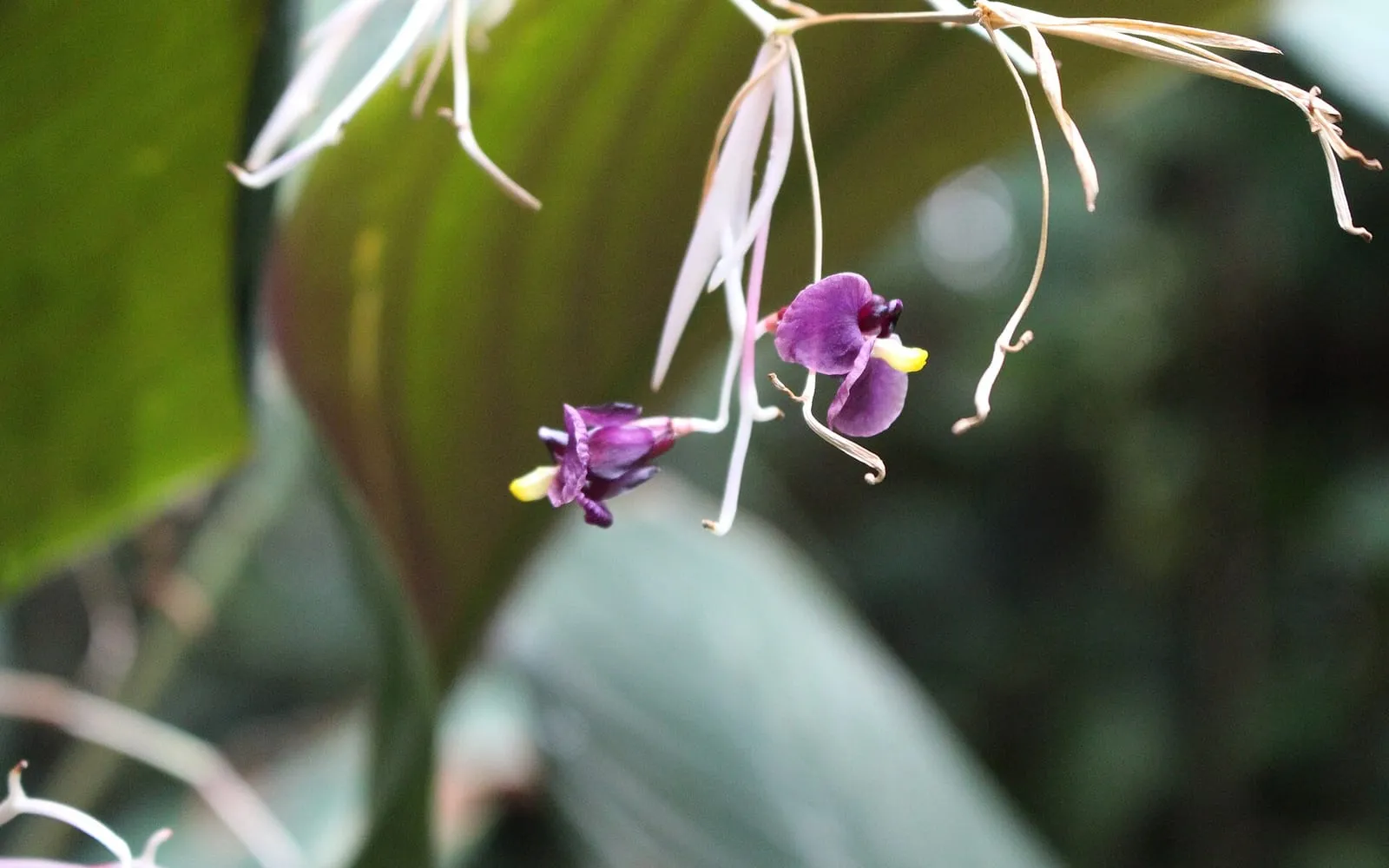
Small pale flowers open on slender branching heads and give way to soft, reddish, berry-like fruits that draw forest birds. Every blade sits on a stalk tipped with the pulvinus, the swollen band of water-driven cells that a prayer plant uses to tilt its leaf. As dusk comes on, those hinges lift the blades upward; by morning they have settled flat again. The stems rise from a stout creeping rhizome that spreads underground and sends up fresh canes.
Where it grows
This species is widespread across tropical Africa, from West Africa through the Congo basin and on into the east. It favours the brighter parts of the forest, taking clearings, riverbanks, roadside regrowth and the margins where the canopy opens up. Warmth is constant, rainfall high, and the air humid all year, with no cold season to force a true rest. Its bulk and speed of growth let it persist in disturbed, well-lit patches where smaller herbs would soon be shaded out.
People and the plant
Villagers cut the large leaves to wrap and carry food and to cover simple shelters, and split the tough stems for tying and coarse weaving. The plant turns up in local remedies across its range as well. These uses, rather than a place on a windowsill, keep it in cultivation near its home. Its speed and size mean a stand can be cut back hard and still recover, so a household can treat it as a renewable crop of leaf and cane rather than a specimen to nurse.
Room, repotting and shaping
Being the tallest of the marantochloas, this plant needs planning before it arrives. Stand it where the canes can rise without meeting a ceiling or a curtain, and choose a heavy, wide pot that will not topple as the top growth gets heavier. Repot in spring as growth resumes, sliding it into a container a size larger and packing fresh open mix around the roots. Old, tired canes can be cut out at the base to make room for new ones, which keeps the clump dense and upright. Once a plant has filled its pot and begun to push at the sides, divide it instead of moving it into an ever larger container, since a split clump regrows with far more vigour than a pot-bound one.
Growing it under glass or indoors
Being tropical, M. purpurea has no tolerance of frost and belongs to the warm zones, about USDA 10 to 12. Keep it above roughly 13 deg C, clear of chilling draughts and cold glass. It takes light shade to filtered sun, matching the half-lit forest edge; fierce direct sun bleaches the leaves and dulls the purple. Allow it room and a large container, since a cramped root run limits the vigorous growth that makes this plant worth growing.
Watering, compost and humidity
Set it into a free-draining yet moisture-holding medium, peat-free where possible, opened up with bark, coir and grit. Water generously while it is growing strongly in warmth, letting the surface just begin to dry between soakings, then cut back firmly as the temperature falls so the rhizome never stands cold and sodden. Mineral-heavy tap water can blemish the foliage, so rain or filtered water is the safer choice. Warm, moist air keeps the big leaves from crisping along the edge.
A backdrop plant for a large space
In a big conservatory this species works well as a living backdrop, its height and broad leaves framing lower, brighter tropicals set out in front of it. Because it grows fast, it fills a bare corner within a season or two, and the folding leaves add slow movement to a planting that would otherwise sit quite still. Place it towards the back where its size fits the planting, and keep the front row for smaller plants that would vanish beside it. Three stems staggered in height look better than a lone cane standing on its own. When the top growth begins to shade its own base, thin a few canes so light reaches the low leaves and the clump stays leafy to the floor.
Feeding and propagation
From spring to early autumn, feed fortnightly with a dilute balanced fertiliser, then withhold it altogether in winter. The quickest way to increase the plant is by division, splitting the rhizome in spring into rooted, growing pieces and potting them up in warmth. Firm basal stem cuttings will also root in a humid, sheltered spot with bottom heat.
Common problems
A collapse of the lower leaves over sour wet compost signals rhizome rot from cold and overwatering, so warm the plant and let the mix dry out. Brown papery leaf margins come from dry air or salty water. Spider mites and mealybugs move in when the air is warm and dry, the mites speckling the leaf backs and the mealybugs massing as white fluff in the joints; rinse, wipe and raise humidity to reduce them.
Quick answers
Why is it called purple? For the reddish-purple tint on the stems and the undersides of the leaves, seen best with light coming through from behind.
How large will it grow? Given warmth and space it makes a tall clump of canes, potentially head high, so it suits a conservatory floor better than a shelf.
Does it fruit indoors? Rarely. In the wild it sets small reddish fleshy fruits after flowering, but under cover it seldom blooms at all.
What is the biggest killer? Cold, wet compost. Match the watering to the warmth and the plant rarely fails.
Purple Marantochloa Prayer Plant problem guides
Not sure what is wrong? See the common houseplant pests guide.