
Houseplant
Wall-Rue
Asplenium ruta-muraria
Also known as Asplenium ruta-muraria
How to grow Asplenium ruta-muraria, wall-rue, a tiny hardy limestone-crevice fern for a trough, tufa or old wall.
At a glance
- Difficulty
- Moderate
- Water
- When the gritty mix starts to dry near the surface; barely moist in winter
- Light
- Bright indirect light
- Temperature
- Cool and fully hardy; dislikes heat
- Humidity
- Average
- Hardiness
- USDA 3-8, RHS H7, hardy to -30 C
- Type
- Perennial
- Height
- 3-12 cm
- Native to
- the temperate Northern Hemisphere
A fern of limestone cliffs and old lime mortar across the temperate Northern Hemisphere, fully hardy through severe winters. It struggles in hot summers, in stagnant air and in rich or acid compost, so it does best in cool, bright, airy sites with sharp drainage and an alkaline footing.
Hardiness zones describe winter cold alone. Summer heat, humidity, rainfall and the length of the growing season decide as much, so treat the range as the outer limit rather than as a recommendation.
Not known to be toxic
Wall-rue is not recorded as poisonous to people or pets, and spleenworts are not listed as toxic by the ASPCA or the RHS. A pet or child that chewed a frond would be unlikely to come to real harm beyond a possible mild stomach upset.
Sources: ASPCA toxic and non-toxic plants, RHS potentially harmful garden plants
About
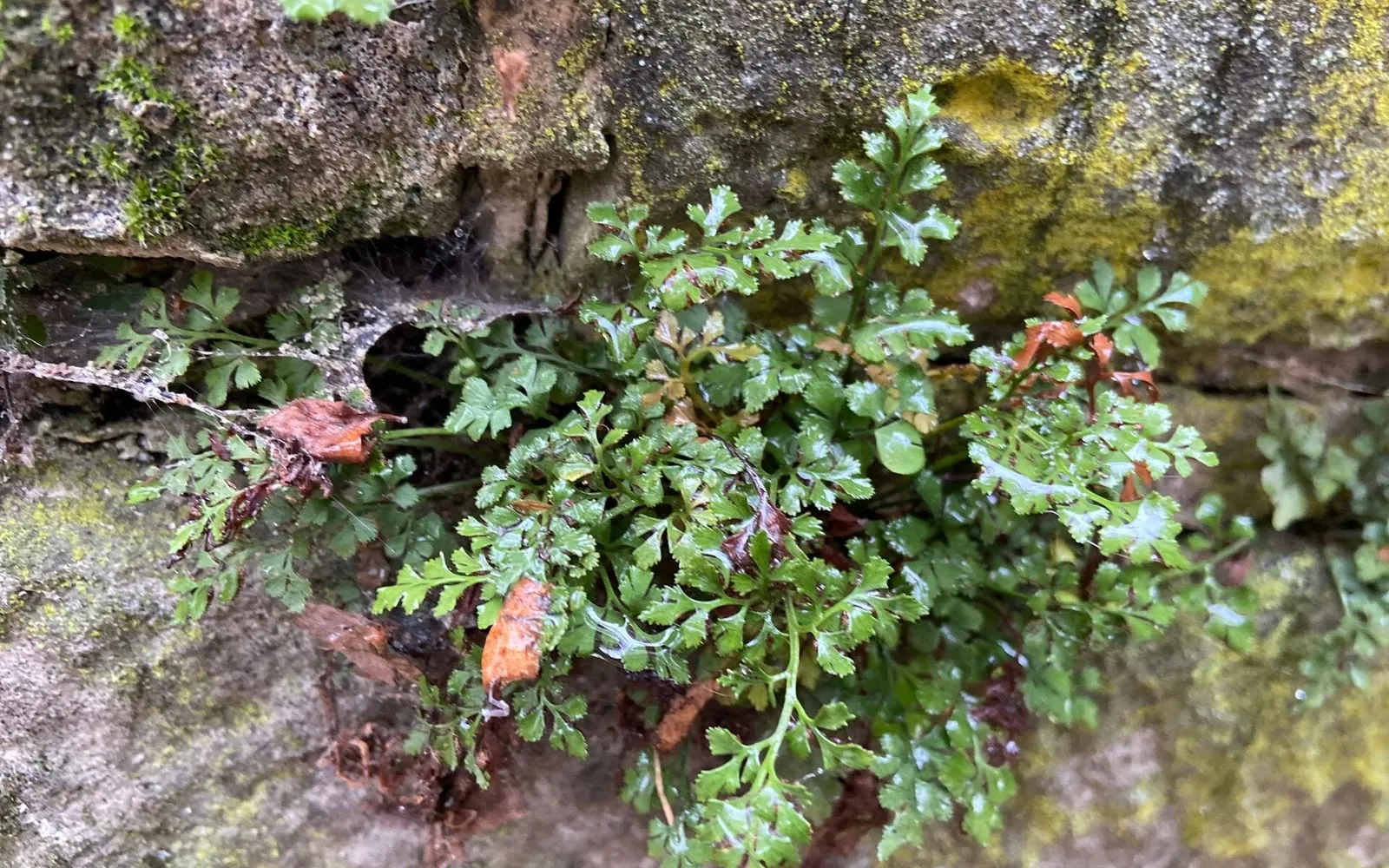
Wall-rue is a fern most people have walked past without a second look. It is tiny, only a few centimetres tall, tucked into the joints of old limestone walls and mortar, where it makes a dense little tuft of leathery, blue-green fronds cut into small wedge- or diamond-shaped segments. The name recalls a passing likeness to the herb rue, though the two are unrelated, and the plant is properly a spleenwort, Asplenium ruta-muraria.
Its growth is closely tied to lime. Across the temperate northern hemisphere, from Europe through Asia into North America, it colonises limestone cliffs, chalk grassland outcrops and the lime-rich mortar of stone walls, threading its roots into small, lean cracks. That is very different from the tropical maidenhairs, and it needs different care.
Treat it as the hardy crevice plant it is. It suits a trough, a block of tufa, a crevice garden or a gritty pan in a cool, bright, airy spot far better than a warm windowsill. Give it sharp, alkaline drainage, cool air and steady but never stagnant moisture, and it will settle for years. Rich, sodden compost and a hot, close room are what defeat it.
Appearance and character
The fronds are small and leathery, a matt blue-green, divided into little wedge- or diamond-shaped segments on slender green stalks, and they cluster into a dense, low tuft.
It keeps to a few centimetres tall, a fern of cracks and crevices instead of a leafy specimen, and it holds its foliage through the year.
Fresh fronds push up from the compact crown and toughen as they age, and the tuft slowly broadens instead of spreading or trailing.
Being a fern it never flowers, and its spores ripen in narrow lines beneath the leathery segments.
Where it is from
Wall-rue is native right across the temperate northern hemisphere, on limestone cliffs and pavement, chalk outcrops and, very often, the old lime mortar of stone walls, throughout Europe, temperate Asia and North America.
Everything about its care follows from those lime-rich crevices. It needs sharp drainage, an alkaline footing, cool and airy surroundings, bright light out of scorching sun, and moisture that comes and goes instead of sitting constant. It is fully at home with cold, so it needs no protection from frost, but it responds poorly to heat, stagnant wet and acid, peaty composts.
How it grows
It grows slowly and steadily through the milder months and almost stops in the depths of winter, holding its leathery fronds the year round. Cool air, sharp drainage and lime keep it healthy; heat and a sodden, acid root run are what set it back.
Plant it in a gritty, free-draining mix with plenty of limestone chippings or crushed mortar, in a trough, a tufa block or a shallow pan, and let surplus water drain away at once. Where it is happy it will seed itself into nearby cracks. To increase it deliberately, sow spores onto a limy, gritty surface, which is slow but reliable.
Stand it somewhere cool, bright and airy, out of the fiercest sun, and water with rainwater or hard tap water alike, since the lime in hard water does it no harm at all.
Through the seasons
Spring brings slow fresh growth. Top-dress with grit or limestone chippings, and water as the mix begins to dry.
Summer is the main growing time, though it never races. Keep it cool and airy, shaded from the hottest sun, and water before the gritty mix dries right out.
Autumn slows it towards rest. Ease off the watering as growth winds down.
Winter it rests, and its full hardiness shows. Keep it barely moist, cool and airy, and let it take the cold it is built for.
Care difficulty
Moderate, and the difficulty is different from tropical ferns. Given lime, sharp drainage, cool air and bright light it is tough and long-lived. It fails in heat, in rich or acid compost, and in a mix left sodden, which rots the small crown. A warm, close, dimly lit room suits it least of all.
Watering
Water as the gritty mix starts to dry near the surface, letting the surplus run straight through, since the crown rots if it sits wet. Hard tap water is welcome here, its lime matching the plant’s native rock, so there is no need to save rainwater for it.
Through winter keep it only just moist. It can tolerate short dry spells, but it still needs access to moisture without standing water around the roots.
Warning signs, diseases and pests
A crown gone soft and black has been kept too wet in too rich a mix. Lift it, cut away the rot, and replant into sharper, grittier, limy drainage. Browning, shrivelled fronds in summer usually mean heat and a mix dried right out, so move it somewhere cooler and water before it fully dries.
Kept cool and airy it draws few pests. In a hot, dry, stagnant spot spider mites may appear and speckle the fronds, which better ventilation and cooler air discourage better than spraying.
Growing environment
Cool, bright, airy conditions matter most, out of the scorching midday sun that shrivels the small fronds but never in deep shade. An alpine house, a cold frame, an open porch or an outdoor trough all suit it.
Pair that with a gritty, sharply draining, lime-rich mix and it needs little else. Warmth, stagnant air and rich wet compost are the conditions to keep it away from.
Feeding
It is a lean plant of poor crevices and needs very little. A weak, balanced feed once or twice over the growing season is ample, and many growers give none at all.
Never feed it heavily, since rich feeding forces soft growth unlike its natural tough tuft. A fresh gritty mix carries it for a long time before any feed is needed.
Troubleshooting
Why is my wall-rue struggling? Most often heat and a rich, wet, acid compost, which rot the crown, or a hot dry spell that shrivels the fronds. Cool, airy conditions and a gritty, limy mix put it right.
How much light does it want? Bright, airy light out of the scorching sun. It is a plant of open rock faces, not of deep shade.
Do I need to use rainwater? No. Hard, limy tap water suits it, matching the limestone it grows on in the wild.
Is it really hardy? Yes. It grows on cold northern walls and cliffs and takes frost in its stride, so it needs cool rather than warm conditions.
Is it safe around pets? Spleenworts are not recorded as poisonous, so it is treated as safe around cats, dogs and children.
Wall-Rue problem guides
Not sure what is wrong? See the common houseplant pests guide.