
Houseplant
Utah Agave
Agave utahensis
Also known as Agave utahensis
How to grow Agave utahensis, the utah agave, a small grey rosette of the high western deserts with a long slender spine, slow to build and mildly toxic.
At a glance
- Difficulty
- Easy
- Water
- Only when the whole mix has dried right through
- Light
- Full sun to bright light
- Temperature
- Hardy to around -20 deg C if kept dry; also tolerates hot summers
- Humidity
- Low; damaged by damp winter air
- Hardiness
- USDA 5-10, RHS H6, hardy to -20 C
- Type
- Perennial
- Height
- 20-40 cm
- Native to
- the southwestern United States
The most cold-hardy agave, from the high deserts and plateaus of Utah, Nevada, Arizona and California, where winters freeze hard and summers are hot and dry. The limit is winter wet. It survives deep frost on sharp drainage in a dry winter but rots in cold, wet soil and humid air, so in a wet-winter climate it does best in a pot or raised gritty bed under cover from winter rain.
Hardiness zones describe winter cold alone. Summer heat, humidity, rainfall and the length of the growing season decide as much, so treat the range as the outer limit rather than as a recommendation.
Harmful if eaten
- Do not eat
- The leaves and sap
- Harm from
- Eating it and handling it
- Affects
- People, cats and dogs
Agaves carry a sap with calcium oxalate crystals and saponins. The ASPCA lists Agave as toxic to cats and dogs, which may drool, vomit or get a skin rash after chewing or brushing against it. On human skin the sap can cause redness, itching and blistering in sensitive people, so wear gloves and eye protection when cutting or removing offsets. The rigid terminal spine is a sharper hazard than the sap, and can jab deeply into a hand or an eye.
Sources: ASPCA toxic and non-toxic plants, RHS potentially harmful garden plants
About
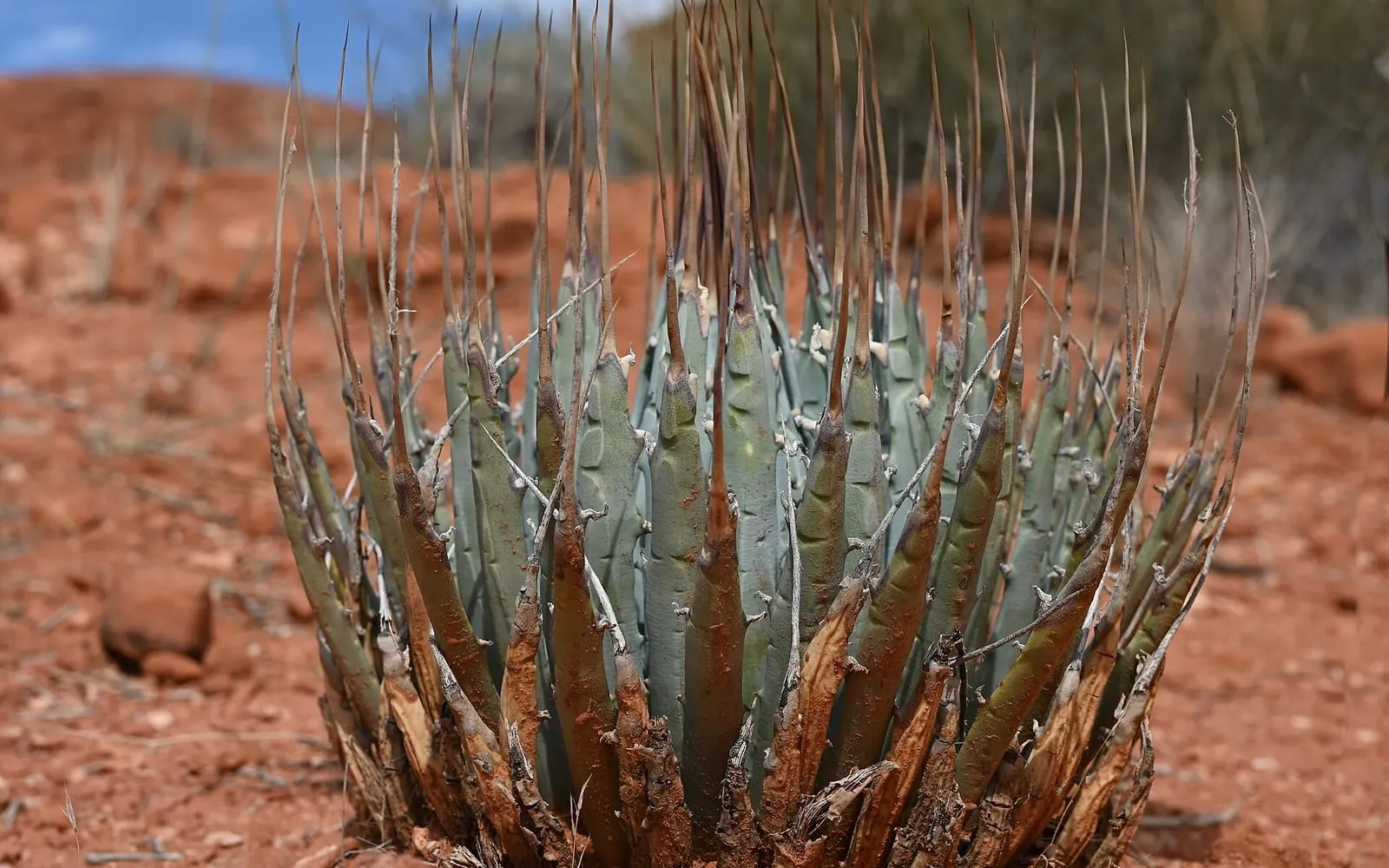
Agave utahensis grows higher and further north than any other agave. It is scattered across the cold, stony plateaus and canyon rims of Utah, Nevada, Arizona and the eastern fringe of California, well up into the Great Basin and Mojave country. The rosette is small and packed tight, and each leaf ends in a long, narrow terminal spine.
On those plateaus it handles hard freezes and thin mineral soils that dry as soon as the snow has gone. Cold is not usually what kills it in cultivation. Wet does, because cold, wet compost rots the crown long before dry frost troubles it. Keep it on sharp drainage and out of winter rain.
In a pot it is slow and compact. It stores water in its stiff leaves, needs strong light, gritty compost and warmth, and needs very little watering. Its slow pace is part of growing it.
Appearance and character
The leaves are short, narrow and rigid, a pale grey-green, gathered into a compact rosette. Fine teeth edge the margins, and each blade draws out into an unusually long, slender spine, ivory-white in some forms.
The rosette stays small and is often solitary, though some populations produce modest offsets at the base. That compact size makes it a good plant for a trough or a small pot.
Flowering is the rosette’s last act. Given many years it raises a slender stalk, sets seed and dies, while any offsets carry on. Reaching that point takes a long time, and a container plant almost never flowers, so the small grey rosette is the main feature.
Where it is from
It grows on limestone ledges, canyon rims and gravel slopes across the high deserts and plateaus of the western United States, at altitudes no other agave reaches. Summers are hot and dry, winters are cold, and the coarse soil drains within minutes.
That habitat explains its care. It needs strong light and a mix that drains immediately after watering. A potted plant rots if the roots sit cold and wet.
How it grows
A single leaf or two can be a whole season’s progress. The rosette grows more slowly than almost any relative. Strong light keeps the leaves rigid, grey and tightly stacked; in poor light they loosen and the rosette pulls apart.
Grow it in a gritty, mineral mix in a pot that sheds water fast. Wait until the whole mix has dried before watering. The rigid leaves can supply the plant through long dry spells, while lingering damp rots the roots.
It takes hard frost if the mix stays dry, so wet compost is the winter risk. An offset, where one appears, can be removed with a few roots. Seed also works, but seedlings are slow.
Through the seasons
Spring brings slow new growth as light strengthens. Reintroduce sparse watering and move a pot-bound plant into fresh grit.
Summer gives the year’s small amount of growth. Water once the mix has dried, and give it full, unbroken light.
Autumn slows the plant further. Stretch the gaps between watering and stop feeding as the light drops.
Winter is a cool, dry rest. Give a small drink at long intervals, or none outdoors, and keep the little rosette clear of winter rain and damp air.
Care difficulty
Easy, and a neat, long-lived plant for a small pot, though its slowness will test anyone in a hurry. It stores its own water and takes next to no feed. The main problem is a cold, sodden root run rotting the base, so keep it dry through winter. The long terminal spine is sharp, so stand it where no hand or paw lands on it.
Watering
Let the grit dry to the bottom of the pot, then water it and pour away anything that gathers beneath. The stiff leaves hold enough water to get the rosette through long dry spells, and trapped moisture around the roots rots them.
Over winter reduce watering to almost nothing, since a chilled, saturated mix can kill a settled rosette. When you hesitate over watering, skip it, because this agave handles drought far better than a sodden pot.
Warning signs, diseases and pests
Rot from a cold, waterlogged root run is the usual problem, seen as a soft, darkening base or a rosette gone slack in its mix. Improve the drainage, cut the watering right down, especially over winter, and keep it in strong light.
Dry indoor air can bring spider mites, and mealybugs settle into the packed leaf bases. Check the folds of the small rosette and clear any early outbreak while it is confined.
Brown tips come from dry indoor air, or from scorch where a leaf presses on hot glass. Keep the watering steady, give the plant a little more air movement, and pull it back an inch from the pane.
Growing environment
Give it the brightest light you have. Full sun keeps the rosette small, grey and compact; shade opens the form and washes out the colour.
It is hardy to around minus 20 deg C on dry ground and does not need winter warmth. A bright sill, a sunny glasshouse or a gritty trough outdoors under cover from winter rain all suit it.
Grow it in a lean, sharp, gritty mix in a small pot that drains fast, and turn it for an even rosette. Move it by the pot to keep clear of the long spine.
Feeding
A single weak, balanced feed across the growing season is plenty for such a slow grower. Overfeeding makes the short grey leaves soft and pulls the tight little rosette apart, so feed lightly.
Give nothing over winter. Because it grows so slowly, a repot into fresh grit keeps it fed for years, and the potting mix matters far more than fertiliser.
Troubleshooting
Why is my utah agave going soft at the base? A cold, wet root run has started rot. Improve the drainage, cut the watering right back, and move the little pot somewhere warmer and brighter.
How much light does it need? All the direct sun you can find. Without it the tight grey rosette loosens, the leaves lengthen and the whip-thin spines lose their stiffness.
How often should I water it? Once the mix has dried through, and sparingly over winter, judged by the compost.
Why has it hardly grown? Slow growth is normal here. It is among the slowest of all agaves, so a small plant stays small for many years.
Is it safe around pets? Its sap is a mild irritant and the ASPCA lists Agave as harmful to cats and dogs, so a chewer may drool or get a mild upset. The sharper hazard on this species is the single long, needle-fine terminal spine, stiff enough to jab, so set the plant beyond a pet’s or child’s reach.
Utah Agave problem guides
Not sure what is wrong? See the common houseplant pests guide.