
Houseplant
Palmer Agave
Agave palmeri
Also known as Agave palmeri
How to grow Agave palmeri, the palmer agave, a grey-green rosette of the Arizona sky islands whose night-scented flowers feed migrating bats and appear once.
At a glance
- Difficulty
- Easy
- Water
- When the mix has dried through; drought-hardy
- Light
- Full sun
- Temperature
- Hardy to about -10 deg C if kept dry; keep frost-free if the mix stays wet
- Humidity
- Low
- Hardiness
- USDA 8-10, RHS H3, hardy to -9 C
- Type
- Perennial
- Height
- Up to 1.2 m
- Native to
- the southwestern United States, Mexico
An agave of the sky-island grasslands and rocky slopes of the southwestern United States and northern Mexico, which take hard frost in winter and heavy rain in summer. It survives about -9 deg C when its roots are dry, and needs full sun and very sharp drainage. Cold combined with wet rots the crown.
Hardiness zones describe winter cold alone. Summer heat, humidity, rainfall and the length of the growing season decide as much, so treat the range as the outer limit rather than as a recommendation.
Harmful if eaten
- Do not eat
- The sap; the leaf tips and teeth also wound
- Harm from
- Handling it and eating it
- Affects
- People, cats and dogs
Like other agaves, Agave palmeri carries a sap with calcium oxalate crystals and saponins. The sap irritates skin, reddening and itching it, and burns the mouth and stomach of a pet or child that chews a leaf, causing drooling and vomiting. The ASPCA lists agaves as toxic to cats and dogs. Each leaf also ends in a hard spine and carries marginal teeth that can wound deeply. Wear gloves and eye protection when cutting or handling it.
Sources: ASPCA toxic and non-toxic plants, RHS potentially harmful garden plants
About
Most of what makes Agave palmeri famous happens after dark. Its flower stalk opens at night and releases a musky, nectar-heavy scent. That scent draws lesser long-nosed bats north on their spring migration. The bats feed, and the plant is pollinated along the mountain corridors of the borderlands. Before that final flowering, it is an unshowy, dependable grey-green rosette.
The species belongs to the sky islands, the isolated mountain ranges of south-eastern Arizona and south-western New Mexico, and it runs on south into Sonora and Chihuahua. It grows in highland grasslands, and Indigenous peoples there used it for food, drink, fibre and soap.
It is steady and undemanding in cultivation. It stores water in its leaves, needs strong light, sharp drainage and warmth, and needs almost no handling. Cold roots left standing in wet are the main thing that will kill it, so careful watering matters more than anything else.
Appearance and character
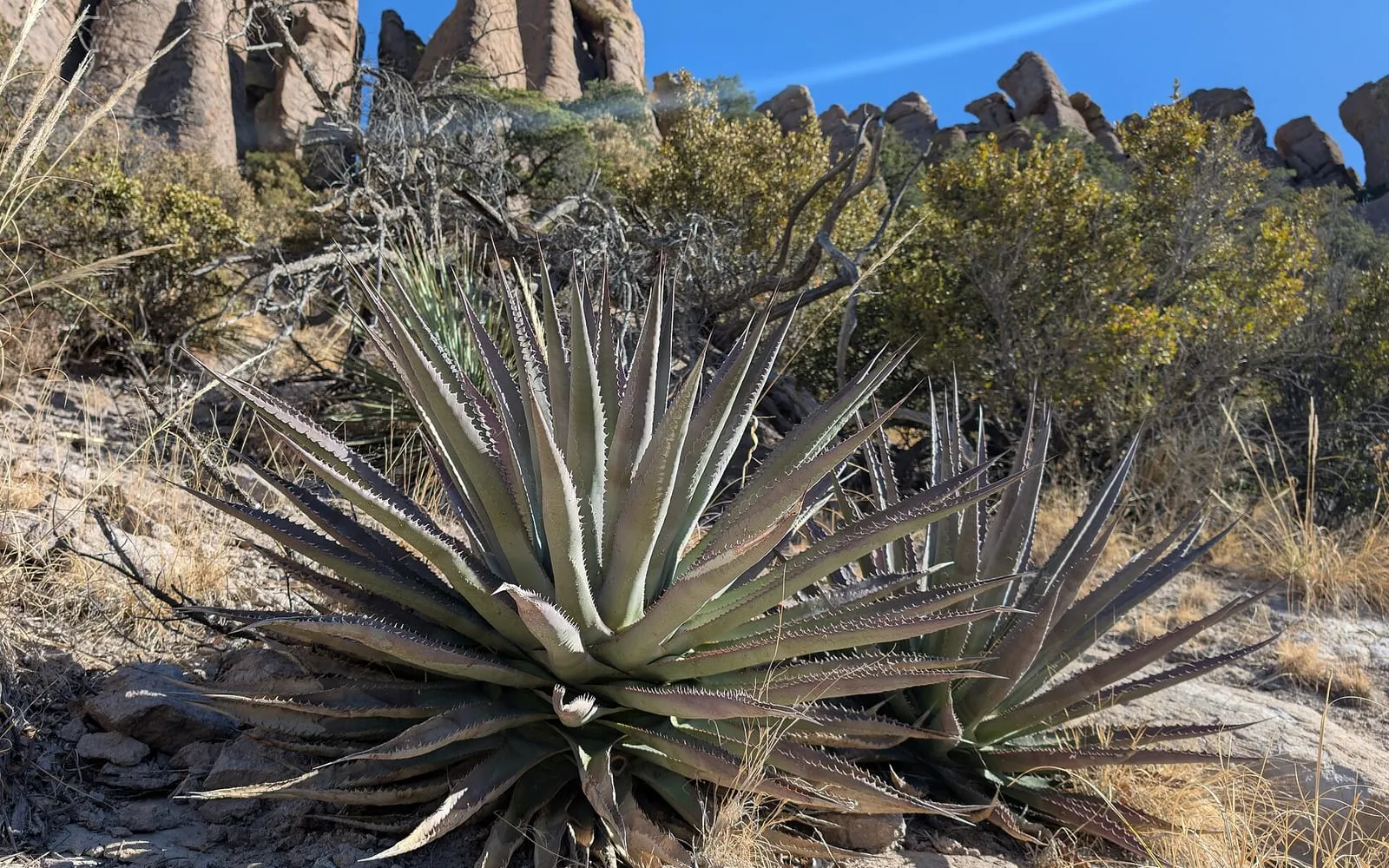
The leaves are long, moderately wide and stiff, a greyish green, and they narrow from a broad base to a hard point. Modest teeth line the margins, and each blade closes on a firm, dark terminal spine that warrants a careful approach.
The rosette is open and even, and mature plants tend to grow alone or produce only the occasional offset. It usually stays as a clean single crown rather than a spreading clump, which keeps it well behaved in a pot.
This is a once-flowering agave. An established plant eventually sends its bat-pollinated stalk metres into the air, sets seed and dies. Indoors that stage is unlikely, and the grey-green rosette is the main reason to grow it.
Where it is from
Highland grassland and rocky slopes across south-eastern Arizona, south-western New Mexico and the neighbouring Mexican states are where it grows. Summers are warm and stormy, winters cool and dry at altitude, and the coarse ground disposes of a downpour in minutes.
That mountain home explains the growing conditions. It needs strong light and ground that lets water drain through quickly. It has no tolerance for a cold pot holding standing water. Give it heat, brightness and a stony root run.
How it grows
The rosette gains leaves through the warm season and then keeps its shape untouched while the cold lasts. Given full sun the blades hold stiff, grey and tightly ranked; short of it the crown opens up and the colour turns flat.
Root it in a rough, stony mix built more of grit than of anything organic. After it has settled, hold water back until the whole pot has dried through, and rely on the fleshy blades to carry their own supply across the rainless weeks, because a mix kept damp slowly rots the roots.
It takes frost down to about -9 deg C while dry, but wet cold rots it, so keep a potted plant under cover in a damp winter. An occasional offset can be eased off with a few roots, and where none appears the plant is grown from seed.
Through the seasons
Spring wakes the crown as the light lengthens. Bring water back gradually and move a crowded plant into a larger pot of fresh grit.
Summer is when it makes its growth. Water once the mix has dried out, and set it in the strongest light you have.
Autumn slows growth. Widen the intervals between drinks and reduce the feed as the days grow shorter.
Winter needs a dry rest. Water only at long intervals, and keep the crown clear of cold, clammy air.
Care difficulty
Easy, and a clean solitary specimen wherever light and drainage are right. It stores its own water and needs little feeding or tidying. The main risk is a cold, wet root run rotting the base, so keep it dry through the cold months. Its teeth and end-spine also need a position where people will not brush against them.
Watering
Allow the stony mix to dry right through, then water it heavily and drain off anything that pools underneath. The water stored in the leaves carries the crown through dry spells. Water trapped around the roots is what leads to rot.
Give hardly a drop over winter, since a cold, sodden mix will finish an otherwise healthy plant. When you cannot decide, wait, because this agave handles drought far more comfortably than it handles wet feet.
Warning signs, diseases and pests
Root rot from cold, standing wet is the chief threat, showing as a softened, darkening base or a crown that has worked loose in the mix. Improve the drainage, cut the watering back hard, above all through winter, and keep it in strong light.
Dry indoor air encourages spider mites, and mealybugs lodge in the leaf bases. Work through the folds of the crown and see off any early outbreak while it is confined to a spot or two.
Brown tips usually mean the air is parched or the plant has scorched behind glass. Steady the watering, add a little airflow, and the leaves recover.
Growing environment
Give it the most direct light you can manage. Full sun holds the crown open and the leaves firm and grey; in shade the shape sags and the colour drains.
A plant that takes dry frost but not cold wet, it needs a sheltered position in winter. A bright sill or a sunny glasshouse suits it, and a warm summer stood outside does it good.
Pot it in a lean, sharp, grit-heavy mix in a container that drains fast, and turn it now and then for symmetry. Lift it by the pot to stay clear of the spine.
Feeding
A weak, balanced feed once or twice through the growing season is enough. Feed it too well and the leaves soften and stretch, blurring the clean crown, so keep every dose light.
Give nothing over winter. A repot into fresh grit sustains it for a long stretch, so the pot works harder than any bottle.
Troubleshooting
Why is my palmer agave going soft at the base? A cold, wet root run is the usual reason. Open up the drainage, water much less, and hold it warm and bright.
How much light does it need? As much direct light as you can give. In shade the crown opens and the grey dulls.
How often should I water it? Once the mix has dried through, and sparingly over winter, judged by the state of the compost.
How do I propagate it? Ease off a rooted offset where one appears, or raise fresh plants from seed.
Is it safe around pets? No. The sap irritates skin and mouth and the ASPCA lists agaves as toxic to cats and dogs, so keep chewing pets off it and mind the teeth and end-spine.
Palmer Agave problem guides
Not sure what is wrong? See the common houseplant pests guide.