
Houseplant
Flaming Sword
Vriesea splendens
Also known as Vriesea, Painted Feather
How to grow Vriesea splendens. The banded vase rosette, the sword-shaped bract spike, cup care and why humidity matters more than feeding.
At a glance
- Difficulty
- Moderate
- Water
- Empty and fully replace the water in the central cup every two to three weeks rather than topping it up
- Light
- Bright, filtered light. No direct sun, which fades the leaf banding
- Temperature
- 18-27 deg C. Never below 10 deg C
- Humidity
- High, 60 percent or more. This is the species' main demand
- Hardiness
- USDA 10-12, RHS H1b, hardy to 10 C
- Type
- Tender evergreen perennial, flowering once and then producing offsets
- Height
- 45-60 cm tall including the spike
- Native to
- Venezuela, Guyana, Suriname, French Guiana, Trinidad
Warm, wet lowland and cloud forest with humidity rarely below 70 percent. The zone number is a winter minimum only, and it says nothing about that humidity floor, which is the thing most indoor growers fail to supply and the reason the species has a reputation for being fussier than other tank bromeliads.
Hardiness zones describe winter cold alone. Summer heat, humidity, rainfall and the length of the growing season decide as much, so treat the range as the outer limit rather than as a recommendation.
Not known to be toxic
Non-toxic. Vriesea does not appear on the ASPCA's toxic plant list, and commonly cultivated bromeliad genera including Vriesea are recorded on the ASPCA's non-toxic register for cats and dogs alike. The RHS list of potentially harmful garden plants does not name it either. The leaves are smooth-edged and unarmed, unlike the spinier tank bromeliads such as Aechmea, so there is no scratch hazard from handling one. The only practical caution is the cup of standing water at the centre of the rosette, which is worth keeping out of reach of a very young child in the same way any small container of water in the home would be, and which should be flushed regularly so it does not turn stagnant.
Sources: ASPCA (non-toxic bromeliad genera, cats and dogs), RHS potentially harmful garden plants
About
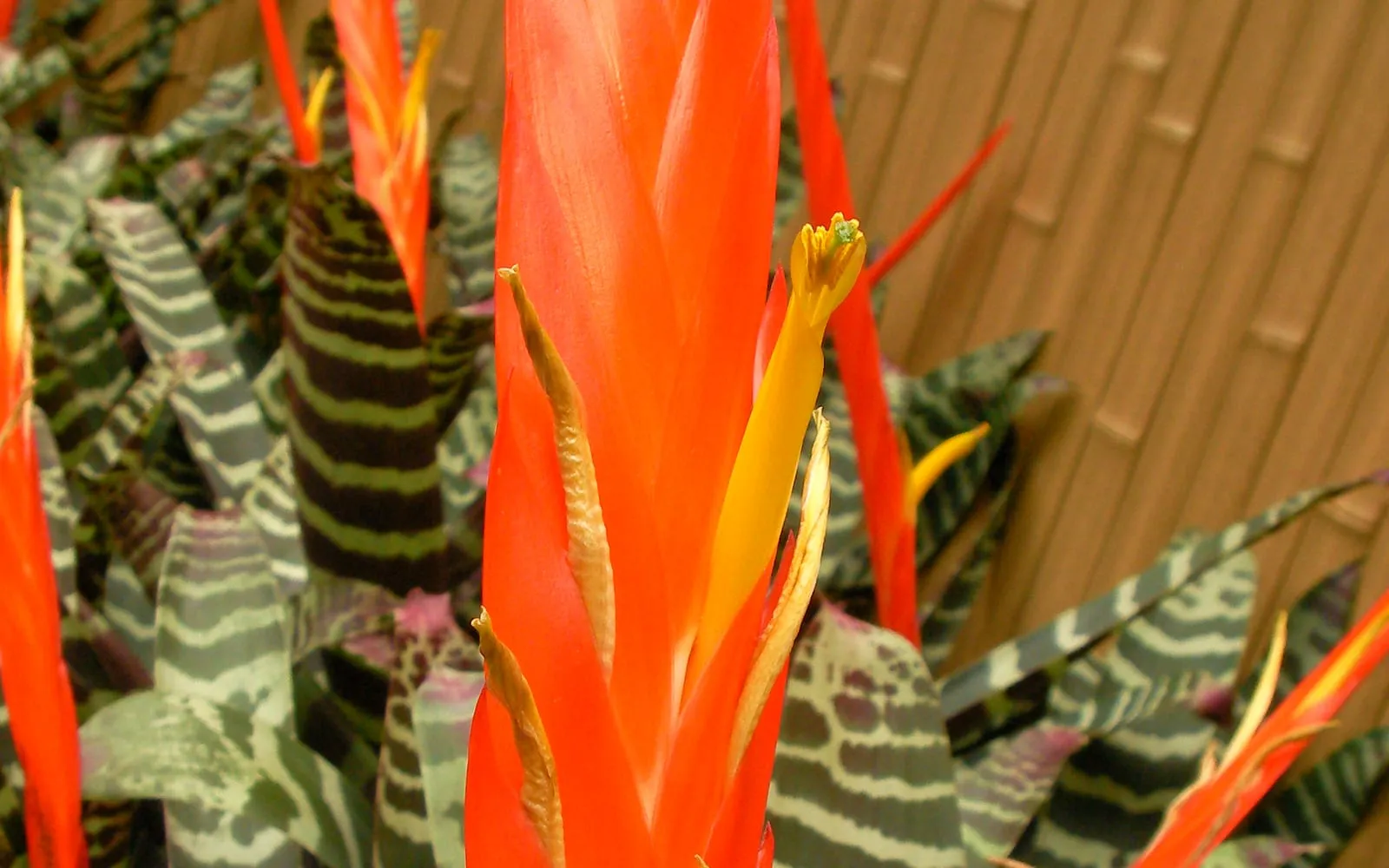
A Flaming Sword earns its name from the flower spike rather than from anything about the leaves. A flat, upright blade of overlapping scarlet bracts rises from the centre of the rosette, and small yellow flowers open one or two at a time from slits between them over several weeks, giving the whole structure the look of a flame working its way up a sword blade.
The rosette below it is a vase of stiff, glossy green leaves, often banded or mottled with maroon on the outer surface, packed tightly enough at the base to hold water. Vriesea splendens received the Royal Horticultural Society’s Award of Garden Merit, recognition given only to plants judged reliably good in cultivation, and it is one of the more widely grown Vriesea species for exactly that reason: the flower spike is dramatic and long-lasting, and a well-sited plant is not difficult to keep going for years between offsets.
It does, however, need humidity closer to a rainforest floor than to an ordinary living room. That condition trips up more owners than watering or light.
Appearance and character
An upright, funnel-shaped rosette of 15 to 25 strap-shaped leaves, reaching 45 to 60 cm across at maturity.
The leaves are smooth-edged, glossy and mid-to-dark green, frequently carrying irregular maroon or deep purple banding on the underside or across the whole leaf, depending on the individual plant. Some nursery selections show far more banding than others, since it varies within the species.
The leaf bases overlap into a deep, narrow cup, the plant’s primary water store, distinct from Guzmania’s shallower and broader funnel.
The bract spike is the plant’s signature: a flattened, sword-shaped column of tightly overlapping scarlet or orange bracts, rising 30 cm or more above the rosette on a stiff stem. It can take several months to reach full colour once it first appears.
The true flowers are small, tubular and yellow, emerging briefly from narrow gaps between the bracts and lasting only a day or two each before withering, while the bracts beneath them hold their colour for two months or longer.
Vriesea splendens is monocarpic, so the parent rosette that produces the spike does not flower a second time. It declines slowly over the following year while offsets, called pups, form around its base to take its place.
Where it is from
Vriesea splendens is native to the Guiana Shield and the eastern edge of Venezuela, recorded across Trinidad, Guyana, Suriname and French Guiana.
It grows as an epiphyte in humid lowland rainforest and cloud forest, lodged in the crooks of branches or on mossy bark rather than rooted in soil, at elevations where fog and rain keep the air saturated for most of the year.
Constant humidity defines its native habitat more than heat or light. Daytime temperatures in the region rarely climb far above what a warm living room already offers, but the air rarely drops below 70 percent relative humidity either, day or night.
Light beneath the forest canopy reaches the plant filtered and dappled, and strong direct sun both scorches the foliage and bleaches out the maroon banding that gives many plants their character, which is why growers site it back from a sunny window rather than on the sill.
How it grows
Pot it in an open bark or orchid-style mix, since the true root system is small and exists mainly to anchor the plant to whatever it is mounted on or potted in, rather than to draw up most of its water.
Keep the central cup filled with 2 to 3 cm of water at all times, using rainwater or filtered water where the tap supply is hard, since mineral deposits show up as a chalky film on the bracts.
Replace the water in the cup completely every two to three weeks rather than adding more on top. In a shaded or low-airflow spot, water left standing longer than that can sour and encourage rot at the base of the leaves, more readily than it does in a Guzmania’s shallower cup because the deeper reservoir stays wetter for longer between refills.
Raise the humidity around the plant deliberately. This is the step that decides whether Vriesea thrives or merely survives indoors, and a pebble tray, a grouped cluster of other humidity-loving plants, or a small humidifier all help meaningfully.
Position it in bright, filtered light out of any direct sun, which both scorches the foliage and fades the maroon banding some plants carry.
Feed lightly, since the plant is not a heavy feeder and excess fertiliser salts show up as leaf tip burn before they show up as extra growth.
Watch for the bract spike to emerge from the centre of the rosette on a mature plant, usually after two to three years of growth, and expect it to hold its colour for two months or more once fully developed.
Once the spike fades and the parent rosette begins to decline, separate offsets once they reach roughly a third of the parent’s size and have their own roots, potting each into fresh bark mix.
Through the seasons
Spring is the start of active growth for an established plant. Resume feeding every four to six weeks, check the bark mix more often as it dries faster with longer days, and inspect any offsets from the previous year for signs of readiness to separate.
Summer brings the strongest growth and, on a mature rosette, the flower spike. Keep the cup replaced every two to three weeks, maintain humidity if the room runs air conditioning, and keep the plant well back from direct summer sun through south or west-facing glass.
Autumn is when a spike that appeared in summer often continues to hold its colour. Ease off feeding as daylight shortens and keep an eye on humidity as heating systems begin to switch on and dry the air.
Winter is the plant’s quiet period. Stop feeding, let the bark mix run a little drier between checks, and pay close attention to humidity, since a centrally heated room in winter is the furthest thing from the wet forest this species comes from.
Care difficulty
Moderate, and the difficulty sits almost entirely in humidity.
Light and temperature requirements are unremarkable for a tropical houseplant, and watering the cup is a simple routine once established. What catches new growers out is treating a Flaming Sword like an ordinary foliage plant and leaving it in the dry air of a centrally heated room, where it survives for a while and then declines slowly without an obvious single cause.
A plant given consistent humidity, whether from a bathroom, a grouped display, or a humidifier, is considerably easier to keep than the same plant left to the ambient air of a dry living room.
The monocarpic habit surprises first-time owners the way it does with any tank bromeliad. The rosette that flowers will not flower again, and the plant’s future lies in the offsets that follow.
Watering
Keep the central cup filled with 2 to 3 cm of water, checking weekly and topping up as it evaporates.
Empty and fully replace that water every two to three weeks rather than letting it accumulate. A deep cup that is only ever topped up builds a layer of old, stagnant water at the bottom that a quick refill never reaches, and that layer is where rot tends to start.
Use rainwater or filtered water for the cup where possible, since the maroon banding on the leaves shows mineral deposits more visibly than plain green foliage does.
Water the bark mix lightly and only once the surface has dried, since a mix that never dries between waterings encourages the same rot that a stagnant cup does.
In a cool room over winter, reduce the water depth in the cup slightly rather than keeping it brimming, since evaporation slows and the same volume takes longer to need replacing.
Warning signs, diseases and pests
A soft, dark, foul-smelling base with leaves that pull away easily is rot, almost always from water left too long in the cup or from a bark mix kept constantly wet. Trim away affected tissue, repot into fresh mix, and flush the cup more often.
Faded, washed-out banding on the leaves usually means too much direct sun. Move the plant back from the window or filter the light with a sheer curtain.
Brown, crisping leaf edges without any softness point to air that is too dry rather than too little water in the cup. Raise humidity before adjusting the watering routine.
Scale insects appear as small, flat, brownish or tan bumps along the stem and leaf undersides, often with a faint sticky residue nearby. Wipe them off with a cloth dipped in dilute soapy water or treat with horticultural oil.
Mealybugs gather as small white cottony tufts in the leaf axils, and a cotton bud dipped in isopropyl alcohol removes them; check again after a week for stragglers.
Fungal leaf spot shows as small, dark, sometimes water-soaked patches on the foliage, usually where humidity is high but airflow is poor. Improve ventilation around the plant and remove badly affected leaves.
A rosette that stops putting out new leaves after its spike fades is behaving normally rather than failing. Look for offsets forming at the base and let the parent decline in its own time.
Growing environment
Bright, filtered light with no direct sun, since strong light both scorches the foliage and bleaches the maroon banding many plants carry.
Warmth between 18 and 27 deg C, and protection from anything below 10 deg C, which damages the foliage within a few days.
High humidity, 60 percent or more, supplied by a pebble tray, a grouped arrangement of plants, or a humidifier in a dry room. A well-lit bathroom or kitchen with steady warmth is often the best spot in an ordinary home.
An open bark, orchid or specialist bromeliad mix, never a dense water-retentive compost, which suffocates the small root system.
Good air movement around the foliage, since still, humid air without circulation encourages the fungal spotting and rot the species is otherwise resistant to.
Away from cold glass and draughty windowsills in winter, where night temperatures can drop well below the plant’s tolerance even in a heated room.
Feeding
Feed every four to six weeks from spring to early autumn with a balanced liquid fertiliser diluted to a quarter strength, or a specialist bromeliad formula at label strength.
Add the feed to the water going into the cup rather than to the bark mix, since the leaf bases absorb nutrients directly through specialised absorbing scales.
Stop feeding entirely over winter, when growth slows and unused fertiliser is more likely to accumulate as salts in the cup and mix.
A Vriesea that is never fed will still grow and eventually flower, though more slowly and with a shorter-lived spike than one given a light, consistent feeding routine through the growing season.
Avoid full-strength houseplant fertiliser. The leaves scorch at the tips within days of a feed that is too concentrated, well before any benefit to growth shows.
Troubleshooting
The sword-shaped spike has been red for weeks with no sign of flowers. That is normal. The bracts are what give the spike its colour and hold it for weeks or months, while the small yellow true flowers open briefly from between them and are easy to miss.
Should I cut the spike off once it browns? Yes, cut it back to the base once it has fully faded. It will not flower again, and removing it lets the plant put its energy into the offsets forming around its base.
My plant’s leaf banding has faded to plain green. Too much direct sun is the usual cause. Move it back from the window into bright but filtered light and the next flush of leaves should show more colour.
The base has gone soft and smells unpleasant. That is rot, almost always from water sitting too long in the cup or from bark mix kept constantly wet. Trim the affected tissue away, repot into a fresh open mix, and flush the cup every two to three weeks going forward.
How humid does the room really need to be? Aim for 60 percent or higher where possible. A plant kept in typical indoor humidity of 30 to 40 percent will usually survive but grow slowly and show more leaf tip browning than one given extra humidity.
When should I separate the offsets? Once a pup reaches roughly a third of the parent’s size and has developed its own roots, cut it away cleanly and pot it into fresh bark mix; it will establish faster than one removed too early.
Can I mount it on bark instead of potting it? Yes, once it has established some roots, though it will need more frequent misting or soaking to compensate for the lack of any compost holding moisture around the base.
Flaming Sword problem guides
Not sure what is wrong? See the common houseplant pests guide.