
Houseplant
Scarlet Star
Guzmania lingulata
Also known as Orange Star, Guzmania
How to grow Guzmania lingulata. Bright indirect light, filling the central cup, feeding through the leaves and rescuing the offset after flowering.
At a glance
- Difficulty
- Easy
- Water
- Keep the central cup topped up with 1-2 cm of water, flushed and refilled every two to three weeks
- Light
- Bright, indirect light. No direct midday sun
- Temperature
- 18-27 deg C. Never below 10 deg C
- Humidity
- High. 60 percent or more suits it best
- Hardiness
- USDA 10-12, RHS H1b, hardy to 10 C
- Type
- Tender evergreen perennial, flowering once and then producing offsets
- Height
- 30-45 cm across and 40 cm tall in bloom
- Native to
- Costa Rica, Colombia, Peru, Brazil, Central America, Northern South America
Warm, humid rainforest understorey with no dry season to speak of. The zone number describes the winter minimum only. A Guzmania also needs the humidity of that forest floor, which a centrally heated room in a temperate winter will not supply without help.
Hardiness zones describe winter cold alone. Summer heat, humidity, rainfall and the length of the growing season decide as much, so treat the range as the outer limit rather than as a recommendation.
Not known to be toxic
Non-toxic. Guzmania lingulata does not appear on the ASPCA's toxic plant list, and a related cultivar, Guzmania lingulata minor, is named specifically on the ASPCA's non-toxic register under its trade name Orange Star. The RHS list of potentially harmful garden plants does not include any Guzmania. Nothing in the leaves, bracts or cup water is known to cause more than mild stomach upset if chewed, and the plant has no spines or sap that irritates skin. The only real hazard is the cup itself for a household with young children or curious pets: it holds standing water that can sour if it is never flushed, and a child could tip a top-heavy pot over reaching into it.
Sources: ASPCA (Orange Star, Guzmania lingulata minor), RHS potentially harmful garden plants
About
The colour on a Scarlet Star is not the flower. What draws the eye is a cluster of waxy bracts, modified leaves rather than petals, holding their red, orange or yellow for months at a stretch while the true flowers are small and short-lived and easy to miss among them. That trade is the whole appeal of the plant: a display that would exhaust most tropical species in a fortnight instead sits on a windowsill from late summer into winter.
Guzmania lingulata grows as a rosette of smooth, strap-shaped leaves packed tightly enough at the base to form a small reservoir, called the cup or the vase, and the plant is watered by filling that reservoir rather than soaking the compost. In the wild it sits high in a tree, catching whatever rain and leaf litter fall past it, and the pot at home is asked to do a much smaller version of the same job.
It is one of the easier bromeliads to keep, tolerant of ordinary indoor light and forgiving of an irregular watering routine, which is why it turns up in supermarkets and garden centres far more often than its epiphytic relatives.
Appearance and character
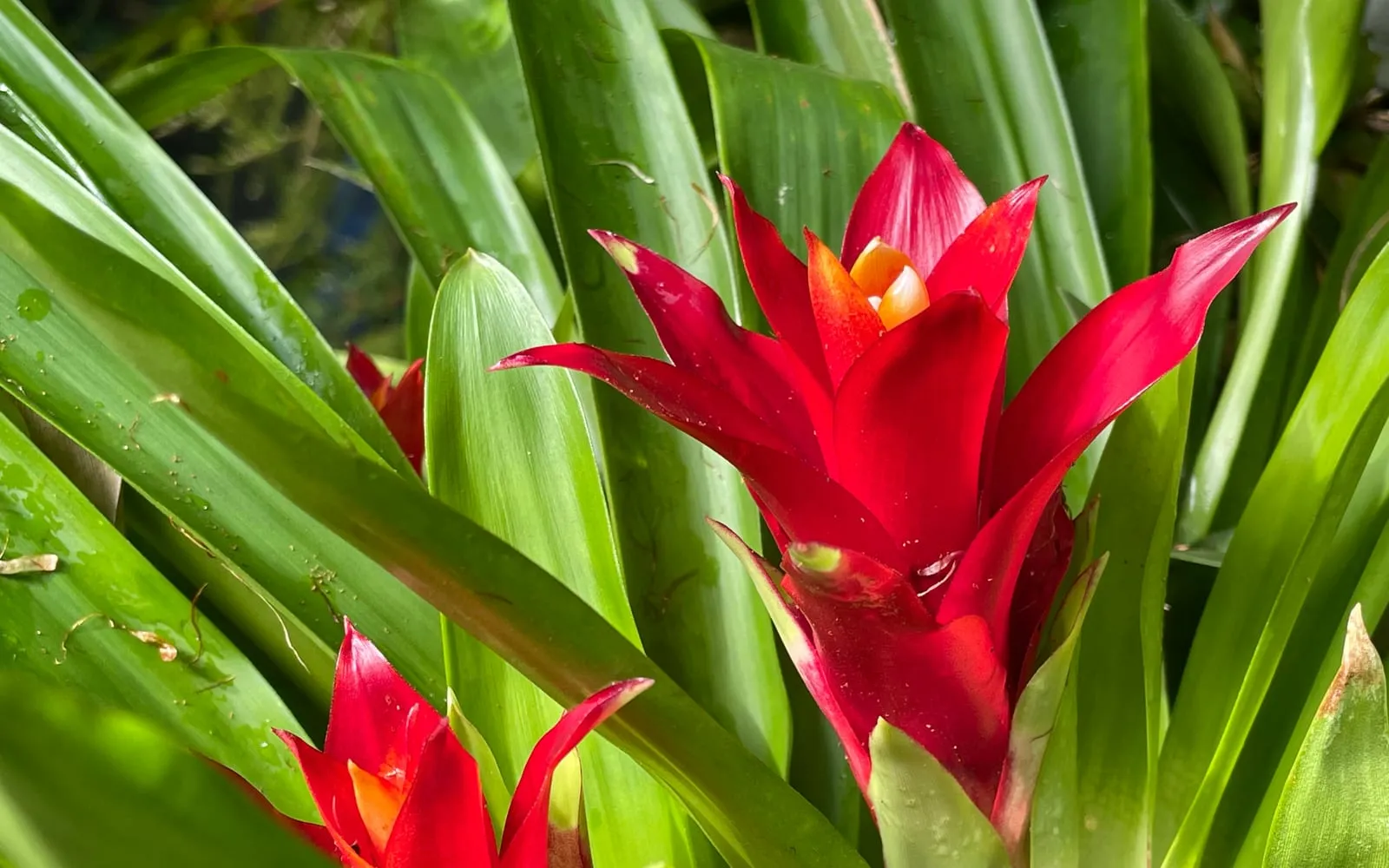
A low, open rosette 30 to 45 cm across, built from twenty or more leaves arranged in an overlapping spiral.
Individual leaves are smooth, glossy, mid-green and strap-shaped, 20 to 30 cm long and unarmed. Nothing on a Guzmania scratches, which sets it apart from its spinier bromeliad relatives immediately.
The leaf bases overlap so closely that they form a watertight funnel at the centre of the rosette. That funnel, the cup, is the plant’s real root system in daily use, since the true roots below the compost mostly anchor the plant rather than feed it.
The bract cluster rises from the centre of the cup on a short stalk, a tight cone of star-shaped, waxy bracts in scarlet, orange, salmon or occasionally pure yellow. Bracts are leaves that have taken on flower colour to attract a pollinator, and on a Scarlet Star they do the job so well that most buyers never notice the actual flowers.
The true flowers are small, tubular and white or pale yellow, opening one or two at a time from between the bracts over several weeks. They last a day or two each and contribute almost nothing to the display; the bracts supply the colour for two to six months on their own.
Once flowering finishes the parent rosette has spent itself. It does not die outright, but it stops producing new leaves and slowly fades over the following year while channelling its energy into offsets, called pups, that emerge around its base.
Where it is from
Guzmania lingulata is native to a wide belt of Central and northern South America, recorded from Costa Rica and Nicaragua south through Colombia, Ecuador, Peru and into Brazil.
It grows as an epiphyte on tree trunks and branches in humid lowland and montane rainforest, wedged into bark crevices or moss mats rather than rooted in soil, and it draws nutrients from decaying leaf litter that collects in its cup as much as from anything the roots reach.
The forests it comes from carry no real dry season, and humidity rarely drops much below 70 percent even at night. That is the hardest condition to replicate indoors, and most of the trouble people have with a Scarlet Star traces back to air drier than anything it evolved for rather than to light or temperature.
Light under a rainforest canopy is filtered and moving rather than direct, which is why the species scorches easily on a sun-facing windowsill and does better a metre or two back from the glass.
How it grows
Pot it in an open bark or orchid-style mix rather than ordinary compost. The natural root system is small and exists mainly to grip whatever it is growing on, so a dense, water-retentive compost around it does more harm than good.
Fill the central cup with water rather than relying on watering the compost. Rainwater or filtered water is safest, since tap water minerals build up as a white crust on the bract cluster over time.
Empty and refresh the cup roughly every two to three weeks rather than topping it up. Standing water that is never replaced goes stale, picks up algae, and can turn the base of the rosette soft.
Keep the compost lightly moist rather than wet. A once-weekly check with a finger in the mix is enough; if it is dry an inch down, water it lightly.
Position it out of direct sun, particularly through glass at midday, where scorching shows first as pale, bleached patches on the leaves facing the window.
Raise the humidity around the plant where the room runs dry, with a pebble tray, a grouped cluster of other plants, or a humidifier. A bathroom with good light suits it well.
Feed sparingly by adding a quarter-strength liquid feed to the cup water once a month through the growing season, and stop over winter when growth slows.
Once the bract cluster fades and the parent rosette starts to decline, look for offsets forming at its base. Leave them attached until they reach roughly a third of the parent’s size, then separate them with a clean cut and pot them on individually; the parent can then be discarded once its pups are established.
Through the seasons
Spring brings the start of active growth. Resume monthly feeding in the cup water, check the compost more often as the plant dries faster in longer daylight, and watch for offsets if a rosette flowered the previous autumn.
Summer is when growth and any flowering push hardest. Keep the cup topped up and flushed every two to three weeks, maintain humidity if the room runs an air conditioner, and shield the plant from strong midday sun through a south-facing window.
Autumn often brings the bract display on a mature plant, which can hold its colour into winter. Ease off feeding as light levels fall and keep the cup a little shallower, since evaporation slows and stale water becomes more of a risk.
Winter is the quiet season. Stop feeding, let the compost run slightly drier between checks, and pay closer attention to humidity once the central heating comes on, since dry indoor air in winter is the biggest stress a Scarlet Star faces indoors.
Care difficulty
Easy, and one of the most forgiving bromeliads sold as a houseplant.
It tolerates the ordinary light levels of a living room, does not need daily attention, and its main requirement, a full cup, is quick to check at a glance.
The two failures that do turn up are a cup left stagnant for months, which sours and can rot the base, and air kept too dry for too long, which shows as browning leaf tips rather than anything dramatic. Both are corrected easily once noticed.
Because the plant is monocarpic, a gardener who expects the same rosette to flower again the following year will be disappointed. Understanding that the display is a one-time event followed by offsets removes most of the confusion new owners run into.
Watering
Fill the central cup with 1 to 2 cm of water and keep it topped up, using rainwater or filtered water rather than hard tap water where possible.
Flush the cup out completely every two to three weeks rather than adding more on top, tipping it upside down over a sink and refilling with fresh water. This is the step people skip, and stale water sitting for months is the commonest cause of a Guzmania turning soft at the base.
Water the compost lightly and only when the top inch has dried out. A Guzmania in bark or orchid mix dries quickly and does not want to sit wet.
In a cool room over winter, reduce the depth of water in the cup rather than leaving it brimming, since evaporation slows and standing water lasts longer before it needs changing.
Signs of overwatering are a soft, dark base and leaves that pull away from the centre with little resistance. Signs of underwatering are dry, curling leaf tips and a compost that has pulled away from the pot’s edge.
Warning signs, diseases and pests
A soft, discoloured base with leaves that detach easily points to rot from water sitting too long in the cup or compost. Tip the plant out, trim away any mushy tissue, repot into fresh bark mix, and flush the cup more often going forward.
Brown, crisping leaf tips usually mean the air is too dry rather than the plant being underwatered. Raise humidity before reaching for the watering can.
A white, waxy crust building up on the bracts or leaf edges is mineral scale from hard tap water. Switch to rainwater or filtered water for the cup.
Scale insects show as small, flat, brownish bumps along the leaf undersides and stems, often with a sticky residue on nearby surfaces. Wipe them off with a cloth dipped in dilute soapy water, or treat with horticultural oil.
Mealybugs collect in the leaf axils as small white, cottony tufts. Remove them with a cotton bud dipped in isopropyl alcohol, checking again after a week for any missed.
Spider mites are rare on a plant kept reasonably humid, but a hot, dry spot can bring them on, showing as fine stippling and pale speckling across the leaves. Raising humidity and rinsing the foliage under tepid water usually settles a mild case.
A rosette that stops producing new leaves and slowly fades after flowering is not diseased. That is the normal end of a Guzmania’s single bloom cycle, and the plant’s energy has moved into the offsets at its base.
Growing environment
Bright, indirect light suits it best, with the plant kept a short distance back from a south or west-facing window rather than pressed against the glass.
Warmth between 18 and 27 deg C year round, and protection from anything below 10 deg C, which will damage the foliage within days.
High humidity, ideally 60 percent or more. A pebble tray, a grouped arrangement of houseplants, or a run humidifier all help in a dry room, and a steamy bathroom with adequate light is one of the best spots in an ordinary house.
An open bark, orchid or specialist bromeliad mix rather than ordinary potting compost, which holds too much water around the small root system.
Steady airflow around the plant, since still, humid air without any movement encourages fungal problems on the leaves and in the cup.
Away from cold draughts and single-glazed windowsills in winter, where night temperatures can drop well below what the plant tolerates even if the daytime room feels warm.
Feeding
Feed once a month from spring to early autumn with a balanced liquid fertiliser diluted to a quarter of the strength recommended on the label, or a specialist bromeliad formula used at label strength.
Add the feed to the water going into the central cup rather than watering it onto the compost, since the leaves absorb nutrients directly through specialised scales at the base of the rosette.
Stop feeding entirely over winter, when growth slows and unused fertiliser salts are more likely to build up in the compost and the cup.
A plant that is never fed will still grow and eventually flower, but more slowly and with a smaller bract display than one fed lightly through the season.
Never apply fertiliser at full houseplant strength. Guzmania leaves are more sensitive to salt burn than most tropical foliage, and a strong feed shows as brown patches within days rather than gradually.
Troubleshooting
The colourful part is fading. Is my plant dying? No. What you are seeing is the bract cluster, not the flower, and bracts naturally hold their colour for months before fading as the rosette that produced them comes to the end of its single flowering cycle.
Should I cut off the flower spike once it fades? You can, close to the base, once it has fully browned. It will not regrow or flower a second time, and removing it tidies the plant while it produces offsets.
How do I know when to repot the offsets? Wait until a pup reaches roughly a third of the size of the parent rosette and has its own visible roots, then separate it with a clean, sharp knife and pot it into fresh bark mix.
The leaf tips are turning brown and crisp. This is almost always low humidity rather than underwatering. Increase humidity around the plant before changing your watering routine.
Can I water it like an ordinary houseplant, straight onto the compost? You can water the compost lightly, but the cup is the plant’s main water source and needs to be kept filled and flushed regularly for the plant to thrive.
White crust has built up where the bracts meet the leaves. That is mineral scale from hard tap water evaporating out of the cup. Switch to rainwater or filtered water and wipe the crust away with a damp cloth.
The base has gone soft and the leaves pull away easily. That is rot, usually from water left standing too long in the cup or from compost that never dries between waterings. Trim away the affected tissue, repot into fresh bark mix, and flush the cup more often in future.
Scarlet Star problem guides
Not sure what is wrong? See the common houseplant pests guide.