
Houseplant
Nidularium
Nidularium innocentii
Also known as Bird's Nest Bromeliad, Bromelia Nidularium
How to grow Nidularium innocentii. The bird's-nest bromeliad that wants shade rather than sun, with bracts flushing red low in its central cup.
At a glance
- Difficulty
- Easy
- Water
- Keep the shallow central cup filled with a little water, flushed every two to three weeks
- Light
- Low to medium indirect light. Tolerates and often prefers shade that would leave most tank bromeliads pale and weak
- Temperature
- 16-27 deg C. Never below 10 deg C
- Humidity
- Moderate to high. Benefits from extra humidity but is not as demanding as a strict rainforest-canopy species
- Hardiness
- USDA 10-11, RHS H1b, hardy to 10 C
- Type
- Tender evergreen perennial, flowering once and then producing offsets
- Height
- 20-30 cm tall, 30-40 cm across
- Native to
- Brazil, Atlantic Forest
The shaded floor and lower storeys of Brazil's Atlantic Forest, a habitat with far less direct light reaching the plant than the canopy most tank bromeliads occupy. The zone number is a winter minimum only, and it says nothing about the low light this species needs to look its best, which is the opposite requirement from most of its close relatives.
Hardiness zones describe winter cold alone. Summer heat, humidity, rainfall and the length of the growing season decide as much, so treat the range as the outer limit rather than as a recommendation.
Not known to be toxic
Non-toxic. Nidularium has no dedicated ASPCA entry, but the ASPCA's records for closely related, commonly cultivated tank bromeliad genera consistently describe the family as safe for cats, dogs and horses, and the RHS list of potentially harmful garden plants does not include it. The leaf margins carry small, fine teeth, gentler than a Neoregelia's and far short of an Aechmea's or a Dyckia's, unlikely to do more than lightly scratch skin brushed firmly against them. The one point worth noting is the same one that applies to every tank bromeliad in this collection: the cup holds standing water at a height a small child or a pet could reach, and it is worth keeping fresh rather than left to sit for months.
Sources: ASPCA (Toxic and Non-toxic Plants, general bromeliad genera), RHS potentially harmful garden plants
About
Most tank bromeliads want more light than an ordinary room provides. Nidularium innocentii is the exception, a species that grows naturally on the shaded floor of the Atlantic Forest and prefers the low light of an interior spot away from a window over the brighter conditions its relatives ask for. It is easy to confuse with a Neoregelia at a glance, since both form flat rosettes with a reddening centre, but the two plants want almost opposite light levels, and treating a Nidularium like its brighter-loving lookalike is the most common mistake made with it.
The genus name comes from the Latin for a small nest, and it describes the plant precisely. Rather than raising its flower cluster on a spike the way a Guzmania or a Vriesea does, Nidularium tucks a dense cluster of reddened bracts and small flowers down inside its own central cup, nestled among the surrounding leaves in a way that resembles a bird’s nest built low in a hollow.
Grown well, in a spot most other flowering houseplants would find too dim, it forms a neat, low clump that reflowers as new rosettes mature, asking for less light and less fuss than almost anything else in this collection.
Appearance and character
A low, flat, open rosette 20 to 30 cm tall and 30 to 40 cm across, with broad, softly arching leaves rather than the stiffer, more upright form of an Aechmea or a Vriesea.
Leaves are glossy mid-green, sometimes lightly mottled or banded depending on the variety, with fine, gentle teeth along the margins rather than any serious spine.
The leaf bases overlap into a shallow, saucer-like cup at the centre, in the same style as a Neoregelia’s, and this is where the whole flowering structure eventually sits rather than rising above it.
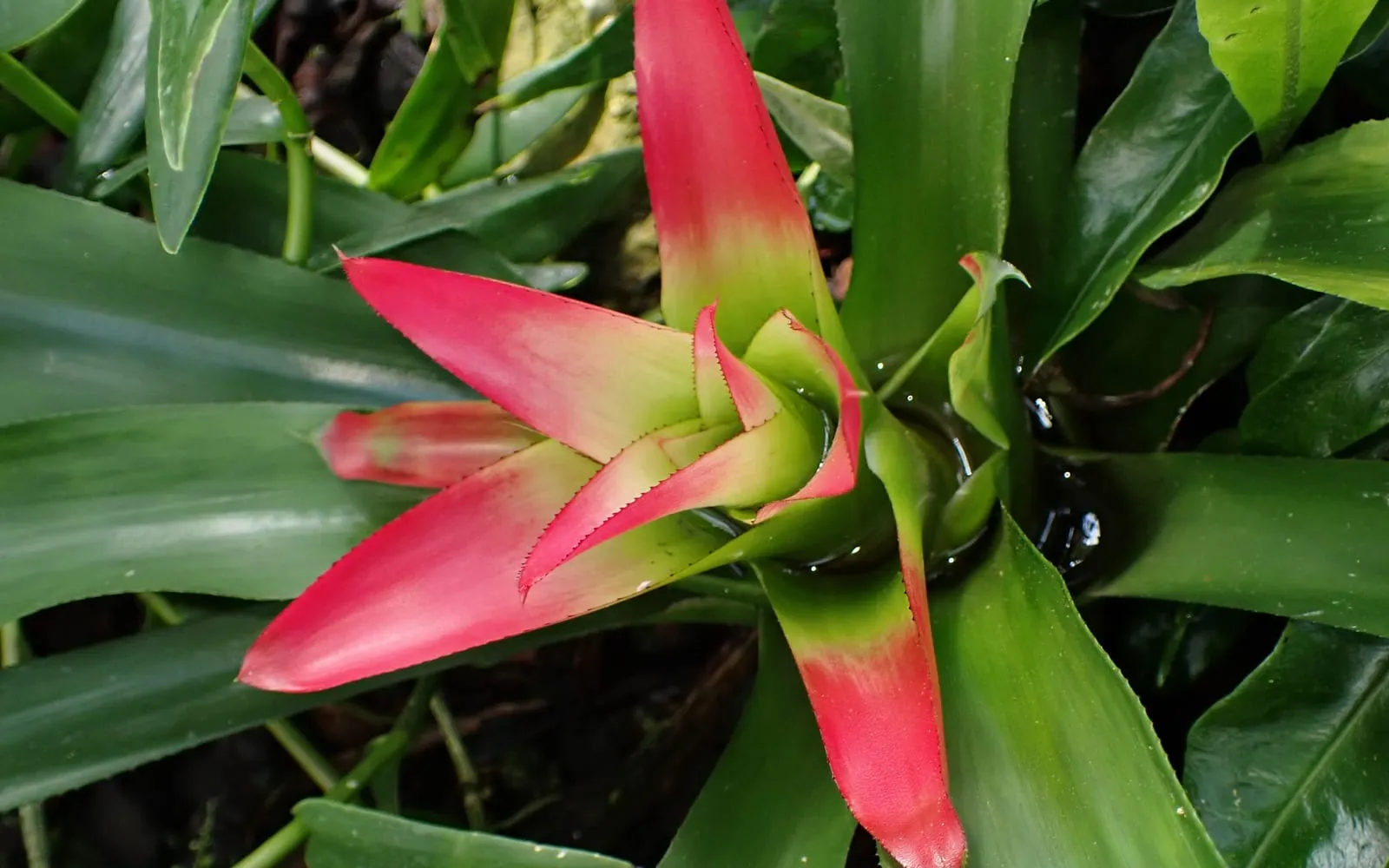
As flowering approaches, the innermost leaves and bracts surrounding the cup flush deep red or burgundy, and a tight, low cluster of small white or pale flowers opens directly among them, nested down in the middle of the rosette rather than lifted clear of it on a stalk. The nest-like arrangement is where the plant gets its common name and its genus name both.
The colour of the bracts can hold for several months, considerably longer than the individual flowers themselves last. Most tank bromeliads follow the same pattern, with a showy, long-lived bract advertising a small, short-lived true flower.
Like every bromeliad in this collection, a flowered rosette is monocarpic and does not repeat. It declines gradually over the following months while offsets develop around its base to replace it, and a mature clump typically holds several rosettes at different stages so that flowering recurs across the group most years.
Where it is from
Nidularium innocentii is endemic to the Atlantic Forest of southeastern Brazil, a coastal forest system that also produced Neoregelia carolinae and shares much of the same general climate.
Unlike Neoregelia, though, Nidularium is recorded specifically from the forest floor and from decaying logs in deep shade, growing at ground level under a closed canopy rather than higher up on exposed branches or in more open, sun-struck spots. That is the key habitat difference behind the two genera’s very different light preferences despite their similar appearance.
Light reaching the forest floor in that habitat is dim and heavily filtered, often just a fraction of what falls on the canopy above, and the species has adapted leaves and pigments suited to gathering what little reaches it rather than tolerating strong direct sun.
Humidity at ground level under a closed canopy stays consistently high, since the forest floor is sheltered from the drying wind that reaches the upper storeys, which is part of why Nidularium appreciates extra humidity indoors even though its light needs are so much lower than most of its relatives.
How it grows
Pot it in an open, free-draining mix, either a specialist bromeliad or orchid blend or an ordinary houseplant compost cut with bark and perlite, matching the leaf litter and decaying wood it roots into naturally.
Position it in low to medium indirect light, away from a bright south-facing window rather than close to one. A spot that would leave a Guzmania or a Neoregelia pale and struggling is often exactly right for this species. This is the most important thing to get right.
Keep the shallow central cup filled with a little water, roughly 1 to 2 cm, and flush it every two to three weeks rather than letting it sit unchanged, in the same way every other tank bromeliad in this collection needs.
Because the plant is used to consistently high ground-level humidity, raise the humidity around it where practical, though it tolerates a drier room better than a strict rainforest-canopy species like Aechmea chantinii does.
Feed sparingly through the growing season, since the plant is not a heavy feeder and grows steadily on relatively little.
Watch for the bract cluster to develop low in the cup on a maturing rosette, and expect it to hold its colour for a couple of months before fading as the small flowers finish.
Once the parent rosette begins to decline after flowering, separate offsets once they reach roughly a third of the parent’s size and have developed their own roots, potting each individually into fresh, open mix.
Through the seasons
Spring restarts active growth. Resume light feeding every four to six weeks, and check any offsets from the previous year for readiness to separate.
Summer is the main growing period, and typically the season a mature rosette flowers. Flush the cup every two to three weeks, keep the compost lightly moist, and resist the urge to move the plant somewhere brighter even in strong summer light.
Autumn often shows the last of a summer bract display fading. Reduce feeding, and keep an eye on humidity as heating systems begin to switch on.
Winter is the quiet season. Stop feeding, water the compost a little less often, and keep the cup slightly shallower rather than brimming, since evaporation slows considerably in a cooler room.
Care difficulty
Easy, and notably more forgiving of a dim spot than any other tank bromeliad in this collection.
Its main requirement, low to moderate light, is the opposite of what a new bromeliad grower usually expects, and the most common mistake is giving it the bright windowsill treatment that suits a Guzmania or a Neoregelia, which tends to bleach or scorch a Nidularium’s foliage rather than improve its colouring.
Once sited correctly, in a spot most flowering plants would find too shaded, it needs little beyond the same cup-flushing routine every tank bromeliad shares, and it tolerates the humidity of an ordinary room reasonably well.
Its resemblance to Neoregelia causes more confusion than any actual care difficulty. Confirming which one you have, by checking whether the plant is thriving in shade or bright light, settles the question quickly.
Watering
Keep the shallow central cup filled with 1 to 2 cm of water, checking every few days since a wide, shallow cup evaporates faster than a narrow, deep one.
Flush the cup completely every two to three weeks, tipping out the old water before refilling, rather than only adding to what is already sitting there.
Water the compost when the top inch has dried, letting it dry out somewhat between waterings rather than keeping it constantly damp.
Use rainwater or filtered water where the tap supply is hard, since mineral deposits show as a pale crust on the reddened bracts and leaves closest to the cup.
Signs of an underfilled cup are a slight dulling of the central colour. Signs of a cup left stagnant too long are a musty smell and visible algae in the standing water.
Warning signs, diseases and pests
A soft, discoloured base with leaves that come away easily is rot, from compost kept too wet or a cup left stagnant for too long. Trim the affected tissue, repot into fresher, more open mix, and flush the cup more regularly.
Pale, bleached or scorched patches on the leaves usually mean the plant has been given more direct sun than it wants. Move it to a dimmer spot and expect new growth to come back a healthier green.
Weak, leggy growth reaching toward a light source can happen if the plant is kept in near-total darkness rather than the gentle shade it prefers. Move it somewhere with a little more ambient light, without going as far as direct sun.
Scale insects appear as small, flat, brownish bumps, usually along the undersides of the outer leaves. Wipe them off with a cloth dipped in dilute soapy water or treat with horticultural oil.
Mealybugs cluster as small white tufts in the leaf axils near the cup, a sheltered, humid spot they favour. A cotton bud dipped in isopropyl alcohol removes them, with a follow-up check after a week.
A rosette that stops producing new leaves after flowering is behaving normally, not failing, and the plant’s energy has already shifted to the offsets forming around its base.
Growing environment
Low to medium indirect light, away from a bright, sun-facing window rather than close to one. This is the species’ defining need and the opposite of what most tank bromeliads in this collection want.
Warmth between 16 and 27 deg C, and protection from anything below 10 deg C, which damages the foliage within a few days.
Moderate to high humidity, benefiting from extra humidity where practical but coping with an ordinary room better than a strict rainforest-canopy species such as Aechmea chantinii.
An open, free-draining mix, either specialist bromeliad compost or an ordinary houseplant mix cut with bark and perlite.
A spot such as a hallway, a north-facing room, or a shelf set back from a bright window all suit it better than a sun-facing sill.
Away from cold draughts in winter, since a sustained chill damages the leaves even though the plant otherwise tolerates lower light than most of its relatives.
Feeding
Feed every four to six weeks from spring to early autumn with a balanced liquid fertiliser at a quarter of the strength recommended on the label, or a specialist bromeliad formula at label strength.
Add the feed to the cup water rather than the compost, in keeping with how this species and its relatives absorb nutrients through their leaf bases.
Use fertiliser sparingly. A plant given too much tends to grow soft and pale rather than developing the deeper colouring it is capable of in a correctly shaded spot.
Stop feeding entirely over winter, when growth slows and any unused fertiliser is more likely to accumulate as salts in the cup.
A Nidularium grown without any feeding at all will still flower reliably in the right light, though a light feeding routine through the growing season tends to produce a fuller, faster-maturing clump.
Troubleshooting
Everyone says bromeliads need bright light. Why is mine happier in shade? Nidularium is one of the exceptions. It grows on the shaded floor of Brazil’s Atlantic Forest, unlike the canopy-dwelling species most bromeliad advice is written for, and it prefers dimmer conditions than most of its relatives.
How do I tell it apart from a Neoregelia? They look similar. Light tolerance is the clearest test. A Nidularium thrives in a shadier spot that would leave a Neoregelia pale and struggling, while a Neoregelia colours up strongly in bright light that would scorch a Nidularium.
I can’t find the flowers even though the centre has coloured up. Look down into the cup itself rather than for anything raised above the rosette. Nidularium nests its flower cluster low inside the cup rather than lifting it on a spike the way most bromeliads do.
The leaves have bleached patches after I moved it to a brighter spot. That is scorch. Move it back to a dimmer position and the next flush of leaves should return to a healthier green.
The base has gone soft and mushy. That is rot, usually from compost kept too wet or a cup left stagnant too long. Trim away the affected tissue, repot into a more open mix, and flush the cup every two to three weeks going forward.
Can I grow it alongside brighter-loving bromeliads in the same room? Yes, as long as it sits further back from the window than the others. A shared humid spot works well provided each plant gets the light level it needs.
When should I separate the offsets? Once a pup reaches roughly a third of the parent rosette’s size and has its own roots, separate it with a clean cut and pot it into fresh, open mix rather than leaving it attached indefinitely.
Nidularium problem guides
Not sure what is wrong? See the common houseplant pests guide.