
Houseplant
Darwin's Orchid
Angraecum sesquipedale
Also known as Madagascar Star Orchid, Christmas Star Orchid, Comet Orchid
How to grow Darwin's orchid, Angraecum sesquipedale, including its 30 cm nectar spur, waxy white star-shaped flowers, and the moth prediction it made famous.
At a glance
- Difficulty
- Moderate
- Water
- Water regularly, allowing the surface to dry slightly between soakings
- Light
- Bright indirect light, some gentle direct morning sun
- Temperature
- 15-28 deg C
- Humidity
- 60-80 percent
- Hardiness
- USDA 10-11, RHS H1b, hardy to 10 C
- Type
- Evergreen epiphytic perennial orchid, monopodial with no pseudobulbs
- Height
- 60-90 cm
- Native to
- Madagascar
Native to lowland and mid-elevation forest on the eastern side of Madagascar, warm and consistently humid year round with no strong seasonal cold to speak of. The zone figure captures none of the plant's need for a deep root run or the months it takes a flower spike to develop and open, both of which matter more day to day than any figure tied to winter temperature.
Hardiness zones describe winter cold alone. Summer heat, humidity, rainfall and the length of the growing season decide as much, so treat the range as the outer limit rather than as a recommendation.
Not known to be toxic
Angraecum has no toxicity listing from the RHS or the ASPCA, and orchids of this kind carry an unusually clean safety record among houseplants generally. No part of the plant is documented as harmful to cats, dogs or people if chewed, and there is no recorded history of poisoning associated with the species.
Source: ASPCA
About
Darwin’s orchid is famous for a single measurement: the pale green nectar spur trailing behind each flower, which can reach 27 to 30 cm in length. In 1862, Charles Darwin examined a specimen sent from Madagascar and wrote that only a moth with an extraordinarily long tongue could reach the nectar at the bottom of a spur that long, though no such insect was known to exist at the time. The prediction stood unconfirmed for over forty years.
In 1903, a subspecies of hawkmoth with a proboscis long enough to match the spur was described and given the name Xanthopan morganii praedicta, its final word chosen to honour Darwin’s forecast. Direct observation of the moth pollinating the flower, tongue fully uncoiled to reach the nectar at the very base of the spur, did not happen until 1992, 130 years after Darwin made the prediction.
Appearance and character
Unlike most other orchids in this collection, Angraecum sesquipedale has no pseudobulbs. It grows as a single upright stem, thick and woody with age, carrying two neat ranks of broad, leathery, strap-shaped leaves along its length rather than clustering pseudobulbs at the base. A mature plant can reach 60 to 90 cm tall, considerably larger than most epiphytic orchids grown as houseplants.
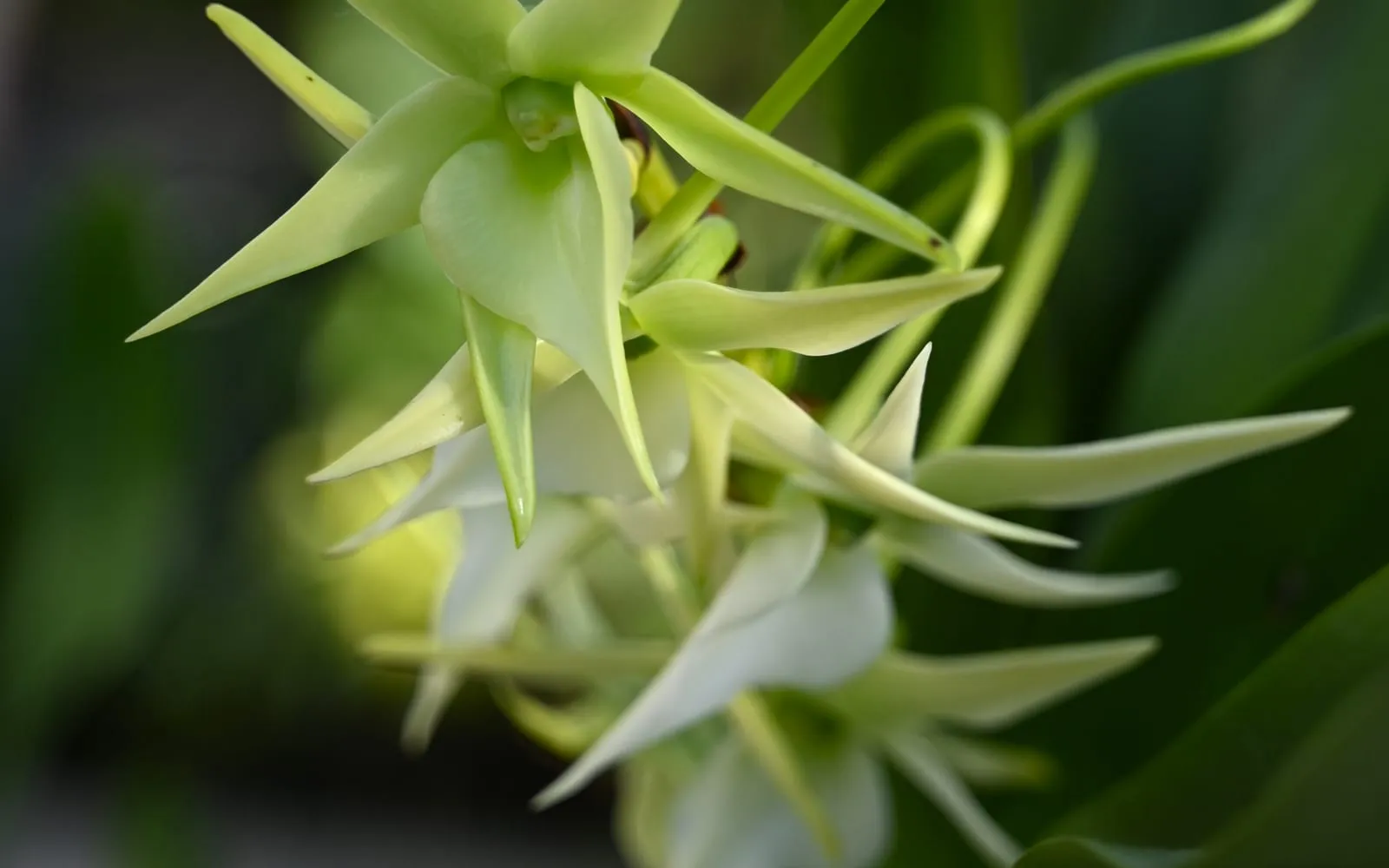
Flowers open from the leaf axils, usually in winter, large and waxy, star-shaped, ivory white ageing to a pale creamy green, with six pointed segments radiating around the long, slender spur. A single flower can remain open for six weeks or more, among the longest-lasting blooms of any commonly grown orchid, and a mature plant may open several at once.
Where it is from
This species grows on the eastern side of Madagascar, in lowland and mid-elevation rainforest that stays warm and humid across the year with no pronounced dry season or cold spell. Madagascar’s long isolation from mainland Africa has produced an extraordinarily high proportion of plant and animal species found nowhere else, and this orchid, together with the long-tongued hawkmoth that pollinates it, is one of the clearest examples of two species evolving in lockstep with each other on the island.
The consistently warm, wet climate it comes from is why this species has no meaningful cold tolerance and why a real seasonal rest, of the kind that benefits a Cattleya or Laelia, is neither needed nor wanted here. Steady warmth and humidity, held fairly constant across the year, suit it better than any deliberate seasonal variation.
How it grows
Pot it in a coarse, open bark mix inside a reasonably deep container, since this species develops long, thick roots that run well down into the mix rather than staying shallow. A pot too small or too shallow restricts root growth and slows the plant’s development noticeably.
Growth proceeds steadily from the top of the single stem, adding new leaves in alternating ranks over months rather than in a single burst the way a pseudobulb-forming orchid produces a new growth. Because there is no pseudobulb reserve, consistent watering and feeding matter more here than for many other orchids, though the thick roots do provide some buffer against an occasional missed watering.
A flower spike, once initiated, can take several months to develop fully before opening, considerably longer than most other orchids in this collection, so patience through that period is part of growing the species well.
Through the seasons
Spring brings steady new leaf growth along the stem. Continue regular watering and feeding as growth picks up with warmer, brighter days.
Summer is a period of strong, steady growth, with warmth and humidity supporting new leaves and root development. Watch for the first signs of a developing flower spike toward the end of the season.
Autumn a flower spike, if one has begun, continues its slow development through this period. Maintain steady watering and feeding rather than easing off, since this species has no strong dormant phase.
Winter brings the main flowering, with the long-spurred blooms opening and often lasting six weeks or more. Keep the plant warm, since it has little tolerance for cold at any time of year.
Care difficulty
Moderate. It needs little seasonal adjustment because it has no pronounced dry rest or cool period to time correctly. The challenge is its slow pace: a flower spike can take months to open once it starts, so patience matters more than technique.
Watering
Water regularly, letting the surface of the mix dry slightly between soakings rather than keeping it constantly saturated. A thorough soak with full drainage suits the thick roots well; they dislike sitting in stagnant moisture but also do not tolerate the extended dry spells a succulent-leaved species such as Brassavola shrugs off easily.
Because this species has no pseudobulb reserve and no strong dormant period, watering stays fairly consistent across the year rather than dropping off sharply in any one season.
Warning signs, diseases and pests
Scale insects and mealybugs can settle along the stem and in the leaf axils, appearing as small brown bumps or cottony white tufts, and checking these hidden spots regularly is worthwhile since the plant’s tall, upright growth habit can make an early infestation easy to miss. Treat with horticultural soap as soon as one is found.
Spider mites occasionally appear in warm, dry indoor air, showing as fine speckling on the leaves; raising humidity around the plant discourages them without conflicting with its normal care.
Soft, blackened patches at the base of the stem or on a root usually mean rot from a mix that has stayed wet too long or a pot that drains poorly. Cut away any affected tissue with a clean blade, improve drainage, and water more cautiously afterward. A lower leaf that yellows and drops as the stem lengthens is normal ageing rather than a cause for concern.
Growing environment
Bright indirect light suits this species well, with some gentle direct morning sun tolerated; harsh midday sun can mark the broad leaves, while too little light slows growth and delays flowering considerably. An east-facing window or a lightly shaded spot near a bright one usually works.
High humidity, in the 60 to 80 percent range, matches this species’ rainforest origins and supports the long, thick roots this plant relies on. Keep it reliably warm year round, since it has essentially no cold tolerance at any point.
Feeding
A balanced orchid fertiliser at quarter to half strength, applied every second watering through active growth, supports the steady leaf and root production this species relies on in place of a pseudobulb reserve.
Feeding can continue at a similar pace across most of the year, easing back only slightly during any period of noticeably slower growth, since this species has no pronounced dormant season that calls for a sharper seasonal cut.
Troubleshooting
How long does it take for a flower spike to open once it appears? Often several months from first appearing to the flower fully opening, considerably longer than most other orchids. Continue steady watering and feeding through this period rather than assuming the plant has stalled.
The plant is growing slowly compared with other orchids I keep. This is normal for the species, which builds height gradually along a single stem rather than producing a fresh burst of growth from a new pseudobulb each season. Consistent warmth, light and feeding over time matter more here than any single adjustment.
A lower leaf has yellowed and dropped. Usually normal ageing as the stem lengthens and older leaves are shed from the base, particularly on a well-established plant. Continued yellowing further up the stem is worth investigating as a possible sign of a root problem.
Is the moth that pollinates this species actually confirmed? Yes. A hawkmoth subspecies with a matching tongue length, Xanthopan morganii praedicta, was described in 1903, and it was directly observed pollinating the flower in 1992, fulfilling Darwin’s 1862 prediction after more than a century.
The roots are growing over the edge of the pot rather than staying inside it. Normal for this species, whose thick roots often run along the outside of the growing medium as well as through it. Leave them be rather than trimming or forcing them back into the pot, and repot into a larger container once the current one is clearly too small.
A developing flower spike seems to have stalled. Check that watering, feeding and warmth have stayed consistent, since any of the three dropping off can slow an already gradual process considerably. Given time and steady conditions, most stalled spikes resume and eventually open.
Darwin's Orchid problem guides
Not sure what is wrong? See the common houseplant pests guide.