
Houseplant
Triostar
Stromanthe sanguinea
Also known as Stromanthe sanguinea
How to grow Stromanthe sanguinea 'Triostar', the cream, pink and green prayer plant from Brazil, with watering, humidity and siting advice for each season.
At a glance
- Difficulty
- Easy
- Water
- When the top few centimetres of mix have dried
- Light
- Bright indirect light to light shade
- Temperature
- Warm; keep above about 13 deg C
- Humidity
- Average to high
- Hardiness
- USDA 10-12, RHS H1b, hardy to 13 C
- Type
- Perennial
- Height
- 60-150 cm
- Native to
- Brazil
A tender tropical foliage plant from Brazil, growing in warm, humid, shaded to filtered light. It needs warmth, humidity and bright indirect light, and it cannot take frost or chill. It is safest above about 13 deg C, and cold, wet compost or dry air spoils it.
Hardiness zones describe winter cold alone. Summer heat, humidity, rainfall and the length of the growing season decide as much, so treat the range as the outer limit rather than as a recommendation.
Not known to be toxic
Stromanthe sanguinea, the triostar, is not recorded among the seriously toxic plants, and related plants in its group are not listed as toxic by the ASPCA or the RHS. A pet or child that chewed a leaf would be unlikely to come to real harm beyond a possible mild stomach upset.
Sources: ASPCA toxic and non-toxic plants, RHS potentially harmful garden plants
Painted leaves and a pink reverse
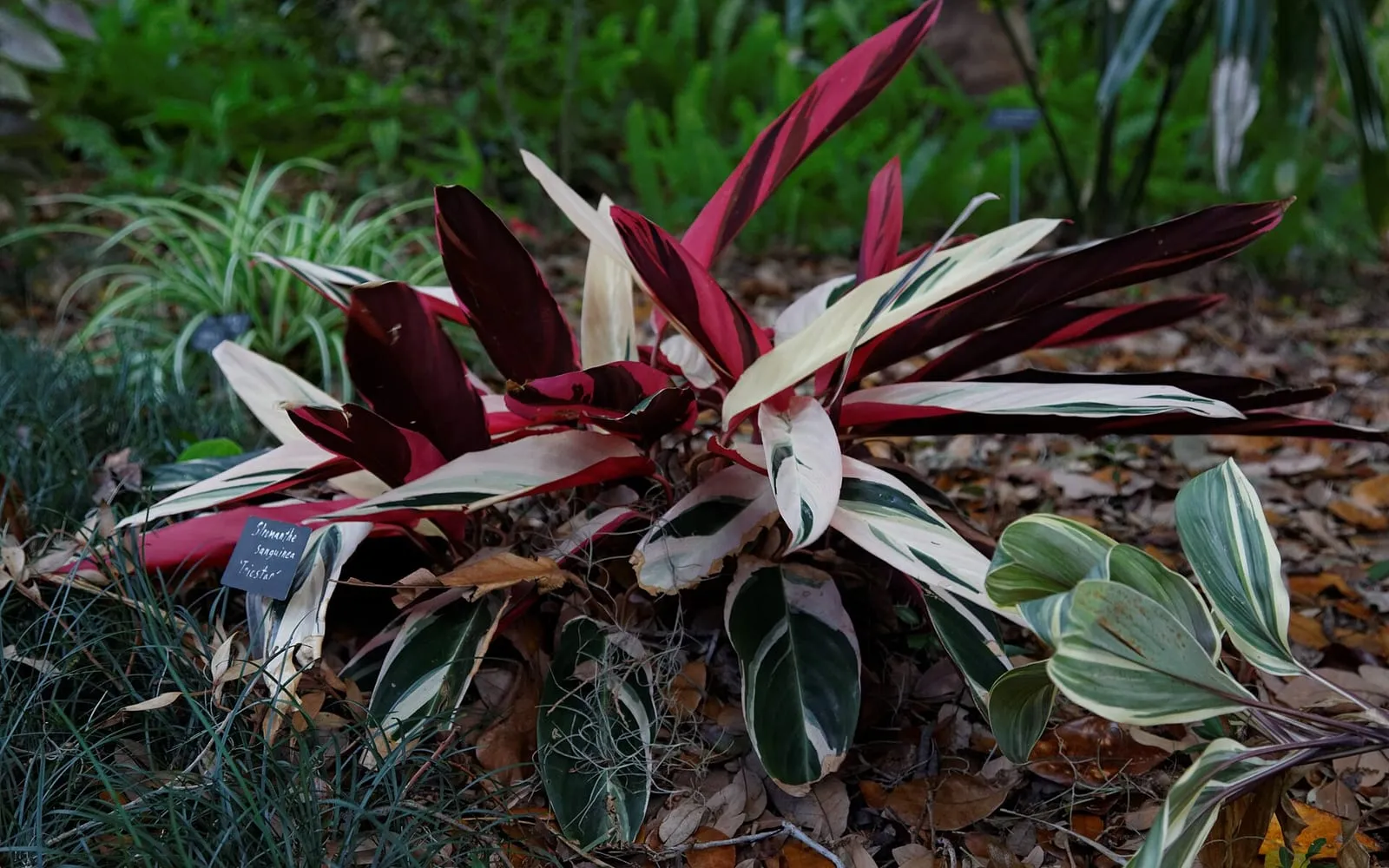
No two leaves on a triostar have the same markings. The upper face is streaked and splashed in irregular bands of cream, ivory-white and green, one blade heavy with pale sectors and the next barely touched, so a mature clump has a varied pattern rather than a repeat. The underside of each leaf is solid magenta-pink, with the same colour running down the leaf stalks. Held on upright stems, the lance-shaped blades bunch into a dense clump that leans towards its light.
The plant is a Stromanthe, sister genus to Calathea and Maranta within the prayer-plant family Marantaceae. Growers still meet it labelled ‘Tricolor’ as often as ‘Triostar’, the two names attached to the same variegated selection. Whatever the tag reads, the pink-backed variegated leaf is the giveaway.
The nightly fold
In the evening the blades swing up from the horizontal and press together in loose vertical pairs, turning their magenta undersides outward, then flatten and spread again through the morning. A swollen hinge of tissue called a pulvinus sits at the top of each leaf stalk and drives the movement by shifting water pressure between its cells. This rise and fall follows a daily rhythm instead of the sun, so a triostar folds on schedule even in a windowless room under a lamp. A plant that stops folding is usually thirsty, chilled or standing in air that is too dry.
Home ground in coastal Brazil
Stromanthe sanguinea grows wild in the Mata Atlantica, the belt of Atlantic coastal forest that runs down the east of Brazil. There it roots in the leaf mould of the forest understorey, screened from full sun by the trees above and bathed in humid, rain-washed air that stays warm the year round. Frost never reaches it and the ground never bakes dry. Its care follows that setting, and a bright, humid, draught-free corner indoors is the nearest a house comes to it.
Light without direct sun
Set the triostar where daylight is generous but filtered, a metre or so back from an east-facing window or behind a voile at a brighter aspect. Strong midday sun striking the blades scorches the pale variegated sectors first, since those cream and white patches carry little chlorophyll to protect them and burn to brown crescents. Too little light causes a different problem: the leaves grow smaller, the cream fades towards green as the plant produces more chlorophyll, and the stems stretch and flop. Turn the pot a little each week so the clump fills out evenly instead of tilting to one side.
Watering and water quality
Water when the top two or three centimetres of the mix feel dry, soak the rootball through, then let the surplus drain away so the roots stay moist without standing in water. Like its Calathea cousins, this plant reacts badly to the minerals in hard tap water. Fluoride, chlorine and dissolved lime gather in the leaf tissue and scorch the thin margins to a papery brown. Rainwater, filtered water or tap water left uncovered overnight spares it that. Through the darker, cooler months growth slows and the roots need far less, so hold back and never leave the mix cold and sodden.
Warmth and moist air
Everyday room warmth of around eighteen to twenty-six degrees C suits the triostar, and it should stay above roughly thirteen degrees C. Keep it clear of draughts from doors and windows, away from radiators, and off a cold pane in winter. Dry indoor air is the usual cause of crisping edges. Standing the pot on a wide tray of wet pebbles, clustering it with other leafy plants, or running a small humidifier nearby all lift the moisture around the foliage. Misting wets the leaves for a few minutes and can leave hard-water spots, so the tray works well where a spray bottle does not.
Feeding, potting and division
From spring through to early autumn, feed every couple of weeks with a balanced houseplant fertiliser mixed to half its stated strength, because the fine roots brown at the tips after a strong dose. Stop feeding over winter. Repot in spring only once the roots crowd the pot, shifting up a single size into a loose, airy, peat-free mix opened out with bark, coir and a little perlite. Increase your stock by division: lift a full clump in spring, work the rhizomes apart into pieces that each keep roots and a fan of leaves, and pot them up in warm, humid conditions until they root away.
Flowers and common faults
In winter an established triostar sometimes throws a branched spray of small red bracts studded with modest white flowers. It is a foliage plant first, and the bloom is secondary. Browned, brittle leaf margins point to dry air or a build-up of tap-water minerals, so raise the humidity and switch to rainwater. Whole leaves yellowing over sour, wet compost mean the roots are drowning; let the mix dry further and check that the pot drains. When the cream fades and the leaves shrink, the plant needs brighter, filtered light. In warm dry air, spider mites stipple the undersides with fine pale flecks and spin faint webbing, and mealybugs lodge as white tufts in the leaf joints. Rinse the foliage, lift the humidity, and wipe mealybugs away with a cotton bud dipped in dilute alcohol.
Quick answers
Why are the pale patches turning brown? Direct sun or dry air. Move it out of the beam and raise the humidity around it.
Why has it stopped folding at night? It is thirsty, cold or too dark. Correct the conditions and the movement returns within a few days.
Is it safe around pets? Stromanthe is not listed among the harmful plants for cats and dogs, so a nibble should cause nothing worse than a mild upset. Keep it out of reach anyway to spare the leaves.
How do I make more? Divide the clump in spring, keeping roots and leaves on every piece.
Triostar problem guides
Not sure what is wrong? See the common houseplant pests guide.