
Houseplant
Morning-Glory Begonia
Begonia convolvulacea
Also known as Begonia convolvulacea
How to grow Begonia convolvulacea, the morning-glory begonia, a scrambling begonia whose twining stems echo the bindweeds and morning glories.
At a glance
- Difficulty
- Easy
- Water
- When the top few centimetres of mix have dried
- Light
- Bright indirect light to light shade
- Temperature
- Warm; keep above about 13 deg C
- Humidity
- Average to high
- Hardiness
- USDA 10-12, RHS H1b, hardy to 13 C
- Type
- Perennial
- Height
- 1-3 m
- Native to
- Brazil
A tender tropical foliage plant from Brazil, growing in warm, humid, shaded to filtered light. It needs warmth, humidity and bright indirect light, and it cannot take frost or chill. It is safest above about 13 deg C, and cold, wet compost or dry air spoils it.
Hardiness zones describe winter cold alone. Summer heat, humidity, rainfall and the length of the growing season decide as much, so treat the range as the outer limit rather than as a recommendation.
Harmful if eaten
- Harm from
- Eating it and handling it
- Affects
- People, cats, dogs and horses
Begonia convolvulacea, the morning-glory begonia, is toxic to cats, dogs and horses. The whole plant holds soluble calcium oxalates, most concentrated in the underground parts, and chewing it can burn the mouth and cause drooling and vomiting. The RHS rates begonias as mildly harmful if eaten and a possible skin irritant. Keep it out of reach of pets and small children, and wash your hands after cutting stems.
Sources: ASPCA toxic and non-toxic plants, RHS potentially harmful garden plants
A climbing begonia
Begonia convolvulacea is one of the unusual scrambling, climbing members of the genus. Its name says as much: convolvulacea means resembling a Convolvulus, the bindweeds and morning glories whose twining habit and heart-shaped leaves it echoes. Instead of sitting in a tidy mound, it throws out long, flexible stems that scramble up through supports or trail from a raised pot, clothed in glossy pointed leaves. It comes from the forests of Brazil, where it climbs among shrubs and low trees towards the light. Indoors, it suits a trellis, a moss pole or a hanging position where its stems can cascade.
Its stems, leaves and flowers
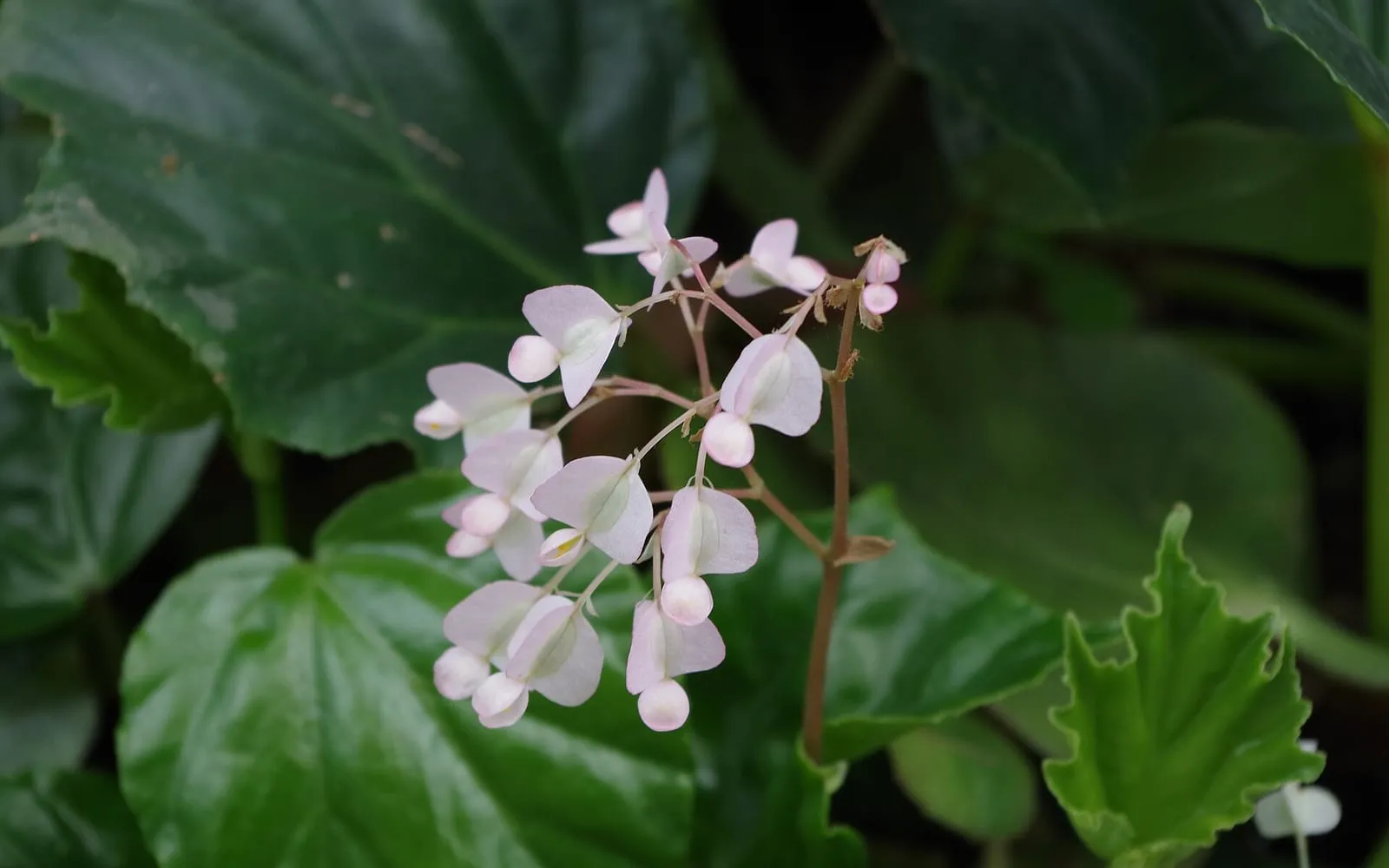
The leaves are smooth, pointed and heart-shaped at the base, lopsided in the begonia manner and a bright, waxy green. The stems themselves are long, wiry and branching, and they lean on nearby support as they grow. In the warmer months the plant carries small white flowers, often fragrant, along the shoots. Each cluster carries male and female flowers separately, as begonias do, with the female backed by a small winged capsule that ripens the seed.
Where it grows wild
In nature it climbs through the humid, shaded forests of Brazil, with stems growing towards the broken light of the canopy while its roots stay in the cool, moist leaf litter below. It can climb a tree trunk to about five metres there, holding on by roots that grow from the stems, and it belongs to section Wageneria, a small group of climbing begonias named for the genus Wageneria in which it was first placed. That habit of climbing from shade towards light explains its needs: warmth without cold snaps, humid air around the leaves, moisture at the root, and bright light above the plant rather than direct sun on the foliage.
Light and support
Give it bright, indirect light and something to climb. A trellis, a moss pole or a few canes supports the stems, while a raised pot or a hanging position suits a plant left to trail. Direct summer sun through glass scorches the glossy leaves, but this species needs more light than deep-shade begonias. A bright spot out of the fiercest rays gives the best growth and flowering. Guide the young stems onto their support and tie them in loosely as they lengthen.
Watering the climber
Water when the top few centimetres of the compost have dried, soaking the pot through and letting it drain freely. A climbing plant in full leaf drinks steadily through the growing season and should be kept evenly moist, though never left standing in cold water, which rots the roots and weakens the stems. In winter, when growth slows, water less and let the surface dry further between drinks. A long-stemmed plant loses water through a lot of leaf, so check it more often in warm, bright spells.
Warmth and humidity
Keep it warm and above about 13 deg C, out of chilling draughts. Coming from humid Brazilian forest, it browns at the leaf edges in dry heated air, so raise the humidity with a pebble tray, a plant grouping, or a moist room. If it grows on a moss pole, keep the pole lightly damp for the aerial roots. Let air move through the stems so damp does not settle and bring on mould.
Feeding
Feed every two weeks through spring and summer with a balanced liquid fertiliser at half strength to support the long, leafy, flowering stems. A vigorous climber uses a fair amount of food in the growing season, but strong feed produces sappy, weak growth, so keep the dose moderate and regular. Ease off through autumn and stop over winter, resuming as the stems start into growth again.
Pruning and propagation
Pinch the growing tips of a young plant to make it branch and cover its support more fully, and shorten over-long or bare stems in spring to keep it bushy. The prunings root easily. Trim a stem below a joint, set it in damp compost or a glass of water, and roots should form within a couple of weeks in warmth. A scrambling stem pinned to a nearby pot of compost will layer and root where it touches, and a large plant can be divided at repotting.
Health and pests
In warm, humid and airy conditions, the morning-glory begonia is usually healthy. Spider mites take hold in dry air, stippling the leaves and webbing the shoot tips; higher humidity and a rinse keep them down. Mealybugs may cluster where the stems fork and can be dabbed off with dilute alcohol. Grey mould can spot leaves and stems left cold and wet in still air. Bare, leafless lengths of stem usually mean too little light or a plant left unpinched. Better light and a spring trim usually put that right.
The growing year
Spring brings vigorous new stems. Pinch the tips, tie them in, take cuttings and start feeding.
Summer is full growth and flower. Water freely, feed and keep the air humid as the stems climb.
Autumn slows the plant. Reduce water, let the feed tail off and tidy over-long stems.
Winter is a warm rest. Keep it above chilling cold, water sparingly and let the compost dry more between drinks.
Questions growers ask
Does it really climb? Yes. It is one of the scrambling begonias and wants a trellis or moss pole to climb, or a raised pot to trail from.
Why has it gone bare at the base of the stems? Too little light or no pinching. Move it brighter, out of direct sun, and shorten the stems in spring to force fresh growth.
How much should I water it? When the top few centimetres have dried, keeping it evenly moist in growth and much less in winter.
What is the easiest way to propagate it? Root a stem cutting in water or damp compost, or layer a scrambling stem into a nearby pot.
Is it safe with pets? Keep it away from pets that chew. Begonias carry soluble oxalates and the ASPCA lists them as toxic to cats, dogs and horses.
Morning-Glory Begonia problem guides
Not sure what is wrong? See the common houseplant pests guide.