
Houseplant
Ruffled Echeveria
Echeveria gibbiflora
Also known as Echeveria gibbiflora
How to grow Echeveria gibbiflora, the ruffled echeveria, with a large trunk-forming rosette and a towering flower spike.
At a glance
- Difficulty
- Easy
- Water
- When the mix has dried right through
- Light
- Full sun to bright light
- Temperature
- Warm; keep frost-free
- Humidity
- Low
- Hardiness
- USDA 9-11, RHS H2, hardy to 5 C
- Type
- Perennial
- Height
- 30-60 cm
- Native to
- Mexico
A succulent from Mexico, storing water in fleshy tissues against drought. It needs full sun, very sharp drainage and long dry spells, and rots in cold, wet compost. Its frost tolerance depends on its origin, and it is safest kept frost-free unless known to be hardy.
Hardiness zones describe winter cold alone. Summer heat, humidity, rainfall and the length of the growing season decide as much, so treat the range as the outer limit rather than as a recommendation.
Not known to be toxic
Echeveria gibbiflora, the ruffled echeveria, is not recorded among the seriously toxic plants, and related plants in its group are not listed as toxic by the ASPCA or the RHS. A pet or child that chewed a leaf would be unlikely to come to serious harm beyond a possible mild stomach upset.
Sources: ASPCA toxic and non-toxic plants, RHS potentially harmful garden plants
About
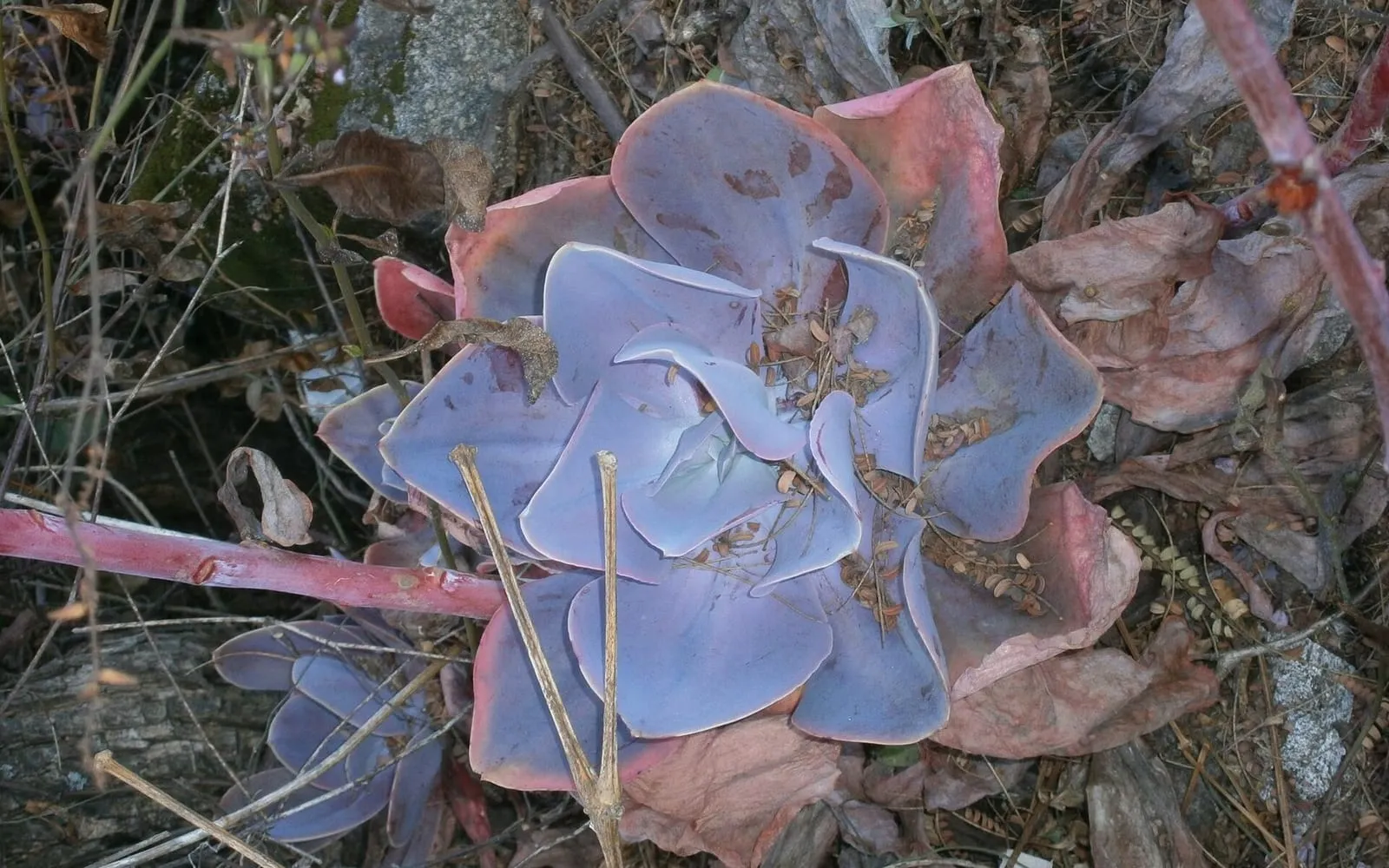
Echeveria gibbiflora is one of the largest echeverias, a Mexican succulent whose rosette can spread wider than a dinner plate on top of a thickening woody stem. Where most echeverias sit flat to the ground, this one lifts its crown on a stout trunk as it ages, so an old plant can look like a small palm topped with a single huge rosette. Its broad, paddle-shaped leaves take on smoky greys, dusky pinks and lavender flushes under a soft waxy bloom.
Several of its forms carry raised, blistered growths on the leaf surface, the carunculate cultivars, and it is these ruffled, bumpy-leaved selections that give the plant its common name. The wild species and its many hybrids have been crossed endlessly, so much of the large-rosette echeveria breeding comes from this one.
It flowers dramatically, sending up a stalk that can stand well over a metre tall and carry coral-pink bells. Easy and undemanding for its size, it carries no serious toxicity, though its bloom-coated leaves mark at a touch.
Appearance and character
The rosette is large and open, built from broad, spoon-shaped leaves that can each be the length of a hand. Their surface carries a fine farina, giving a chalky finish over a base of grey-green flushed with pink or purple, brightest at the leaf edges in strong sun. In the ruffled cultivars the leaf blade is warped and studded with raised carunculate bumps, so no two leaves lie quite the same.
With age the plant grows a bare, thickening stem beneath the crown, gradually lifting the rosette clear of the pot. This trunking is natural, and the leggy stem can be cut and re-rooted if you prefer the rosette back at soil level.
The flower spike is spectacular for a houseplant, a long arching stalk carrying rows of pendent, coral to salmon-pink urn flowers, tall enough to need staking in a pot.
Where it is from
Echeveria gibbiflora grows on rocky slopes and cliffs across the volcanic highlands of central and southern Mexico, in strong sun, thin mineral soil and sharp drainage. The climate swings between a wet growing season and a long dry one, and the plant survives drought with the water stored in its thick leaves and stem.
Give it the brightest position available, a gritty medium that drains at once, and a proper dry spell between waterings, with warmth in growth and a cool, dry winter rest. Cold, sodden compost is unlike its native cliff habitat and rots it from the roots.
How it grows
The plant grows strongly for an echeveria through spring and summer, enlarging its rosette and, over the years, extending its trunk. Its stored water gives it real drought tolerance, so it tolerates a missed watering far more readily than an overwatered spell.
Give it full sun or the brightest indoor light, a fast mineral mix and dry air, and it needs little attention beyond the odd stake for a flower spike. In poor light the big leaves stretch, turn pale and thin, and the rosette opens out. Water sitting on the bloomed leaves both marks the farina and, if it pools in the crown, encourages rot.
Propagation is easy from leaves and from stem sections. A decapitated crown re-roots readily, and the stump often sprouts new offsets.
Through the seasons
Spring brings the main flush of growth and sometimes the flower stalk. Resume watering as the mix dries and stake the spike if one appears.
Summer is the strongest growing spell. Keep it in full sun, water when the mix has dried right through, and give plenty of air movement.
Autumn slows it. Reduce watering and stop feeding as the light drops.
Winter is a cool, dry rest. Keep it bright and frost-free, water sparingly, and keep the crown dry.
Care difficulty
Despite its size, the ruffled echeveria is an easy, forgiving plant. Bright light, sharp drainage and restrained watering are the essentials, and its stored water helps it tolerate missed watering. The main faults are overwatering, which rots the base, and weak light, which draws the plant up and thins it. A tall old trunk is normal.
Watering
Water only when the gritty mix has dried right through, then soak the pot and drain away every drop. Water at the base instead of over the leaves, to keep the bloom intact and water out of the large crown where it can rot. A big plant in a big pot holds water for a long time, so let it dry properly and lean towards under- instead of over-watering. Through winter, water very little. Firm, full leaves mean the plant has enough water; soft, drooping ones point to thirst.
Warning signs, diseases and pests
A soft, browning stem base or a blackening crown is rot from cold, wet compost or water pooling among the leaves. Behead the plant above the rot, dry the cut crown, and re-root it in fresh gritty mix, discarding the rotted base.
Mealybugs gather in the leaf axils and around the crown as white fluff, easy to miss under the broad leaves; remove them with a spirit-soaked swab and inspect regularly. A rosette that opens out, pales and stretches has too little light and should be moved somewhere brighter.
Growing environment
Full sun gives the strongest colour, the tightest rosette and the best chance of flowers, so a south or west window, a conservatory, or a summer spell outdoors in a sunny spot all suit it. It needs warmth in growth and cool, dry conditions over winter, with low humidity and free-moving air instead of any misting.
Grow it in a very free-draining mix, cactus compost with added grit or pumice, in a sturdy pot that will not topple under a top-heavy rosette. Use a heavier terracotta or glazed pot for balance, and repot when the plant has clearly outgrown its container.
Feeding
Feed in spring and summer with a dilute, low-nitrogen cactus food, once or twice over the season. This is a large plant that still grows in lean mineral ground and needs only modest feeding; a heavy dose forces soft, floppy leaves that lose their shape and colour. Give nothing in autumn and winter, and let fresh mix support a newly potted or re-rooted plant through its first weeks.
Troubleshooting
Why is the trunk getting long and bare? This is natural for the species with age. Behead the rosette and re-root it low in the pot, and the stump will often sprout new offsets.
The base has gone soft and brown. Root or stem rot from wet, cold compost. Cut the healthy crown free, dry it, and re-root it in fresh gritty mix.
The big leaves are pale, thin and spreading flat. Too little light. Move it to full sun and the new growth will firm up and colour.
How do I propagate it? Root a beheaded crown, a stem section, or whole leaves laid on gritty mix.
Is it safe around pets? Echeverias are not among the toxic plants, so a nibble is unlikely to do serious harm, though it is sensible to keep any houseplant out of a chewing pet’s reach.
Ruffled Echeveria problem guides
Not sure what is wrong? See the common houseplant pests guide.