
Houseplant
Tiger Jaws
Faucaria tigrina
Also known as Shark's jaws
How to grow tiger jaws as a houseplant. Its toothed, gaping leaf pairs, autumn daisy-like flowers, and why it needs a proper summer rest rather than a winter one.
At a glance
- Difficulty
- Easy
- Water
- Regular watering in autumn and winter, minimal in summer
- Light
- Bright light, several hours of direct sun
- Temperature
- 10-27 deg C, avoid below 2 deg C
- Hardiness
- USDA 9-11, RHS H1c, hardy to 2 C
- Type
- Evergreen perennial succulent
- Height
- 5-10 cm
- Native to
- South Africa
Tender to frost and grown as a houseplant across almost the entire temperate world. Coming from a winter-rainfall region of South Africa, it follows an unusual seasonal rhythm for a succulent: most active growth and flowering happen in autumn and winter, with a real summer rest period rather than the more familiar winter dormancy many other succulents follow.
Hardiness zones describe winter cold alone. Summer heat, humidity, rainfall and the length of the growing season decide as much, so treat the range as the outer limit rather than as a recommendation.
Not known to be toxic
Tiger jaws has no toxicity listing from the RHS or the ASPCA and is considered safe around pets and children. There is no documented history of poisoning associated with this species.
Source: RHS
About
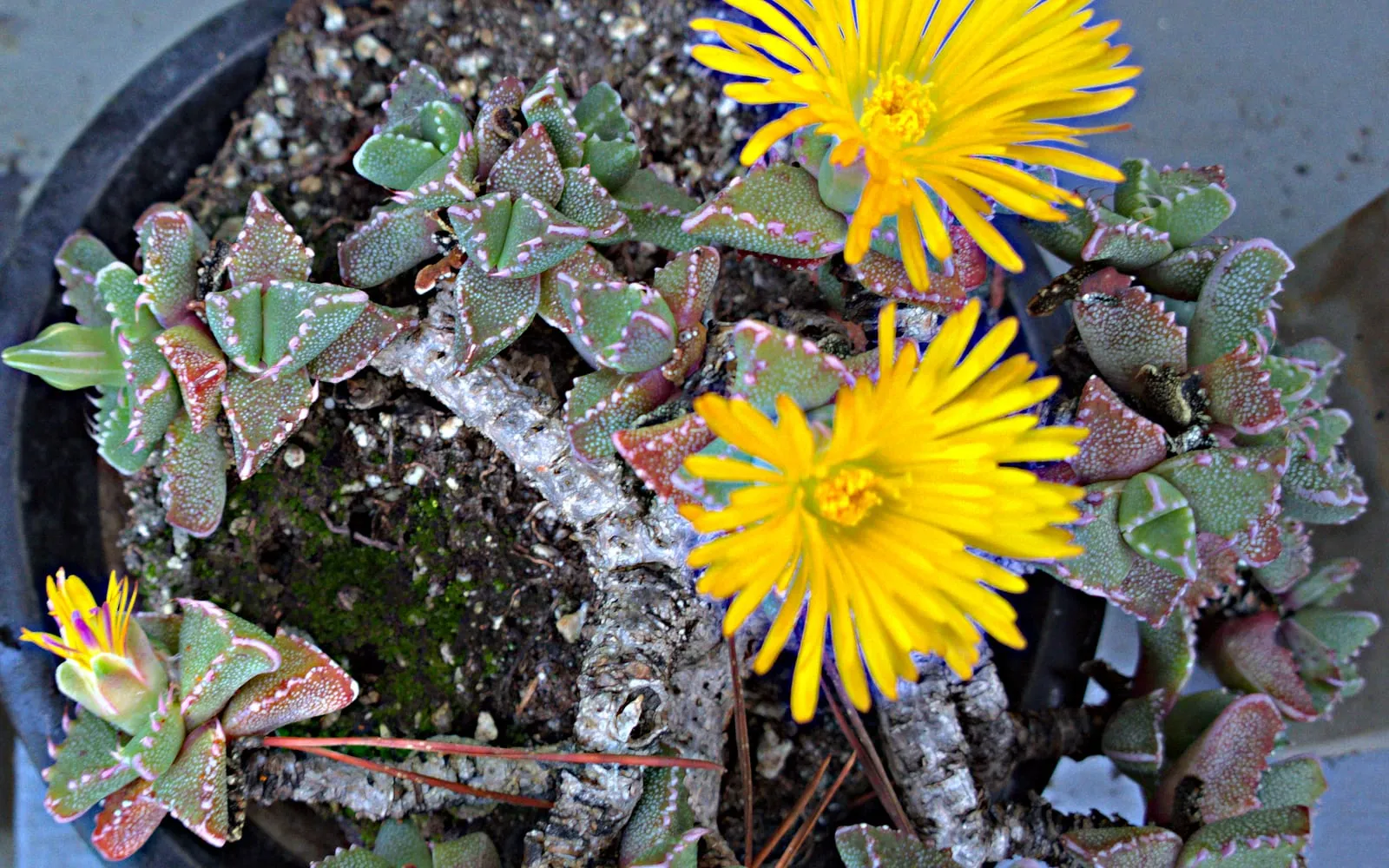
Tiger jaws takes its name from its most distinctive feature: pairs of thick, fleshy leaves edged with soft, curved, tooth-like projections that face each other across a central gap, closely resembling an open, toothed jaw, particularly on a young rosette before it has clustered into a larger clump. Bright yellow, daisy-like flowers open in autumn, often surprising growers used to succulents flowering in spring or summer instead.
Its unusual growing season, active and flowering through autumn and winter with a real rest through summer, reflects its origin in a part of South Africa where rain falls mainly in winter, and getting this seasonal rhythm right in cultivation matters more to growing this species well than almost any other single factor.
Appearance and character
Thick, triangular, grey-green leaves grow in opposite pairs, each pair meeting across a gap edged with soft, curved, tooth-like projections that give the whole rosette its jaw-like appearance. Individual rosettes gradually produce offsets at the base, clustering into a small, dense mat of multiple toothed rosettes over time.
Bright yellow, multi-petalled flowers, resembling a small daisy, open from between the leaf pairs in autumn, typically opening during the day and closing at night or in dull weather, a pattern shared with several related South African daisy-flowered succulents.
Where it is from
Rocky, semi-arid ground in the winter-rainfall regions of South Africa, where most annual rain falls during the cooler months and summer is correspondingly hot and dry.
That winter-rainfall climate is the reason this species’ growing season runs opposite to many other popular succulents, which more often come from summer-rainfall regions and rest through winter instead. Treating tiger jaws the same way, watering it through summer and resting it in winter, works against its natural cycle rather than with it.
How it grows
Individual rosettes grow slowly, producing offsets at the base that gradually build a single starting plant into a small, dense clump of toothed rosettes over a few years. Growth and flowering are concentrated in the cooler months, autumn through winter, with the plant becoming largely dormant through the hottest part of summer.
Because its dormancy falls in summer rather than winter, this species needs a grower to actively remember to withhold water during the season when most other houseplants are being watered generously, which is the most common point of confusion for anyone new to the species.
Through the seasons
Spring growth slows as the plant transitions toward its summer rest; begin reducing watering.
Summer is the dormant season for this species. Water only sparingly, if at all, keeping the compost mostly dry.
Autumn growth resumes strongly, and bright yellow flowers typically open during this period. Resume regular watering and begin feeding.
Winter continues as the main active growing period, with steady growth given adequate light; keep watering regularly, though still allowing the compost to dry between waterings.
Care difficulty
Easy once its reversed seasonal rhythm is understood, though this single point of confusion, watering it through summer like a typical succulent, is common enough to be worth stating plainly: this species needs to be dry in summer and watered through autumn and winter instead.
Watering
Water regularly through autumn and winter, always allowing the compost to dry out between waterings. Reduce sharply through spring and keep the compost mostly dry through summer, when the plant is resting and prone to rot if kept moist during this vulnerable dormant period.
Warning signs, diseases and pests
Mealybug occasionally colonises the base of the rosettes, particularly where offsets cluster closely together, and is treated with careful manual removal or a horticultural soap for persistent infestations. Root rot from watering during the summer rest is the most common serious problem with this species, and is best prevented by respecting its reversed dormancy rather than treated after the fact.
A rosette that has become elongated and loose rather than staying compact usually indicates too little light, particularly common if the plant has been kept in a duller spot through its main fine autumn and winter growing period, when it needs strong light most.
Growing environment
Bright light with several hours of direct sun supports the most compact growth and the best flowering, particularly through the autumn and winter growing season when light levels are often naturally lower indoors. Sharply free-draining succulent or cactus compost is essential, as with any succulent prone to rot in retained moisture.
Feeding
A low-nitrogen cactus or succulent fertiliser, applied once or twice during the autumn and winter growing period, supports flowering and steady offset production. Do not feed during the summer rest, when the plant is not taking up nutrients in any meaningful way.
Troubleshooting
The plant has rotted after being watered through summer. This is the most common mistake with this species, whose dormant season falls in summer rather than winter. Keep it dry through summer in future and water mainly through autumn and winter instead.
No flowers have appeared despite healthy-looking rosettes. Check that the plant received adequate light through autumn, when flowering typically occurs, and confirm it was not kept too warm and dry during this key growing period.
Rosettes look loose and elongated rather than tight and compact. Usually too little light during the main autumn and winter growing season. Move the plant to a brighter spot for stronger, more characteristic growth.
You are unsure when to repot or divide a clustered clump. Early autumn, just as the plant is coming back into active growth, is the best time, giving divisions a full growing season to establish before the following summer’s rest.
You want to grow this species alongside other succulents with a more typical spring or summer growing season. Group it separately if possible, or at least remember to water it on its own reversed schedule rather than following whatever routine suits its neighbours, since treating it the same as a summer-growing succulent is the single most common way this plant is lost.
Tiger Jaws problem guides
Not sure what is wrong? See the common houseplant pests guide.