
Houseplant
Pig's Ear
Cotyledon orbiculata
Also known as Round-leaved navelwort
How to grow pig's ear as a houseplant or in a mild-climate garden. Its thick, chalky-coated leaves, red-margined forms, and clusters of dangling autumn flowers.
At a glance
- Difficulty
- Easy
- Water
- Water when the compost has dried out completely
- Light
- Bright light, several hours of direct sun
- Temperature
- 10-27 deg C, avoid below 2 deg C
- Hardiness
- USDA 9-11, RHS H2, hardy to 2 C
- Type
- Evergreen perennial succulent shrub
- Height
- 30-90 cm
- Native to
- Southern Africa
Tender to frost, though somewhat hardier than many soft-leaved succulents, tolerating a very light chill briefly. It is grown outdoors year round only in a reliably mild, near frost-free climate, and as a container plant, brought under cover for winter, everywhere colder.
Hardiness zones describe winter cold alone. Summer heat, humidity, rainfall and the length of the growing season decide as much, so treat the range as the outer limit rather than as a recommendation.
Toxic if eaten
- Do not eat
- The whole plant, especially the leaves
- Harm from
- Eating it
- Affects
- People, cats, dogs and horses
Cotyledon species contain cardiac glycosides, compounds that can cause serious heart rhythm disturbances if eaten in enough quantity, and this species has a documented history of livestock poisoning in its native South Africa, where the condition is known locally as krimpsiekte. Cases in pets and people from an ornamental houseplant or garden specimen are far less common than in grazing livestock, but the underlying toxin is the same, and any suspected ingestion by a child or pet warrants prompt veterinary or medical attention rather than a wait-and-see approach.
About
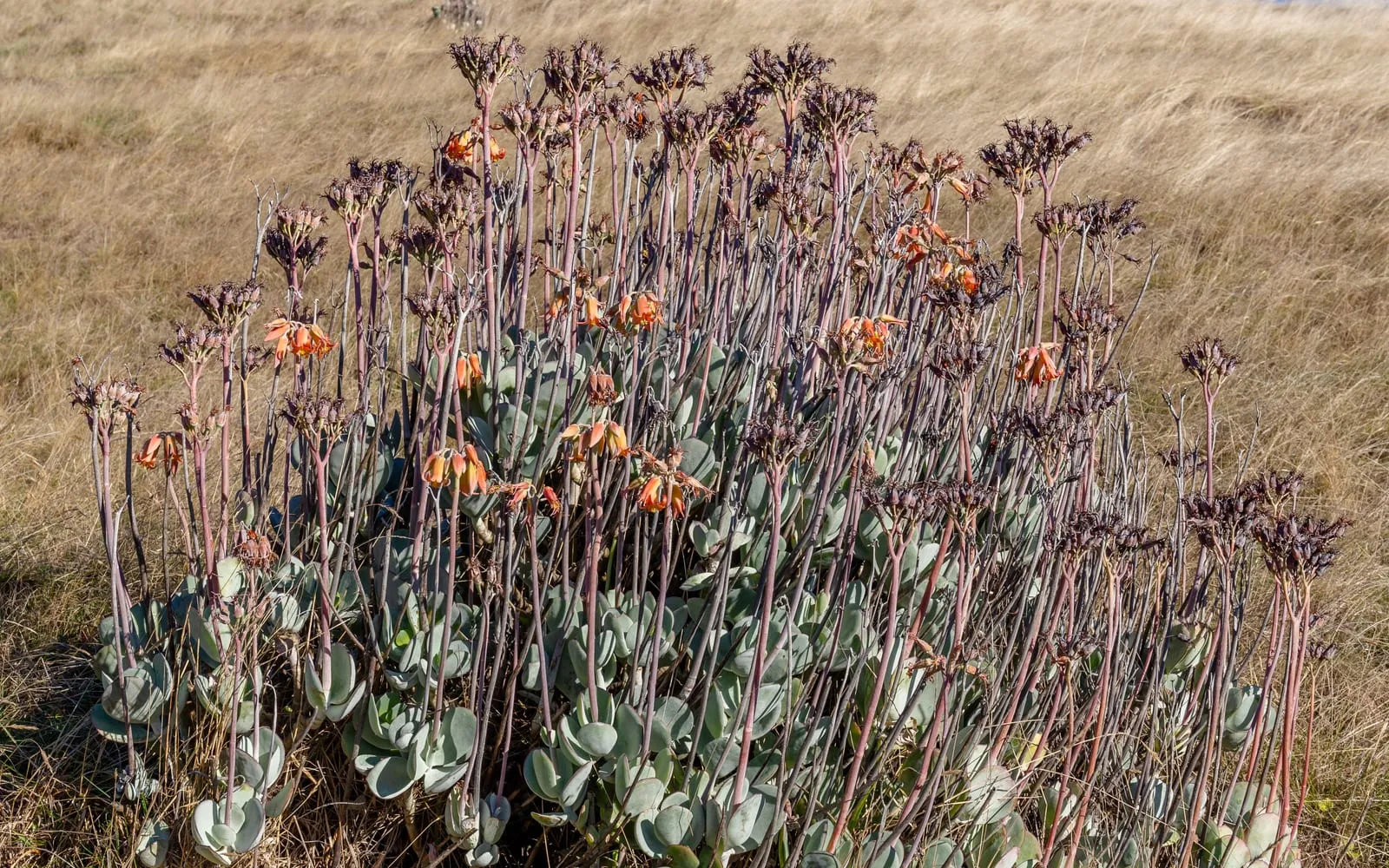
Pig’s ear is a shrubby South African succulent grown for its thick, paddle-shaped leaves, often covered in a fine, chalky, silvery-grey bloom and edged in some forms with a distinctive band of red, an effect that intensifies with strong sun. Unlike many low, rosette-forming succulents, it grows as an upright, branching shrub, giving it more structural presence in a container or border than a typical ground- hugging succulent.
Its name comes from the rounded, slightly cupped shape of the leaves, said to resemble a pig’s ear, and clusters of dangling, bell-shaped orange flowers appear on tall stalks above the foliage in autumn, adding seasonal colour to a plant otherwise valued mainly for its foliage.
Appearance and character
Thick, fleshy, paddle- or tongue-shaped leaves, often coated in a powdery, silver-grey bloom that rubs off with handling, arrange in opposite pairs along upright, branching stems. Many popular forms carry a narrow, wavy band of red along the leaf margin, most pronounced in strong sun, giving the plant a striking two-tone appearance against its otherwise silvery foliage.
Tall flower stalks rise well above the foliage in autumn, holding clusters of small, bell-shaped, orange to red flowers that hang downward, attracting sunbirds in the plant’s native South Africa and adding welcome colour to a garden or container display heading into the cooler months.
Where it is from
Rocky, arid and semi-arid ground across a wide range of southern Africa, in strong sun with sharply draining soil, tolerating drought and heat across a considerable range of habitats from coastal scrub to inland semi-desert.
That broad native range reflects an especially adaptable species, and its cultivated forms and hybrids vary noticeably in leaf shape, size and colour intensity as a result, though all share the same fundamental need for strong light and sharp drainage regardless of which form is grown.
How it grows
An evergreen shrub that branches from the base and along its stems, gradually building a substantial, multi-stemmed plant over several years given good light and occasional feeding. Growth is moderate, faster than many slower succulents but not rapid, and older stems can become somewhat woody at the base as the plant matures.
Because it branches naturally and roots readily from stem or leaf cuttings, propagating new plants is straightforward, and a leggy or overgrown specimen can be cut back hard to encourage bushier regrowth from lower down the stem.
Through the seasons
Spring growth resumes as light and temperature increase, with new leaf pairs developing along the stems.
Summer is the main growing season. Water when the compost has dried out fully and feed once or twice through this period.
Autumn clusters of dangling orange flowers typically appear on mature stems, a useful source of late-season colour.
Winter reduce watering significantly and protect the plant from any real cold; in a marginal climate, bring container-grown specimens under cover before frost threatens.
Care difficulty
Easy. This is a tough, adaptable succulent that tolerates a fairly wide range of conditions provided the basic requirements, strong light and sharp drainage, are met, and it recovers well from hard pruning if it becomes leggy.
Watering
Water only once the compost has dried out completely, soaking thoroughly and letting all excess drain away. This species tolerates real drought well and is much more likely to suffer from overwatering than from being left too dry between waterings.
Warning signs, diseases and pests
Mealybug can settle in the leaf axils and along the stems, and is treated with careful manual removal or a horticultural soap for persistent infestations. Root rot from overwatering is the more serious risk, showing as a soft, discoloured base or lower leaves that yellow and drop despite otherwise unchanged care.
Leggy, sparse growth with wide gaps between leaf pairs usually indicates too little light, and moving the plant to a brighter spot, along with cutting back leggy stems to encourage bushier regrowth, generally restores a more compact, characteristic shape over subsequent seasons.
Growing environment
Bright light with several hours of direct sun brings out the strongest colour, particularly the red leaf margins seen on many popular forms; in lower light the plant stretches and loses much of this colouring. Sharply free-draining succulent or cactus compost is essential, as with virtually all succulents prone to rot in retained moisture.
Feeding
A low-nitrogen cactus or succulent fertiliser, applied once or twice during the growing season, supports steady growth and good leaf colour. Avoid heavy or frequent feeding, which can produce soft, weak growth uncharacteristic of this naturally tough species.
Troubleshooting
Leaves have lost their red margin and look plain silvery-grey. Usually too little light. Move the plant to a brighter spot with more direct sun; new growth will show stronger colour.
Stems have grown tall and leggy with sparse foliage. This reflects insufficient light. Move to a brighter position and cut back leggy stems to encourage fuller, more branched regrowth from lower down.
The base of the plant is soft and discoloured. Suspect root rot from overwatering. Cut back to healthy tissue, let it callus, and repot into fresh, sharply draining compost.
A pet or child may have eaten part of the plant. Treat this as a real concern rather than a minor issue, given the cardiac glycosides this species contains, and seek prompt veterinary or medical advice rather than waiting to see if symptoms develop.
You are choosing where to site this plant given the toxicity concern. Keep it out of reach of grazing pets, small children and livestock, and consider a different, non-toxic succulent for a garden regularly used by young children, even though the plant itself is otherwise easy and rewarding to grow. A raised bed or an elevated container both work well for keeping a valued specimen within admiring distance but out of easy reach, and labelling it clearly in a shared or community garden setting helps too, particularly where other plot holders may not know its toxic reputation.
Pig's Ear problem guides
Not sure what is wrong? See the common houseplant pests guide.