
Houseplant
Crinkle-Leaf Plant
Adromischus cristatus
Also known as Crested adromischus, Key lime pie plant
How to grow the crinkle-leaf plant as a houseplant. Its felted, wavy-edged leaves, trailing habit, and why it resents both deep shade and harsh sun equally.
At a glance
- Difficulty
- Easy
- Water
- Water when the compost has dried out completely
- Light
- Bright indirect light, some gentle direct sun
- Temperature
- 10-27 deg C, avoid below 5 deg C
- Hardiness
- USDA 9-11, RHS H1c, hardy to 5 C
- Type
- Evergreen perennial succulent
- Height
- 5-10 cm tall, trailing 15-20 cm
- Native to
- South Africa
Tender to frost and grown as a houseplant across almost the entire temperate world. It tolerates a light chill better than many other succulents but still needs protection from any real cold, and it is more forgiving of a shadier spot than most succulents, though full deep shade still weakens its characteristic compact, felted growth.
Hardiness zones describe winter cold alone. Summer heat, humidity, rainfall and the length of the growing season decide as much, so treat the range as the outer limit rather than as a recommendation.
Not known to be toxic
Crinkle-leaf plant has no toxicity listing from the RHS or the ASPCA and is considered safe around pets and children. There is no documented history of poisoning associated with this species.
Source: RHS
About
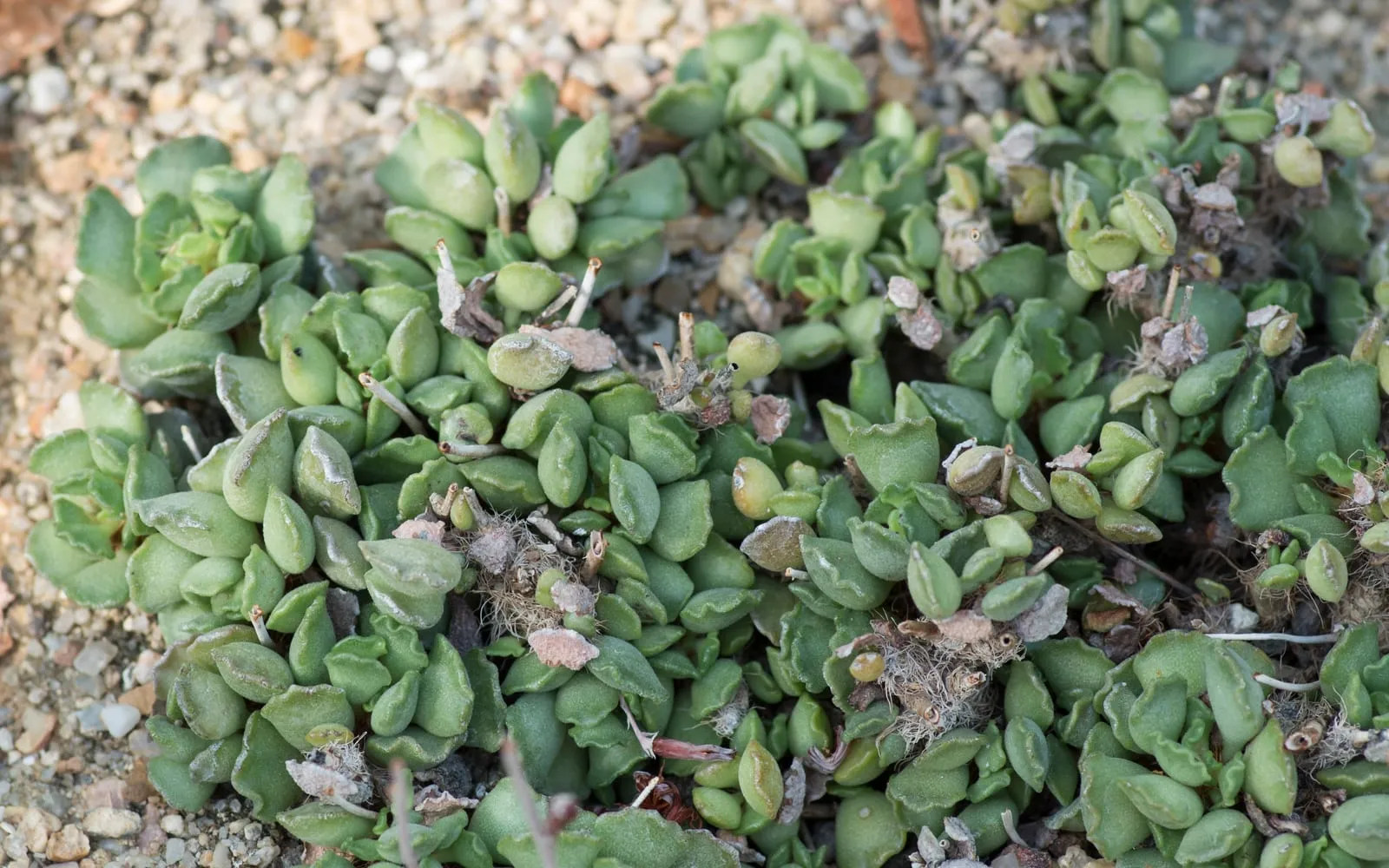
The crinkle-leaf plant is grown for its distinctively textured foliage: small, thick, grey-green leaves with wavy, crested edges and a fine, velvety covering of tiny hairs, giving each leaf a soft, almost felted appearance quite unlike the smooth, glossy surface of most other succulents. Wiry, exposed aerial roots often develop along the trailing stems, adding to its slightly shaggy, characterful look.
It stays naturally compact and slow-growing, which suits it well to a small pot, a shelf display or a shallow dish alongside other small succulents, and its tolerance of a little more shade than many succulents demand makes it a workable choice for a bright room that falls short of a full, unobstructed south-facing windowsill.
Appearance and character
Thick, fleshy leaves, greyish-green and often flushed with a reddish tinge in strong light, cluster along low, trailing stems, each leaf edged with a distinctive wavy, crested margin and covered in a fine, velvety texture visible on close inspection. Slender, wiry aerial roots frequently appear along the stem, giving mature plants a slightly untidy, characterful appearance that many growers find appealing rather than a flaw to correct.
Flowers, when they appear, are small, tubular and pinkish, held on thin stalks well above the foliage, though this species is grown almost entirely for its leaves and stem texture rather than for any significant floral display.
Where it is from
Rocky outcrops and cliff faces in South Africa, often growing in the partial shelter of rock crevices rather than in fully open, unobstructed sun, which is part of why it tolerates more shade in cultivation than many other South African succulents.
That rocky, partially sheltered origin also explains the plant’s felted leaf surface, a likely adaptation to reduce water loss and reflect excess light in an environment with intense sun for at least part of the day, balanced against periods of shade from surrounding rock.
How it grows
A slow-growing, evergreen succulent that spreads gradually along low, trailing stems, producing new leaf clusters at intervals and putting out wiry aerial roots that can anchor into nearby soil or rock given the chance. Growth is unhurried even by succulent standards, and a mature, well-filled pot represents several years of steady, undramatic development rather than rapid growth.
Because it tolerates handling and division reasonably well, individual stem sections with a few leaves attached root readily as cuttings, making this an easy species to propagate and share without needing to disturb an entire established plant.
Through the seasons
Spring growth resumes gently as light levels increase.
Summer is the main growing period, with steady leaf and stem development. Water when the compost has fully dried and feed once or twice through this period.
Autumn growth slows as light and temperature drop.
Winter water sparingly, allowing the compost to stay dry for longer between waterings, and keep the plant away from cold draughts.
Care difficulty
Easy. This is an undemanding, slow-growing succulent that tolerates a reasonably wide range of light conditions and a certain amount of neglect, though it still needs the sharp drainage and careful watering any succulent requires to avoid rot.
Watering
Water only once the compost has dried out completely, soaking thoroughly and letting all excess drain away rather than leaving the pot standing in water. Reduce watering further over winter, when the plant’s growth slows much and its water needs drop with it.
Warning signs, diseases and pests
Mealybug can settle among the leaf clusters and along the stems, and is treated with careful manual removal or a horticultural soap for persistent infestations. Root rot from overwatering is the more serious risk, showing as a soft, discoloured base or leaves that yellow and drop despite otherwise unchanged care.
Leaves that lose their characteristic wavy crest and grow smoother and more elongated than usual often indicate too little light, a mild form of stretching that, while not fatal, changes the plant’s typical appearance; moving it to a brighter spot restores more compact, characteristic growth over time.
Growing environment
Bright indirect light with some gentle direct sun suits it well, and this species tolerates more shade than many other succulents without serious decline, though it still performs best short of deep, low-light conditions. Sharply free-draining succulent or cactus compost is essential, as with virtually all succulents.
Feeding
A low-nitrogen cactus or succulent fertiliser, applied once or twice during the growing season, supports steady development without encouraging the soft growth that heavier feeding can cause. This is a naturally slow grower, and modest feeding suits its pace better than a heavier regime intended for a faster-growing plant.
Troubleshooting
Leaves have lost their wavy, crested texture and grown smoother. Usually too little light. Move the plant to a brighter spot; new growth will show the characteristic texture more strongly.
The base of the plant is soft and discoloured. Suspect root rot from overwatering. Cut back to healthy tissue, let it callus, and repot into fresh, sharply draining compost.
You want to propagate new plants from cuttings. Remove a stem section with a few leaves attached, let the cut end callus for a few days in a dry, shaded spot, then set it on the surface of barely moist, free-draining compost; roots typically develop within a few weeks.
Wiry roots are visible along the trailing stems. This is a normal feature of the species rather than a problem. They can be left as they are, or lightly pressed into contact with the compost surface if you want to encourage them to root and anchor the trailing stem.
You want to display this plant alongside other small succulents. Its low, trailing habit and soft, textured leaves work well spilling over the edge of a shallow dish planting, contrasting nicely against smoother-leaved rosette succulents nearby without competing with them for the same growing conditions, since most share similar light and watering needs. A shallow dish also suits its relatively shallow, spreading root system better than a deep pot would.
Crinkle-Leaf Plant problem guides
Not sure what is wrong? See the common houseplant pests guide.