
Outdoor plant
Jimsonweed
Datura stramonium
Also known as Thorn apple, Devil's snare, Datura, Devil's trumpet
How to recognise Datura stramonium, the jimsonweed. Spiny capsules, trumpet flowers, warm-season growth and serious poisoning risk.
At a glance
- Difficulty
- Easy
- Water
- Never plant it in a garden used by children or pets
- Light
- Full sun
- Temperature
- Frost tender, and it needs a warm summer to flower
- Hardiness
- USDA 9-11, RHS H2, hardy to 0 C
- Type
- Tender annual, killed by the first frost
- Height
- 0.5-1.5 m
- Native to
- Central America, and now naturalised across most of the world
An annual that needs a warm summer to flower and is killed by the first frost, and it seeds itself hard enough to be a declared weed across Australia, southern Africa and much of the Americas. Every part carries tropane alkaloids. Poisonings happen most often through misidentification, so keep it well away from anything edible.
Hardiness zones describe winter cold alone. Summer heat, humidity, rainfall and the length of the growing season decide as much, so treat the range as the outer limit rather than as a recommendation.
Poisonous if eaten
- Do not eat
- Every part, and the seeds most of all
- Harm from
- Eating it, handling it and sap in the eyes
- Affects
- People, cats, dogs and horses
Thorn apple is among the most dangerous plants a gardener is likely to meet, and it is dangerous because the dose is unpredictable. The ASPCA lists thorn apple as toxic to dogs, cats and horses, naming all parts and describing dilated pupils, rapid heart rate, restlessness and convulsions. NC State Extension lists Datura stramonium as poisonous with all parts implicated and the seeds especially so. The alkaloids are atropine, hyoscyamine and scopolamine, and the concentration varies enormously between plants, between parts and between seasons, which is why poisoning cases from a fixed quantity of seed range from mild to fatal. As few as fifty seeds have caused serious poisoning in a child and a hundred have killed. Symptoms include a dry mouth, flushed dry skin, widely dilated pupils, blurred vision, agitation and vivid hallucination, a racing heart, fever, then seizures and respiratory failure, and they can last for days because the alkaloids slow the gut that would clear them. The alkaloids cross skin and are dangerous in the eye. Any suspected ingestion is a medical emergency. Get emergency care immediately, take a piece of the plant, and do not wait for symptoms.
Sources: ASPCA, Thorn apple, NC State Extension, Datura stramonium, RHS potentially harmful garden plants
About
Jimsonweed is a corruption of Jamestown weed, and the name records an incident in Virginia in 1676. Soldiers sent to put down Bacon’s Rebellion gathered the plant for a salad and spent eleven days in a state that a contemporary account describes as a natural fool, blowing feathers into the air and grinning at each other. They recovered with no memory of it. The plant has been called after that ever since.
Datura stramonium is a Central American annual that has spread to warm and temperate regions worldwide as a weed of cultivated ground. In Britain it appears sporadically in hot summers, on allotments, muck heaps, field edges and newly disturbed soil, germinating from a seed bank that can sit dormant for years.
British hospitals admit people who have eaten it most summers, some by accident and some deliberately. The alkaloid content varies so widely between plants that nobody taking it has any idea of the dose, and deaths occur.
Appearance and character
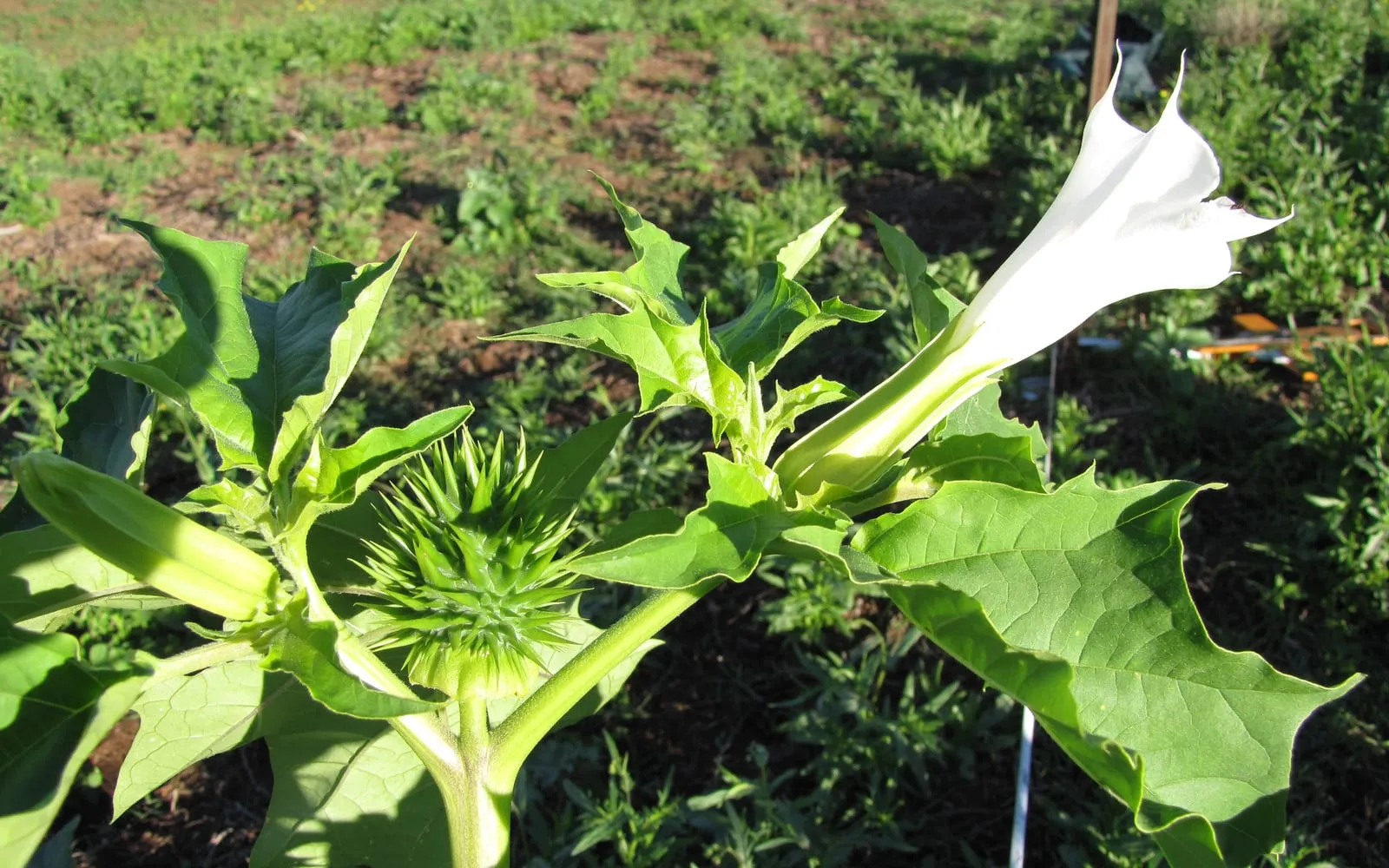
The plant is bushy and forked, branching repeatedly into a Y at each division, reaching a metre or more in a good summer. Stems are stout, smooth, green or purple-flushed, and hollow.
Leaves are large, 10 to 20 cm long, oval in outline but coarsely and irregularly toothed into jagged lobes, thin-textured and slightly greasy to the touch. Crushed they smell strongly and unpleasantly, a rank note that is a reliable warning.
The flowers are the plant’s beauty and the fruit is its signature. Flowers are erect trumpets 6 to 10 cm long, white or flushed violet, opening in the evening with a heavy sweet scent, lasting one night. The fruit is an egg-shaped capsule 3 to 5 cm across, covered in sharp spines, which splits into four to release hundreds of flat black seeds. Nothing else in the temperate flora produces that fruit.
Where it is from
The species is native to Central America and probably Mexico, and it travelled with agriculture and with people. It reached Europe by the sixteenth century and is now naturalised across the warm and temperate world.
In Britain it is a casual rather than an established plant. It appears in warm summers on disturbed rich soil, sets seed if the season is long enough, and is killed by the first frost. Populations rise and fall with the weather.
The seed arrives in several ways. Imported grain and birdseed carry it, contaminated soil and manure move it, and the existing seed bank does the rest. Allotments and market gardens see it most.
How it grows
It behaves as a warm-season annual. Seed germinates in late spring once the soil is warm, growth is fast through midsummer, flowering starts in July and continues until the frost.
Each plant can produce many hundreds of seeds in a good year, in capsules that split on the plant and spill them close by. That is how a single plant becomes a patch the following summer.
Seed longevity in soil is the reason the plant keeps returning. Buried seed remains viable for years, and cultivation brings it back to the surface, which is why the same allotment sees it repeatedly.
Through the seasons
Seedlings appear from late May into July, with two long narrow seed leaves and then the jagged true leaves that identify the plant early.
Flowering runs from July until the frost. Flowers open in the evening and are worked by moths, and each lasts a single night. Capsules follow within weeks and ripen from August.
The first frost kills the plant outright, and the dead stems stand with split capsules through the winter, shedding seed. Removing plants before the capsules ripen is the intervention that matters.
Care difficulty
Nobody should be cultivating this in a garden used by children, pets or livestock. Ornamental daturas and brugmansias are sold and carry the same class of alkaloid, and this species has the additional problem of seeding itself around.
If a plant appears, remove it with gloves before the capsules ripen, and bag the material rather than composting it. Composting spreads viable seed back across the garden.
On an allotment, the practical measures are recognising the seedling, removing plants early, and warning neighbours. A plant that has already shed seed means several more summers of the same job.
Watering
Never plant it deliberately where children or animals have access. That is the only advice this section offers.
The plant is drought tolerant and grows on dry disturbed ground without help. It grows larger on rich moist soil, which is why muck heaps and allotments suit it.
Handling the plant while removing it is the point at which care matters. Gloves, covered arms, and washing afterwards.
Warning signs, diseases and pests
The signs to watch for are the plant itself. A seedling with jagged toothed leaves and a rank smell on disturbed ground in June is worth pulling out at once.
Ripening capsules are the trigger for urgency. Once they split, the seed bank is replenished and the problem persists for years, so removal before August is worth far more than removal in September.
Nothing in Britain eats the plant. Livestock avoid it when other forage exists and are poisoned when it is baled into hay or grows in a bare paddock, and poultry are poisoned by seed in contaminated grain.
Growing environment
Full sun on rich disturbed ground. Allotments, arable field margins, muck heaps, building sites and newly cultivated beds are the classic places.
It needs a warm summer. In a cool wet one plants germinate late, grow poorly and are killed before the seed ripens, which is why the plant is more frequent at the warm end of its range.
It is frost tender and has no overwintering stage other than seed, which is that keeps it from becoming permanently established in a cold climate.
Feeding
Never. Feeding it is not a thing anyone should be doing.
The plant responds strongly to nitrogen-rich soil, which is why muck heaps and manured allotment beds produce the largest specimens.
Where it grows in a vegetable plot, the fertility that suits the crop suits the weed, which is an argument for removing seedlings early rather than for changing how the bed is managed.
Troubleshooting
A child or a pet has eaten some. What do I do? Get medical help or a vet at once. Take a piece of the plant with you and do not wait for symptoms. The seeds are the most concentrated part and as few as fifty have caused serious poisoning in a child.
How do I recognise it? By the fruit above all. An egg-shaped spiny capsule 3 to 5 cm across is unmistakable. Before that, look for jagged toothed leaves, a forked branching habit, a rank smell and large white trumpet flowers that open in the evening.
Why has it appeared on my allotment? Buried seed brought to the surface by cultivation, or seed arriving in manure, birdseed or contaminated soil. Warm summers are when it shows.
How do I get rid of it? Pull plants with gloves before the capsules ripen, bag them and put them in the bin rather than the compost heap. Expect more seedlings for several years from the existing seed bank.
Is it the same as angel’s trumpet? A close relative. Brugmansia, the angel’s trumpet, is a woody shrub with hanging trumpets, and Datura is herbaceous with upright ones. Both contain the same class of alkaloid and both are dangerous.
Can I grow the ornamental daturas safely? They carry the same alkaloids. If you grow them, keep them away from children and animals, remove seed capsules and wear gloves when pruning.
Is it illegal to grow? No. There is no legal restriction on growing it in Britain, which puts the decision entirely on the grower.