
Outdoor plant
Indian Hemp
Apocynum cannabinum
Also known as Hemp dogbane, Dogbane, Indian hemp dogbane
How to recognise Apocynum cannabinum, the hemp dogbane. Milky sap and cardiac glycosides, the bast fibre that made cordage for millennia, and why it is not cannabis.
At a glance
- Difficulty
- Easy
- Water
- Do not introduce it to a garden with livestock
- Light
- Full sun
- Temperature
- Fully hardy, to about minus 30 deg C
- Hardiness
- USDA 3-9, RHS H7, hardy to -30 C
- Type
- Hardy herbaceous perennial from a running rhizome
- Height
- 60-150 cm
- Native to
- North America, from Canada to northern Mexico
The rhizome runs hard enough to make a colony impossible to remove once established, and it is a serious weed of arable land across North America. Cold is no obstacle. Every part carries cardiac glycosides and it has killed grazing stock, so it is not a plant for a paddock edge.
Hardiness zones describe winter cold alone. Summer heat, humidity, rainfall and the length of the growing season decide as much, so treat the range as the outer limit rather than as a recommendation.
Poisonous if eaten
- Do not eat
- Every part, and the milky sap carries it
- Harm from
- Eating it, handling it and sap in the eyes
- Affects
- People, cats, dogs and horses
Apocynum cannabinum contains cardiac glycosides, chiefly cymarin, in the same broad class as the compounds in foxglove and oleander, and it acts on the heart in the same way. NC State Extension lists the species as poisonous, names all parts, and describes the effects. The documented harm is mostly to livestock, which are poisoned by the plant fresh in pasture and, more often, dried in hay, where it stays toxic and where animals cannot avoid it. Sheep, horses and cattle have all been killed by it. The ASPCA carries an entry for Indian hemp, which covers Apocynum androsaemifolium, the spreading dogbane, a related species in the same genus, and the caution transfers. The milky sap irritates skin and is dangerous in the eye, so wear gloves and eye protection if you cut it. Any suspected ingestion by a person or an animal is a medical or veterinary emergency, since cardiac glycoside poisoning affects heart rhythm. Get medical help or a vet at once and take a piece of the plant.
Sources: NC State Extension, Apocynum cannabinum, ASPCA, Indian hemp, a related species in the same genus, RHS potentially harmful garden plants
About
Indian hemp is a confusing name for a plant that has nothing to do with cannabis. The hemp in it refers to fibre. Apocynum cannabinum produces a bast fibre in its stems that is strong, fine and rot-resistant, and indigenous peoples across North America used it for cordage, nets, bowstrings and fishing line for thousands of years. The species epithet cannabinum means hemp-like, and it describes the fibre.
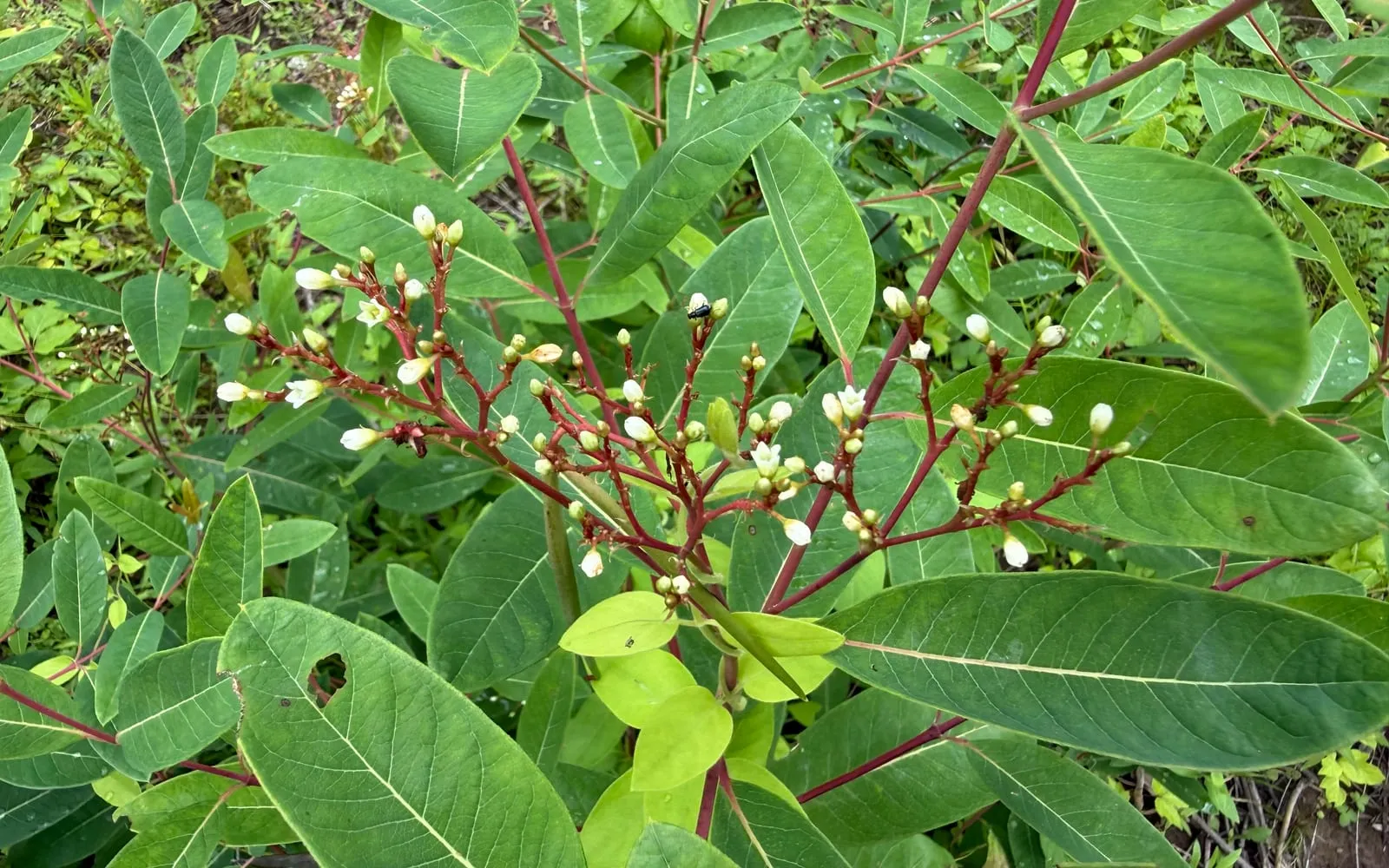
The plant itself is a spreading perennial of riverbanks, roadsides and disturbed ground across North America, standing a metre or more, with reddish stems, milky sap and small greenish-white flowers. It is a serious agricultural weed in the American Midwest and a documented killer of livestock.
In Europe it is not established and is grown only occasionally, usually by people interested in fibre plants. This guide is written for identification, for anyone who meets it in North America or finds it in a collection, and for the fibre history, which is older than most agriculture.
Appearance and character
Stems are upright, smooth, often flushed red or purple, branching in the upper part, and they exude a thick white latex from any cut or broken surface. That milky sap is the quickest field test.
Leaves are opposite, oval to lance-shaped, 5 to 12 cm long, smooth-edged, with a short stalk and a prominent pale midrib, held roughly horizontal. They turn yellow in autumn.
Flowers open from June to August in tight clusters at the stem tips and in the upper leaf axils, each small, 3 to 5 mm across, greenish-white and bell-shaped. The fruit is the distinctive part. Long slender pods 10 to 20 cm long hang in pairs like a wishbone and split to release seeds carried on tufts of silky hairs.
Where it is from
The species is native across most of North America, from southern Canada to northern Mexico, growing on riverbanks, roadsides, field margins, ditches and disturbed ground. It favours open ground with some moisture and tolerates a wide range of soils.
In arable regions of the American Midwest it is a significant weed, spreading by rhizome through no-till fields and difficult to control because cutting and cultivation propagate it from fragments.
The fibre use is ancient and archaeologically documented. Cordage made from Apocynum has been recovered from sites thousands of years old, and the plant was traded between peoples who had it and those who did not.
How it grows
It spreads by a deep running rhizome, sending up shoots along its length, so a single plant becomes a colony and a colony is hard to remove. Rhizome fragments regenerate, which is why cultivation spreads it.
Stems die back to the ground each winter and the dead canes stand through until spring. Growth restarts in late spring, later than many perennials, and flowering follows in midsummer.
The fibre is harvested from mature stems in autumn after the leaves fall, retting them or splitting them by hand to release long bast strands from the outer layer.
Through the seasons
Shoots appear in late spring, which is later than most perennials of similar size.
Flowering runs from June to August, and the small greenish flowers attract a range of insects. The paired pods develop through late summer and split in autumn, releasing silky-tufted seed on the wind.
Stems dry and stand through the winter. That is when the fibre is taken, from stems that have been left to weather, which is how the plant was traditionally processed.
Care difficulty
Growing it is easy and removing it is not, which is the whole difficulty. The running rhizome makes an established colony a long-term commitment.
Anyone growing it for fibre should contain it, ideally in a large bed with a physical barrier, and should keep it well away from grazing animals. Poisoning usually happens through hay rather than through fresh grazing, so any cut material must be kept out of forage.
Removal takes persistence. Digging leaves fragments that regrow, so it means repeated removal across several seasons rather than a single effort.
Watering
Do not introduce it to a garden with livestock nearby. That is the substance of this section.
The plant grows on riverbanks and roadsides and is drought tolerant once established, needing no watering in a temperate climate.
The practical care point is handling. Cutting stems releases milky sap that irritates skin and is dangerous in the eye, so gloves and eye protection are appropriate for any work on it.
Warning signs, diseases and pests
The signs worth watching are about spread. Shoots appearing a metre or more from the original plant mean the rhizome is running, and that is the moment to act rather than later.
Very little attacks the plant, which is unsurprising given the cardiac glycosides. Some specialist insects feed on it, as they do on milkweeds.
The livestock hazard is the standing one. Cut material entering hay is the commonest route to poisoning, since drying does not destroy the glycosides and an animal eating baled hay cannot select around it.
Growing environment
Full sun on almost any soil. It grows on sand, clay and gravel, favours riverbanks and disturbed ground, and tolerates both drought and periodic flooding.
It is fully hardy well below anything a maritime climate produces, surviving minus 30 deg C in its native range.
The one requirement worth naming is containment. A plant that spreads by deep running rhizome needs a position where that is acceptable, or a physical barrier.
Feeding
None. The plant grows vigorously on poor ground and feeding it achieves nothing worth having.
Rich soil produces taller stems, which is of some interest to a fibre grower and of none to anyone else.
Where a colony is being removed rather than grown, avoid disturbing the soil more than necessary, since cultivation fragments the rhizome and multiplies the problem.
Troubleshooting
Is it related to cannabis? No. The name refers to the fibre, which is hemp-like, and cannabinum means hemp-like for that reason. Apocynum cannabinum is in the Apocynaceae alongside oleander and periwinkle.
How do I tell it from milkweed? Both have milky sap and paired pods. Dogbane has small greenish-white bell flowers in loose clusters and slender smooth stems, where common milkweed has large pink-purple flower balls, much broader leaves and warty pods.
Is the sap dangerous? It irritates skin and is dangerous in the eye. Wear gloves and eye protection when cutting the plant and wash afterwards.
Can I still use the fibre? Yes, and people do. Stems are harvested in autumn after the leaves fall, weathered or retted, then split to release long bast strands from the outer layer. The fibre is strong and rot-resistant.
My horse may have eaten some. What do I do? Ring your vet immediately. Cardiac glycoside poisoning affects heart rhythm and is an emergency. Take a piece of the plant with you and check whether any cut material has entered the hay.
How do I get rid of it? With persistence. It spreads by deep running rhizome and regenerates from fragments, so digging alone spreads it. Expect repeated removal over several seasons.
Where is it a problem? North America, where it is a significant agricultural weed. In Europe it turns up in collections and occasionally as a casual, and it is not established.