
Houseplant
Star Begonia
Begonia heracleifolia
Also known as Begonia heracleifolia
How to grow Begonia heracleifolia, the star begonia, a rhizomatous Mexican begonia with deeply cut leaves that spread into pointed lobes like star rays.
At a glance
- Difficulty
- Easy
- Water
- When the top few centimetres of mix have dried
- Light
- Bright indirect light to light shade
- Temperature
- Warm; keep above about 13 deg C
- Humidity
- Average to high
- Hardiness
- USDA 10-12, RHS H1b, hardy to 13 C
- Type
- Perennial
- Height
- 30-50 cm
- Native to
- Mexico, Central America
A tender tropical foliage plant from Mexico and Central America, growing in warm, humid, shaded to filtered light. It needs warmth, humidity and bright indirect light, and it cannot take frost or chill. It is safest above about 13 deg C, and cold, wet compost or dry air spoils it.
Hardiness zones describe winter cold alone. Summer heat, humidity, rainfall and the length of the growing season decide as much, so treat the range as the outer limit rather than as a recommendation.
Harmful if eaten
- Do not eat
- The whole plant, and the underground rhizome most of all
- Harm from
- Eating it and handling it
- Affects
- People, cats, dogs and horses
Begonia heracleifolia, the star begonia, is toxic to cats, dogs and horses. The whole plant holds soluble calcium oxalates, most concentrated in the underground rhizome, and chewing it can burn the mouth and cause drooling and vomiting. The ASPCA lists begonias as toxic to cats, dogs and horses, and the RHS rates them as mildly harmful if eaten and a possible skin irritant. Keep it out of reach of pets and small children, and wash your hands after cutting stems.
Sources: ASPCA toxic and non-toxic plants, RHS potentially harmful garden plants
Meet the star begonia
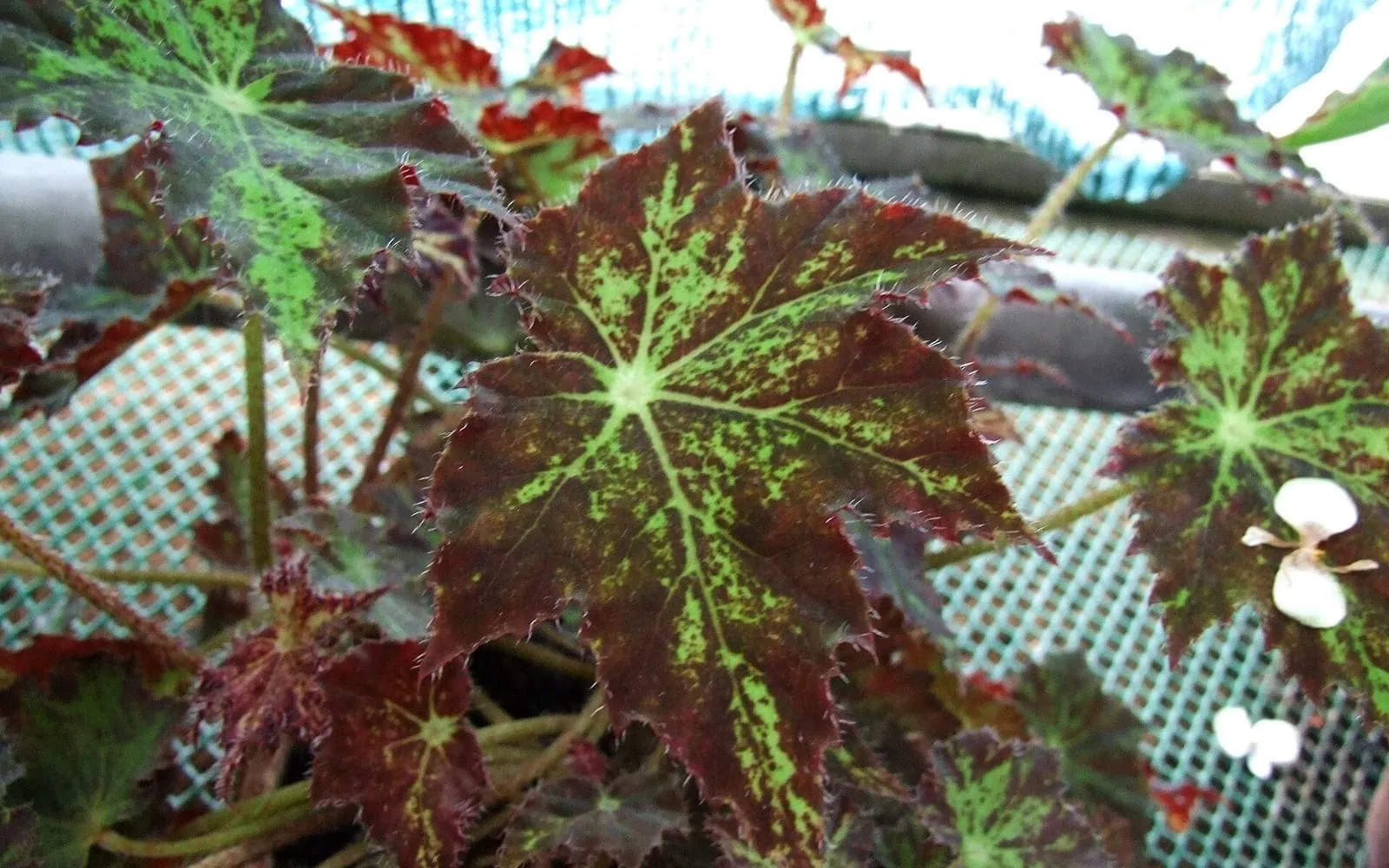
Begonia heracleifolia takes both its common and botanical name from its bold, deeply cut leaves, which spread into pointed lobes like the rays of a star. The species name likens the foliage to the leaf of Heracleum, the hogweeds, whose leaves are lobed in much the same way. It is a rhizomatous begonia from Mexico and Central America, spreading by a thick, hairy stem that creeps over the compost surface and sends up leaf after leaf on tall stalks. A well-grown clump makes a low, layered rosette of star-shaped leaves, with tall stems of pink flowers in winter.
The leaves and flowers
Each leaf is cut two-thirds of the way to the centre into five to nine pointed, jagged lobes, bronze-green above and often flushed red beneath, with a scattering of pale hairs along the edges and stalks. The colouring deepens in good light, with richer bronze and darker lobe edges. From the creeping rhizome the leaves rise on stout, hairy stalks to build a spreading mound. In winter and early spring, tall bare stems rise above the foliage carrying clusters of pink to white flowers. Male and female flowers sit apart on the spray, with the female flowers on the small winged capsule of the genus. This species has long been used as a parent in breeding, passing its bold lobed leaf and tall winter flower stems to many garden hybrids, so a plant labelled star begonia may be the true species or one of its offspring.
Where it comes from
In the wild it grows on shaded, humid rocks, banks and forest floors in Mexico and Central America, with its rhizome creeping through moss and leaf litter and its leaves reaching into broken light. Indoors, that means warmth without cold snaps, humid air around the leaves, and bright light kept off them directly. A shaded, damp, frost-free ledge is the setting to copy.
Light and colour
Bright but indirect light brings out the best bronze colouring and the tightest growth, and it helps the winter flower stems form. An east or north-east window, or a spot set back from a brighter one, gives the right level. In direct summer sun through glass the lobed leaves scorch and fade, while in too little light the colour washes out to plain green, the leaf stalks stretch and the flower stems fail to form. A steady, well-lit place out of direct sun keeps the star pattern clear.
Watering the rhizome
Water when the top of the compost has dried, wetting the mix around the edge and keeping the creeping rhizome itself on the surface instead of buried or constantly wet. The rhizome and the shallow roots rot fast if kept cold and saturated, so let the surface settle towards dry between drinks. A shallow, wide pan suits the surface-running rhizome far better than a deep pot of cold, soggy compost. Water needs fall through winter even as the flower stems rise, so judge by the compost instead of the calendar.
Warmth and humidity
Keep it warm and above about 13 deg C, out of cold draughts. Dry heated air browns the leaf edges and the pointed lobe tips, so raise the humidity with a tray of damp gravel, a plant grouping, or a moist room. Keep some air moving over the low mound so the damp does not sit among the crowded leaf stalks and bring on mould, which the hairy leaves are prone to in stagnant conditions.
Feeding
Feed every couple of weeks through the growing season with a balanced liquid fertiliser at half strength, which keeps the leaves large and the colour rich and helps build the winter flower display. A rhizomatous begonia has a modest root system, so keep the feed dilute instead of strong. Ease off as growth slows and give little over the coolest weeks, even while the flower stems are up.
Propagation
The creeping rhizome makes this a simple plant to multiply. Cut a length of rhizome bearing a leaf or a growing tip, lay it on damp compost and pin it in contact with the surface, and it roots and shoots within weeks. A whole healthy leaf, its main veins nicked and pinned flat to moist compost under cover, will raise plantlets from the cuts. Divide a crowded plant at repotting in spring, giving each rhizome piece a shallow pan of fresh, open mix.
Health and troubles
Given warmth, shade and moist air, the star begonia is an easy, healthy plant. Powdery white patches on the leaves are mildew, brought on by damp, stagnant air; thin the plant and improve ventilation. Mealybugs may hide among the hairy leaf-stalk bases and are dabbed off with dilute alcohol. Grey mould rots leaves left cold and wet. Brown, crisp lobe tips point to air that is too dry, and a soft, browning rhizome means the plant has been kept too wet and cold.
Season by season
Spring brings fresh leaves as flowering ends; divide, take rhizome cuttings and resume feeding.
Summer is steady leafy growth; keep the compost lightly moist, the air humid and the light indirect.
Autumn slows leaf growth as the flower stems begin to form; keep it bright and reduce water.
Winter is the flowering season; give it good light, water sparingly and keep it warm and humid.
Frequently asked
Why has the leaf colour faded to plain green? Too little light. Move it to a brighter spot out of direct sun, and the bronze colouring returns.
When does it flower? In winter and early spring, on tall stems that rise well above the foliage.
How much light does it need? Bright, indirect light; direct sun scorches the lobed leaves and shade drains their colour.
How do I propagate it? Pin a leafy piece of rhizome onto damp compost, or root a whole leaf with its veins nicked.
Is it safe with pets? No. Begonias contain soluble oxalates and the ASPCA lists them as toxic to cats, dogs and horses, so keep it away from pets that chew.
Star Begonia problem guides
Not sure what is wrong? See the common houseplant pests guide.