
Houseplant
Stanhopea
Stanhopea tigrina
Also known as Tiger Stanhopea
How to grow Stanhopea, Stanhopea tigrina, including its downward-growing flower spike, huge waxy blooms lasting only a few days, and its need for a slatted hanging basket.
At a glance
- Difficulty
- Difficult
- Water
- Water generously through the growing season, easing off slightly through a cooler winter
- Light
- Bright indirect light, no direct midday sun
- Temperature
- 15-28 deg C
- Humidity
- 60-80 percent
- Hardiness
- USDA 10-11, RHS H1c, hardy to 10 C
- Type
- Evergreen epiphytic perennial orchid
- Height
- 30-40 cm, with pendant flower spikes growing straight downward
- Native to
- Mexico
Native to cloud forest in Mexico, warm and humid for most of the year with a cooler, drier stretch that eases growth without stopping it outright. The zone number says nothing about the one requirement that decides whether this species can flower at all in cultivation, which is a container that lets its flower spike grow straight down and out into open air rather than blocking it against solid pot walls or a compacted mix.
Hardiness zones describe winter cold alone. Summer heat, humidity, rainfall and the length of the growing season decide as much, so treat the range as the outer limit rather than as a recommendation.
Not known to be toxic
Stanhopea has no toxicity listing from the RHS or the ASPCA, and orchids of this kind carry an unusually clean safety record among houseplants generally. No part of the plant is documented as harmful to cats, dogs or people if chewed, and there is no recorded history of poisoning associated with the species.
Source: ASPCA
About
Stanhopea flowers downward, and growing it well means designing the whole setup around that habit. The flower spike does not rise above the foliage the way almost every other orchid’s does; it pushes straight down out of the base of the pseudobulb, through the potting medium, and out the bottom of the container. Grown in an ordinary solid pot, the spike cannot get out, bends against the pot wall, and aborts before it ever opens. The whole plant is grown in an open-slat hanging basket, or on a mount, specifically to give that downward spike somewhere to go.
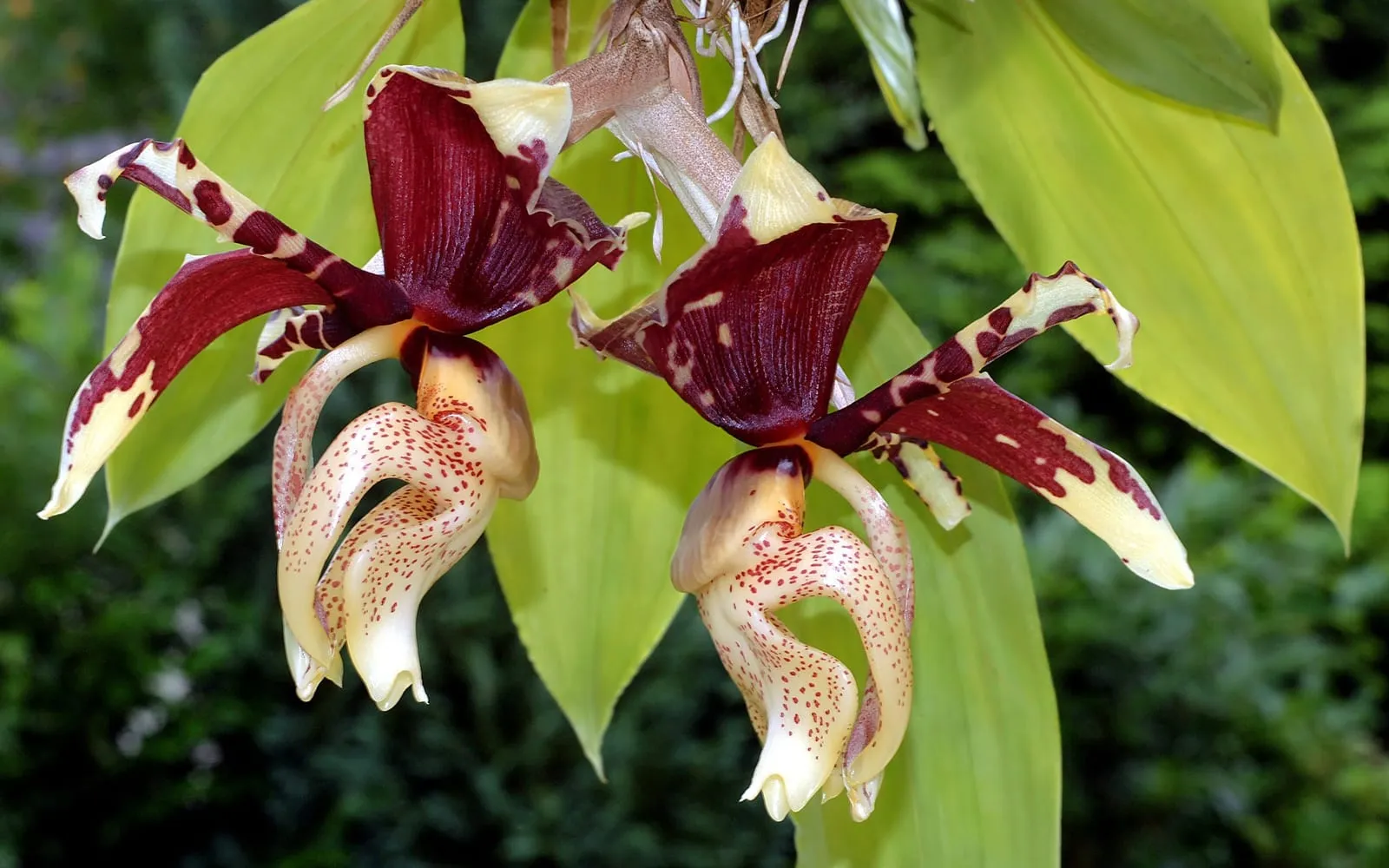
The flowers themselves reward the trouble. Huge by orchid standards, often 12 to 15 cm across, waxy and heavily marked with tiger-like blotches of maroon on a cream or yellow ground, and carrying a powerful, sweet fragrance that can fill a room. They are also famously short-lived, usually lasting only two to three days before collapsing, so a flowering event is closer to a brief occasion than a lasting display.
Appearance and character
Growth comes from clustered, sharply ribbed pseudobulbs, each carrying a single broad, strongly pleated leaf that can reach 30 cm or more. The pleating in the leaf, running lengthwise like an accordion fold, is a normal structural feature of the plant rather than a sign of thirst.
Flower spikes emerge from the base of a mature pseudobulb and immediately head downward, pushing through the mix and out through the basket’s slats or open sides before the buds swell and open. Each spike typically carries two to five flowers, waxy and heavily patterned, opening within hours of each other and filling the surrounding air with fragrance until they collapse just a few days later.
Where it is from
Stanhopea tigrina grows in the cloud forest of Mexico, on tree trunks and larger branches at moderate elevation, where humidity stays high for most of the year and a milder, somewhat drier stretch eases growth without stopping it entirely. Roots typically run over the surface of whatever the plant grows on rather than digging deep into soil, an epiphytic habit reflected in the coarse, fast-draining mix this species needs in cultivation.
The downward growth habit of the flower spike is thought to have developed alongside the plant’s pollinators, male orchid bees that visit the flower in search of fragrance compounds rather than nectar, and a spike aimed down and out from the trunk keeps the flowers clear of the bark and readily accessible to a bee approaching from below or the side.
How it grows
Grow it in an open-slat wooden hanging basket, or mounted on bark, never in a solid pot, since the downward-growing flower spike must have a clear path out of the growing medium. A slatted basket filled loosely with coarse bark or sphagnum gives the spike room to find a gap and push through, which a compacted mix in a closed container does not allow.
New pseudobulbs form at the base of the clump through the warmer months, each one eventually capable of producing a downward spike once mature. Because flowering can happen from any side or the bottom of the basket without warning, position the basket where a spike emerging unexpectedly from underneath will still be visible rather than hidden against a wall or shelf.
Repot, or rather rebasket, only when necessary, since the plant dislikes root disturbance and takes some time to settle afterward. Moving an established plant into a new basket the same size, rather than a larger one, usually causes less setback than a big jump in container size.
Through the seasons
Spring brings new pseudobulb growth as the plant enters its main growing period. Water generously as new growth develops.
Summer is the peak growing and flowering season, when spikes most commonly appear and push their way down and out of the basket. Watch closely, since a spike can appear from an unexpected angle and open within days.
Autumn growth slows gradually into a milder, somewhat drier stretch. Ease off watering slightly, though not as sharply as for a species with a pronounced dry rest.
Winter brings a quieter period overall, with occasional flowering still possible on some plants. Keep the basket warm and reasonably humid even as watering eases back.
Care difficulty
Difficult, and the difficulty is almost entirely about the container rather than day-to-day care. An open-slat hanging basket is essential and non-negotiable, since a plant grown in a conventional pot may build healthy pseudobulbs for years while every flower spike aborts against the pot wall, leaving a grower with no idea why a seemingly healthy plant never flowers.
Watering
Water generously through the growing season, since the open basket drains quickly and rarely holds excess moisture the way a solid pot might. Ease off slightly through the cooler, milder autumn and winter stretch, though this species has no pronounced full dry rest the way a Laelia or coconut orchid does.
Because the basket is open on multiple sides, this species dries out faster between waterings than a potted orchid of similar size, and watering frequency should be judged by how quickly the mix dries rather than by a fixed schedule.
Warning signs, diseases and pests
Scale insects and mealybugs can settle among the crowded pseudobulbs, appearing as small brown bumps or cottony white tufts; check regularly, since the dense clustering makes an early infestation easy to overlook. Spider mites occasionally appear in warm, dry indoor air, showing as fine speckling on the leaves.
Slugs and snails are drawn to the exposed, damp mix in an open basket and can damage soft new growth or even a developing flower spike overnight; check the basket after dark if damage appears without an obvious daytime cause. Soft, blackened tissue at the base of a pseudobulb points to rot, usually from a mix that has stayed waterlogged despite the basket’s drainage; cut away affected tissue and repot into fresh, open mix.
The most common problem with this species is not a pest or disease at all: a flower spike growing straight into a solid pot wall or compacted mix, bending and aborting before it can open. There is no treatment for this beyond correcting the growing setup, since a spike that has already failed will not recover, but the next one from a properly basketed plant should succeed.
Growing environment
Bright indirect light suits this species, with direct midday sun avoided since it scorches the broad, pleated leaves; a lightly shaded spot near a bright window, or filtered light beneath a larger plant, usually works well. High humidity, in the 60 to 80 percent range, supports both the roots and the short-lived flowers, which fade faster in dry air.
Good air movement around the open basket matters more here than for a potted orchid, since the exposed roots and mix benefit from the airflow that keeps them from staying damp for too long after a soak.
Feeding
A balanced orchid fertiliser at quarter strength, applied every second watering through the growing season, supports steady pseudobulb production. Because the open basket drains and dries quickly, feeding at every watering during the warmest months, still at a dilute strength, suits many growers better than skipping every other one.
Reduce feeding through the cooler, quieter months as growth slows, resuming the fuller routine as new pseudobulbs begin forming again in spring.
Troubleshooting
A flower spike appeared and then stopped growing, pressed against the inside of the container. The plant is not in an open-slat basket. This species must be grown in a hanging basket with wide gaps or mounted on bark, since the flower spike grows straight down and needs a clear path out of the growing medium.
The flowers only lasted two or three days. This is normal for the species. Stanhopea flowers are famously short-lived, and a spike opening and collapsing within days is expected rather than a sign anything went wrong.
A pseudobulb has gone soft at the base. Rot, usually from a mix that has stayed waterlogged despite the basket’s drainage. Cut away the affected tissue with a clean blade and repot into fresh, open mix.
Why does the plant need a hanging basket instead of a normal pot? Because its flower spike grows downward rather than upward, unlike almost every other orchid. A solid pot blocks the spike’s path completely, so a slatted basket or a mount is the only setup that lets it flower.
The flowers have an intense, sweet fragrance that seems to change through the day. Normal. Fragrance intensity in this species often shifts with temperature and time of day, typically strongest in warmth, and is part of what draws its bee pollinators to the flower in the wild.
Slugs have damaged a new growth or developing spike. Check the basket after dark, since slugs and snails are drawn to the exposed, damp mix an open basket exposes more than a solid pot would. Remove them by hand and consider a physical barrier around the hanging point if the problem recurs.
Stanhopea problem guides
Not sure what is wrong? See the common houseplant pests guide.