
Houseplant
Short-Spiked Sarcophrynium Prayer Plant
Sarcophrynium brachystachyum
Also known as Sarcophrynium brachystachyum
How to grow Sarcophrynium brachystachyum, the short-spiked sarcophrynium prayer plant, a large-leaved west African forest herb.
At a glance
- Difficulty
- Easy
- Water
- When the top few centimetres of mix have dried
- Light
- Bright indirect light to light shade
- Temperature
- Warm; keep above about 13 deg C
- Humidity
- Average to high
- Hardiness
- USDA 10-12, RHS H1b, hardy to 13 C
- Type
- Perennial
- Height
- 1-2 m
- Native to
- tropical Africa
A tender tropical foliage plant from tropical Africa, growing in warm, humid, shaded to filtered light. It needs warmth, humidity and bright indirect light, and it cannot take frost or chill. It is safest above about 13 deg C, and cold, wet compost or dry air spoils it.
Hardiness zones describe winter cold alone. Summer heat, humidity, rainfall and the length of the growing season decide as much, so treat the range as the outer limit rather than as a recommendation.
Not known to be toxic
Sarcophrynium brachystachyum, the short-spiked sarcophrynium prayer plant, is not recorded among the seriously toxic plants, and related plants in its group are not listed as toxic by the ASPCA or the RHS. A pet or child that chewed a leaf would be unlikely to come to serious harm beyond a possible mild stomach upset.
Sources: ASPCA toxic and non-toxic plants, RHS potentially harmful garden plants
The short-spiked member of the group
Sarcophrynium brachystachyum is a large-leaved herb of west African forest, one of a handful of Sarcophrynium species that gardeners rarely meet outside specialist collections. It spreads by a creeping rhizome into colonies on the forest floor, sending up big blades on long stalks. It is not a dainty or heavily marked plant; the appeal is its size, bold foliage and bright fleshy fruit. Anyone growing it should expect a spreading, vigorous plant rather than a compact pot specimen.
What its name records
The species name brachystachyum means “short-spiked”, built from the Greek for short and for a spike or ear. It refers to the length of the inflorescence compared with relatives that carry a longer flower spike. Sarcophrynium, the genus name, comes from the Greek “sarco”, flesh, and refers to the soft fruits the group produces. Read together, the name describes a fleshy-fruited prayer-plant relative with a short flower spike.
Foliage and fruit
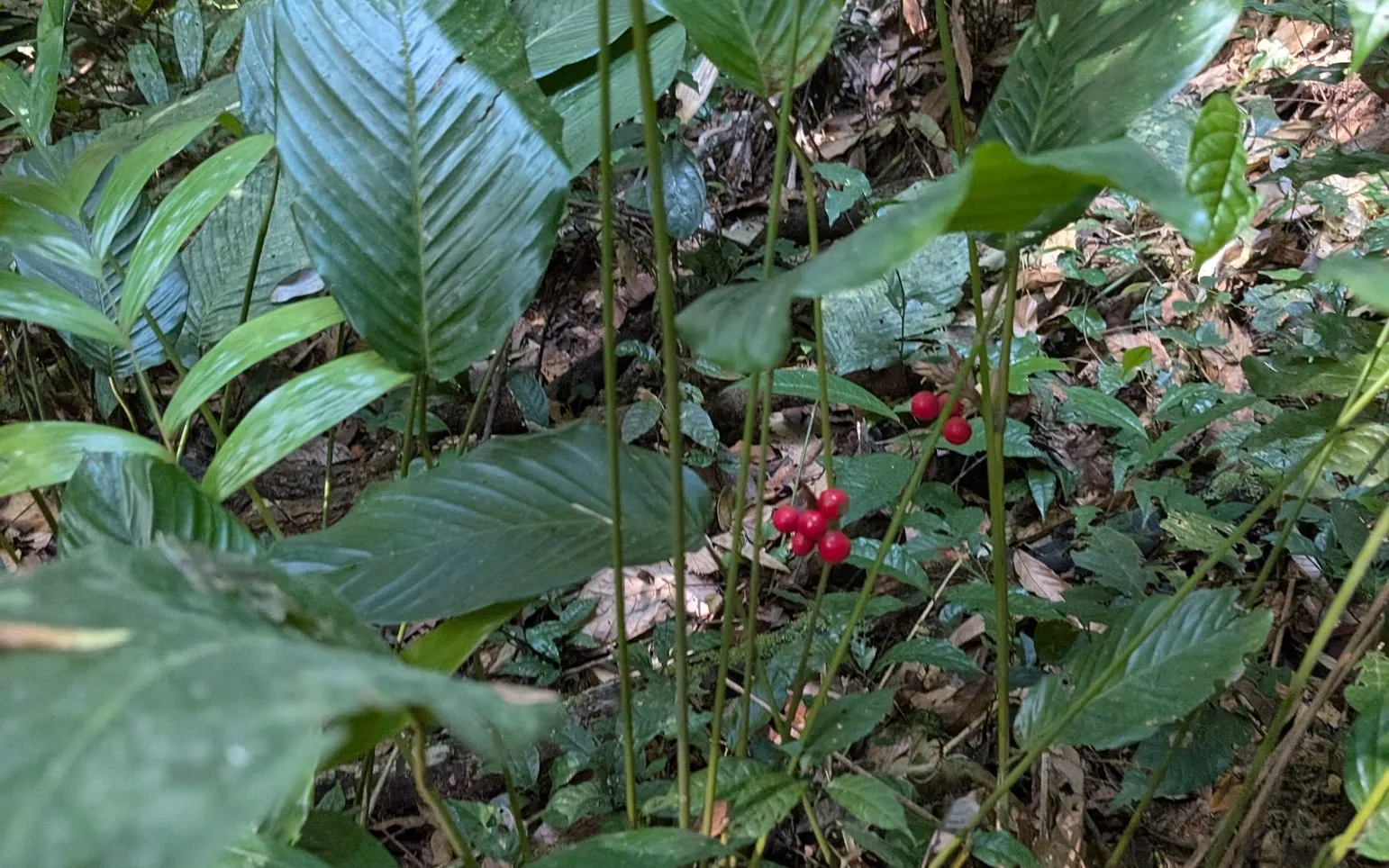
The blades are broad and oval, held well up on stalks that grow straight from the rhizome. Each stalk carries the pulvinus, a short swollen joint, where it joins the leaf. That joint angles the blade towards light and controls the daily leaf movement common to the family. After flowering, the plant sets fleshy fruits that often ripen a reddish colour, standing out against the green leaves. A young blade unrolls from a tube and thickens as it hardens off. The blades run 20 to 40 cm long on sheathing stalks that can reach a metre and a half, and the near-globular orange-red fruit, about 12 to 15 mm across, holds three seeds.
The nightly movement
At dusk the leaves lift and fold together. By the middle of the morning, they have opened out and flattened again. This daily rhythm is called nyctinasty. It works through the pulvinus at each leaf base, where cells take in and release water. The change in pressure moves the blade up or down. Regular movement usually means the plant is warm and watered; leaves held rigid and still usually mean it is cold or dry.
Where it lives and how it is used
The plant grows across the shaded floor of west African rainforest, forming stands in clearings and along damp margins where light reaches the ground. Its broad, tough leaves are cut throughout the region as natural packaging for food and produce, and are also used in roofing and lining simple structures. Its wild habitat stays warm, wet and shaded beneath tall trees all year, with no cold season. Under glass, a grower has to recreate that pattern as closely as possible. It grows from Senegal east to the Central African Republic and DR Congo, and even turns up as a weed in oil palm plantations. In Cameroon the leaves are worked into cushions, plates, mats, fans and parasols, and in Nigeria dried leaves are stored among kola nuts to keep them fresh.
Getting the light right
Give it bright light that never falls straight onto the leaf, roughly what reaches a spot set back from a sunny window or screened by a thin curtain. Direct sun through glass burns and blanches the large blades, while a gloomy corner slows growth and stretches the stalks thin and weak. An east or north aspect usually gives the right balance. Turn the pot from time to time so the clump grows evenly instead of leaning.
Watering
Wait until the top few centimetres of compost feel dry, then soak the rootball and let the excess drain right through, leaving the roots damp and never flooded. The quickest way to lose it is to let it stand in cold, sodden compost, which rots the roots, so keep drainage sharp. Like many prayer-plant relatives, it dislikes hard water, which can scorch the leaf edges over time, so rainwater or filtered water is better. Ease well back on watering through winter.
Warmth and humid air
Keep it warm and settled, above about 13 deg C, and shield it from cold draughts and the chilled air beside a winter window. Because the foliage is broad, dry room air browns the margins quickly, so raise the humidity with a wide gravel tray, a group of leafy neighbours or a humidifier close by. A little air movement helps, as long as it is not cold.
Compost, feeding and propagation
Pot it into a loose, peat-free mix bulked out with bark, coir and perlite so water clears quickly and air gets to the roots. Feed fortnightly through the growing months with a balanced liquid fertiliser at half the label strength, and hold off entirely in winter. As a strong, spreading grower it will outgrow its pot faster than many houseplants, so pot on in spring. To propagate it, split the clump then, giving each piece healthy roots and a shoot; stem sections taken in warmth will also root.
Trouble signs
A wilting plant in wet, sour compost usually has cold, rotting roots. Dry it out and improve the drainage. Brittle brown edges follow dry air or hard-water build-up. Warm, dry conditions bring spider mites, which fleck the undersides and spin faint webbing, and mealybugs, which tuck white waxy tufts into the leaf joints. Rinse the foliage, raise the humidity, and clear the pests with cotton wool moistened in dilute surgical spirit.
Around pets and children
No record lists this plant or its family among the seriously poisonous ones, and its close relatives are noted as safe around cats and dogs. A chewed leaf is unlikely to cause more than a mild, passing stomach upset. The ASPCA lists the related Calathea and Maranta as non-toxic. A chewed leaf can still upset a stomach, so keep a determined chewer away from it.
Questions growers ask
What does “short-spiked” refer to? The flower spike, which is shorter than those of some of its relatives, and which the species name records.
What colour is the fruit? The fleshy fruits often ripen a reddish shade, standing out against the leaves.
Why are the leaf edges browning? Dry air or hard water. Raise the humidity and water with rainwater or filtered water.
How do I propagate it? Split the rhizome clump in spring, keeping roots and a shoot on each division.
Short-Spiked Sarcophrynium Prayer Plant problem guides
Not sure what is wrong? See the common houseplant pests guide.