
Houseplant
Scarlet Lady'S Tresses
Dichromanthus cinnabarinus
Also known as Dichromanthus cinnabarinus
How to grow Dichromanthus cinnabarinus, the scarlet lady's tresses, a Mexican highland orchid with cinnabar-red flowers that suit a bird pollinator.
At a glance
- Difficulty
- Difficult
- Water
- Evenly moist in growth; ease off for any rest
- Light
- Full sun to bright light
- Temperature
- Warm days, cool nights; dry and cool in winter rest
- Humidity
- Average; dry in the winter rest
- Hardiness
- USDA 9-10, RHS H3, hardy to -2 C
- Type
- Perennial
- Height
- 20-60 cm
- Native to
- Mexico, Central America
A highland orchid from Mexico and Central America, growing in pine-oak woodland and grassland at middle to high elevation. It grows in the summer rains and rests dry and cool through winter, and in that rest it tolerates light frost. Wet winter compost rots its fleshy roots, and warm, humid nights give it no rest.
Hardiness zones describe winter cold alone. Summer heat, humidity, rainfall and the length of the growing season decide as much, so treat the range as the outer limit rather than as a recommendation.
Not known to be toxic
Dichromanthus cinnabarinus, the scarlet lady's tresses, is not recorded among the seriously toxic plants, and related plants in its group are not listed as toxic by the ASPCA or the RHS. A pet or child that chewed a leaf would be unlikely to come to serious harm beyond a possible mild stomach upset.
Sources: ASPCA toxic and non-toxic plants, RHS potentially harmful garden plants
About
Dichromanthus cinnabarinus, the scarlet lady’s tresses, is a striking terrestrial orchid of the Mexican and Central American highlands, and one of the few in its family to flower in bright red. It belongs to the lady’s tresses group, whose flowers spiral around an upright spike, and its blooms are a vivid cinnabar to orange-red that stands out on a grassy slope. The plant grows from thickened, fleshy roots, produces a rosette of leaves, and is adapted to a summer-rainfall climate, growing in the wet season and resting through the dry winter. Its red colour points to bird pollination instead of insect pollination. This guide explains how to recognise it and the highland, seasonally dry conditions its cultivation would need.
Appearance and character
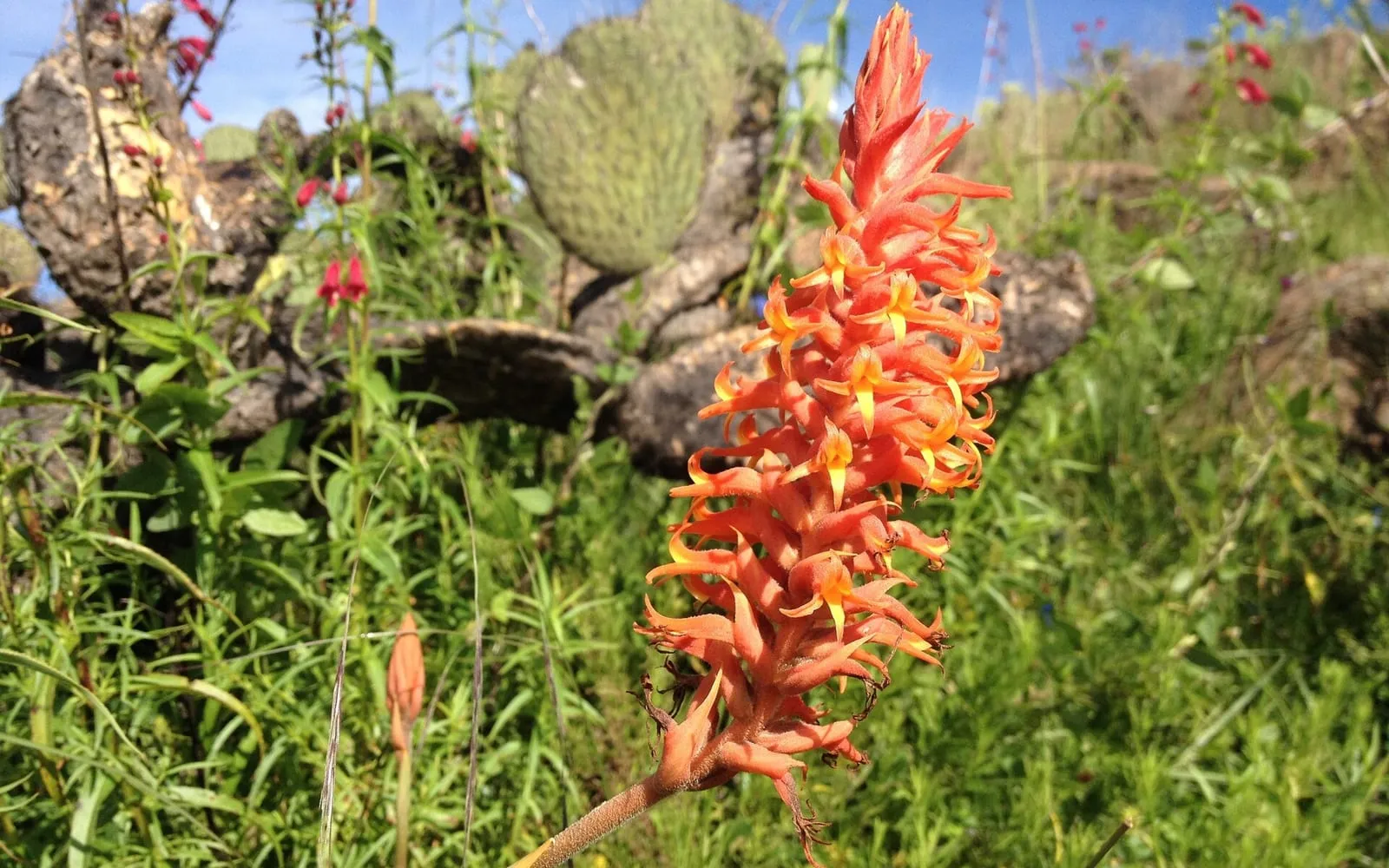
The plant forms a basal rosette of narrow to lance-shaped leaves and sends up a tall, upright flowering spike on which the blooms are arranged in the spiralled ranks that give the lady’s tresses their name. The flowers are tubular and vivid scarlet to orange-red, sometimes with a yellow throat, held outward from the spike. That intense red is unusual among terrestrial orchids and is the plant’s most memorable feature. Below ground it has clustered, fleshy, somewhat tuberous roots instead of the single round tuber of the African geophytes, and these store the plant through its dry rest.
Where it is from
The species is native to Mexico and Central America, growing in pine-oak woodland, grassland and on rocky slopes, mostly at middle to high elevations. Its climate has summer rains and a dry winter, warm days and often cool nights, so the orchid grows and flowers through the wet summer and rests during the dry cool season. The vivid red flowers suit hummingbird pollination, common in its range, and its highland origin means it needs strong light, warm days, cool nights and a clear alternation of a wet growing season and a dry rest.
How it grows
Growth comes each year from fleshy tuberous roots, with the rosette and then the tall spike developing through the summer rains before the plant sets seed and dies back for the dry winter. Hummingbirds visiting the scarlet flowers carry pollen between plants, helped by the colour and the tubular shape. Fine seed germinates in the wild with the aid of soil fungi, and established plants can slowly increase their root clusters. Any attempt to grow it needs to reproduce its summer-wet, winter-dry highland cycle, with bright light and cool nights.
Through the seasons
Onset of the summer rains starts the fleshy roots into growth, and the rosette and flower spike develop as warmth and moisture arrive.
Height of the wet season is when the scarlet spike stands up and the hummingbird-pollinated flowers open.
End of the rains turns the foliage yellow and the plant heads towards its dry rest.
Dry cool winter is dormancy, the fleshy roots kept largely dry until the summer rains return.
Care difficulty
This is a difficult orchid for the specialist. It needs bright light, warm days and cool nights, a wet summer growing season, a dry winter rest and a sharply drained gritty medium, and it dislikes both stagnant wet and a warm sodden dormancy. The practical difficulty is combining strong light and warm-day, cool-night highland conditions with a well-timed dry rest, which is demanding indoors. Match its montane summer-rainfall cycle and it can be grown; blur the seasons and it declines.
Watering
Watering follows the summer rains and stops for the dry winter. Begin as the growing season starts, keeping the gritty medium moist while the rosette and spike develop, using low-mineral water and ensuring sharp drainage so the fleshy roots never stand in stagnant wet. As the foliage yellows towards winter, reduce and then withhold water, keeping the roots dry and cool through dormancy with at most an occasional light trace to stop them shrivelling entirely. The plant’s own growth is a surer guide than the calendar.
Warning signs, diseases and pests
Rotting fleshy roots come from a medium kept wet during the dry rest or from stagnant conditions in growth. Correct this with sharper drainage and a proper dry dormancy. Weak growth and no spike point to too little light or a missed rest. Under glass, aphids attack the developing spike, mealybugs and scale hide in the rosette, and spider mites appear in hot dry air. Remove light infestations by hand, treat heavier ones with a suitable control, and give strong light with cool nights and good ventilation.
Growing environment
Provide bright light, warm days and distinctly cool nights, in the manner of a bright cool-intermediate greenhouse, matching a montane pine-oak setting. The medium should be gritty and very free-draining, based on coarse sand, grit and a little fibre, imitating a stony highland soil. A dry winter rest is essential. Deep shade and warm stagnant conditions are both unsuitable, since the plant comes from sunny slopes with a marked dry season and a swing between warm days and cool nights.
Feeding
Feed lightly during the summer growing season. A very dilute balanced feed given occasionally while the rosette and spike are active suits the lean highland soils it grows in, and heavy feeding leaves harmful salts. Stop feeding as the foliage yellows towards the dry rest, and give none through the winter dormancy.
Troubleshooting
Why are the flowers red? The vivid scarlet colour and tubular shape are adaptations to hummingbird pollination, common in its highland range.
Why are they arranged in a spiral? It is a member of the lady’s tresses group, whose flowers spiral around the upright spike.
Is a leafless winter pot dead? Not if the fleshy roots are firm. Dry-winter dormancy is natural, so keep it dry and cool until the summer rains.
How do I propagate it? By slow division of the fleshy root clusters; seed needs specific soil fungi and rarely germinates in ordinary pots.
Is it toxic to pets? No serious toxicity is recorded for the genus, but keep pets from chewing it as a precaution.
Scarlet Lady'S Tresses problem guides
Not sure what is wrong? See the common houseplant pests guide.