
Houseplant
Hairy Holothrix
Holothrix villosa
Also known as Holothrix villosa
How to grow Holothrix villosa, the hairy holothrix, a small African orchid with two hairy ground-hugging leaves and fringed flowers.
At a glance
- Difficulty
- Difficult
- Water
- Evenly moist in growth; ease off for any rest
- Light
- Bright indirect light
- Temperature
- Warm; keep above about 10 deg C
- Humidity
- High
- Hardiness
- USDA 10-12, RHS H1c, hardy to 10 C
- Type
- Perennial
- Height
- 10-25 cm
- Native to
- southern and tropical Africa
An orchid from southern and tropical Africa, grown in an open, bark-based or free-draining medium. It needs bright filtered light, an open root run, even moisture in growth and the seasonal rest of its origin. It is kept in the temperatures its origin suggests and frost-free unless known to be hardy.
Hardiness zones describe winter cold alone. Summer heat, humidity, rainfall and the length of the growing season decide as much, so treat the range as the outer limit rather than as a recommendation.
Not known to be toxic
Holothrix villosa, the hairy holothrix, is not recorded among the seriously toxic plants, and related plants in its group are not listed as toxic by the ASPCA or the RHS. A pet or child that chewed a leaf would be unlikely to have more than a possible mild stomach upset.
Sources: ASPCA toxic and non-toxic plants, RHS potentially harmful garden plants
About
Holothrix villosa is a small terrestrial orchid of southern and tropical Africa, its species name meaning shaggy or hairy, which describes both its leaves and its flowering stem. It belongs to a genus of little ground orchids that grow on rocky outcrops and shallow soils, growing from a small tuber and appearing seasonally. It has a pair of rounded, hairy leaves pressed flat against the ground and a hairy stem bearing small flowers whose petals are divided into fine fringe-like lobes. By the time it flowers, the leaves have often already withered. Its care follows that rock-dwelling, seasonal life.
Appearance and character
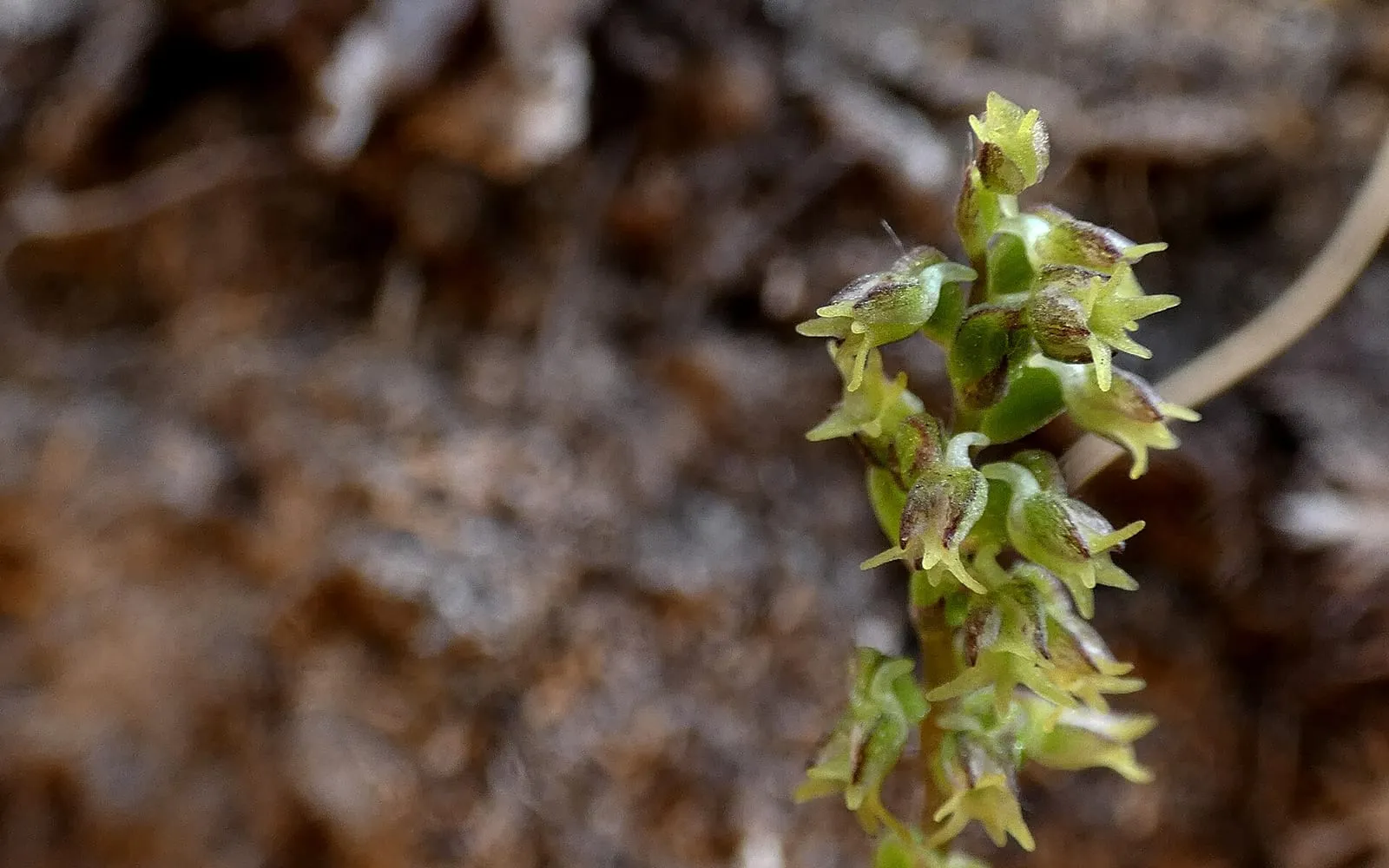
The most distinctive feature is the foliage. Usually two rounded, more or less circular leaves lie flat on the soil surface, softly hairy and visible against bare rock. From between them rises a hairy flowering stem carrying a spike of small flowers, greenish to whitish, in which the petals and lip are cut into narrow, finger-like segments that give the bloom a fringed look. A small underground tuber stores the plant through dormancy. The hairiness, flat ground-pressed leaves and fringed little flowers identify the orchid once found.
Where it is from
The species is native to southern and tropical Africa, growing on rocky outcrops, in shallow soil pockets among rocks and on stony slopes, where seasonal moisture collects and then drains away quickly. It ranges from near sea level to about 2,000 metres, and two varieties are recognised, with var. condensata keeping mostly to lower ground between about 400 and 1,000 metres. Its climate brings a distinct wet growing season and a dry rest, and depending on region that growth may fall in the cooler or the warmer part of the year. Its rock-dwelling habit means it needs shallow, gritty, extremely free-draining conditions, moisture while in growth and near-complete dryness while dormant, like thin soil over stone.
How it grows
The plant renews itself annually from a small tuber. The rounded hairy leaves appear with the rains, the plant photosynthesises to recharge the tuber, and a hairy flower spike follows, frequently after the leaves have begun to shrivel, before the whole plant dies back for the dry season. Fine seed depends on soil fungi to germinate in the wild, and increase is otherwise slow, by tuber. Its life is closely tied to seasonal moisture on rocky ground, so cultivation depends on a sharp wet-then-dry cycle over a gritty shallow medium.
Through the seasons
Start of the wet season starts growth from the tuber, and the pair of rounded hairy leaves unfolds flat on the medium.
Growing season proper sees the leaves feed the tuber, and the hairy flower spike often rises as the foliage begins to age.
End of the rains completes the die-back, the leaves and stem withering as moisture fades.
Dry season is dormancy, the tuber kept dry in its shallow gritty medium until the rains return.
Care difficulty
This is a difficult plant for anyone but a dedicated grower of African terrestrials. It needs a shallow, gritty, sharply drained medium, bright light, moisture only during its growing season and a thoroughly dry rest, and it rots readily if kept wet while dormant. The practical difficulty is that its leaves often wither at flowering and its whole cycle is brief and tied to rock-pocket conditions, so it gives little sustained display for considerable care. Match its habitat closely and it can survive; treat it as an ordinary pot plant and it will not persist.
Watering
Watering follows the short growing season. Begin as the rains would arrive, keeping the shallow gritty medium moist but always draining instantly so no water lingers around the tuber, and continue while the leaves and spike are active. As the foliage withers, reduce watering, then withhold it almost entirely through the dry dormancy, giving at most a rare light watering to stop the small tuber drying out completely. Rainwater or another low-mineral source spares the fine roots the salts of hard water.
Warning signs, diseases and pests
A soft tuber or dark rotting roots come from a medium held too wet, above all during the dry rest. Move the plant to drier, grittier, shallower conditions. Leaves that shrivel early are normal. Under glass, aphids may attack the soft spike, and fungus gnats breed in a medium kept too wet. Keep the growing area bright and airy, water only in season, and handle the small plant gently.
Growing environment
Provide bright light and a shallow, extremely free-draining medium of grit, coarse sand and a little fibre over good drainage, imitating the thin soil of a rocky outcrop. Good ventilation helps prevent rot on the hairy foliage. The temperature regime should match the plant’s provenance, warm or cool according to region, with a dry rest at the appropriate season. Deep shade and heavy water-holding compost are both unsuitable, since the plant needs bright, airy, mineral conditions.
Feeding
Feed very sparingly. The shallow rocky soils it grows in are poor, so a highly dilute balanced feed once or twice during the short growing season is enough. Strong feeding leaves salt residues that harm the fine roots and encourages soft growth prone to rot. Give no feed during the dry dormancy, when the resting tuber is not making active growth.
Troubleshooting
Why have the leaves withered before flowering? That is often natural in this species, whose rounded hairy leaves regularly age as the flower spike rises.
Why is it so hairy? The dense hairs on leaves and stem give the species its name, villosa, and are a normal feature of the plant.
Is a dormant, leafless pot dead? Not if the small tuber is firm. Dry-season dormancy is natural, so keep it dry until the rains return.
How do I propagate it? Mainly by slow tuber increase; seed depends on specific soil fungi and rarely germinates in ordinary pots.
Is it toxic to pets? No serious toxicity is recorded for the genus, but keep pets from chewing it as a precaution.
Hairy Holothrix problem guides
Not sure what is wrong? See the common houseplant pests guide.