
Houseplant
Pale Reed Orchid
Bromheadia finlaysoniana
Also known as Bromheadia finlaysoniana
How to grow Bromheadia finlaysoniana, the pale reed orchid, a Southeast Asian orchid whose whole population flowers on the same day.
At a glance
- Difficulty
- Difficult
- Water
- Evenly moist in growth; ease off for any rest
- Light
- Bright indirect light
- Temperature
- Warm; keep above about 10 deg C
- Humidity
- High
- Hardiness
- USDA 10-12, RHS H1c, hardy to 10 C
- Type
- Perennial
- Height
- 60-150 cm
- Native to
- Southeast Asia
An orchid from Southeast Asia, grown in an open, bark-based or free-draining medium. It needs bright filtered light, an open root run, even moisture in growth and the seasonal rest of its origin. It is kept in the temperatures its origin suggests and frost-free unless known to be hardy.
Hardiness zones describe winter cold alone. Summer heat, humidity, rainfall and the length of the growing season decide as much, so treat the range as the outer limit rather than as a recommendation.
Not known to be toxic
Bromheadia finlaysoniana, the pale reed orchid, is not recorded among the seriously toxic plants, and related plants in its group are not listed as toxic by the ASPCA or the RHS. A pet or child that chewed a leaf would be unlikely to come to real harm beyond a possible mild stomach upset.
Sources: ASPCA toxic and non-toxic plants, RHS potentially harmful garden plants
About
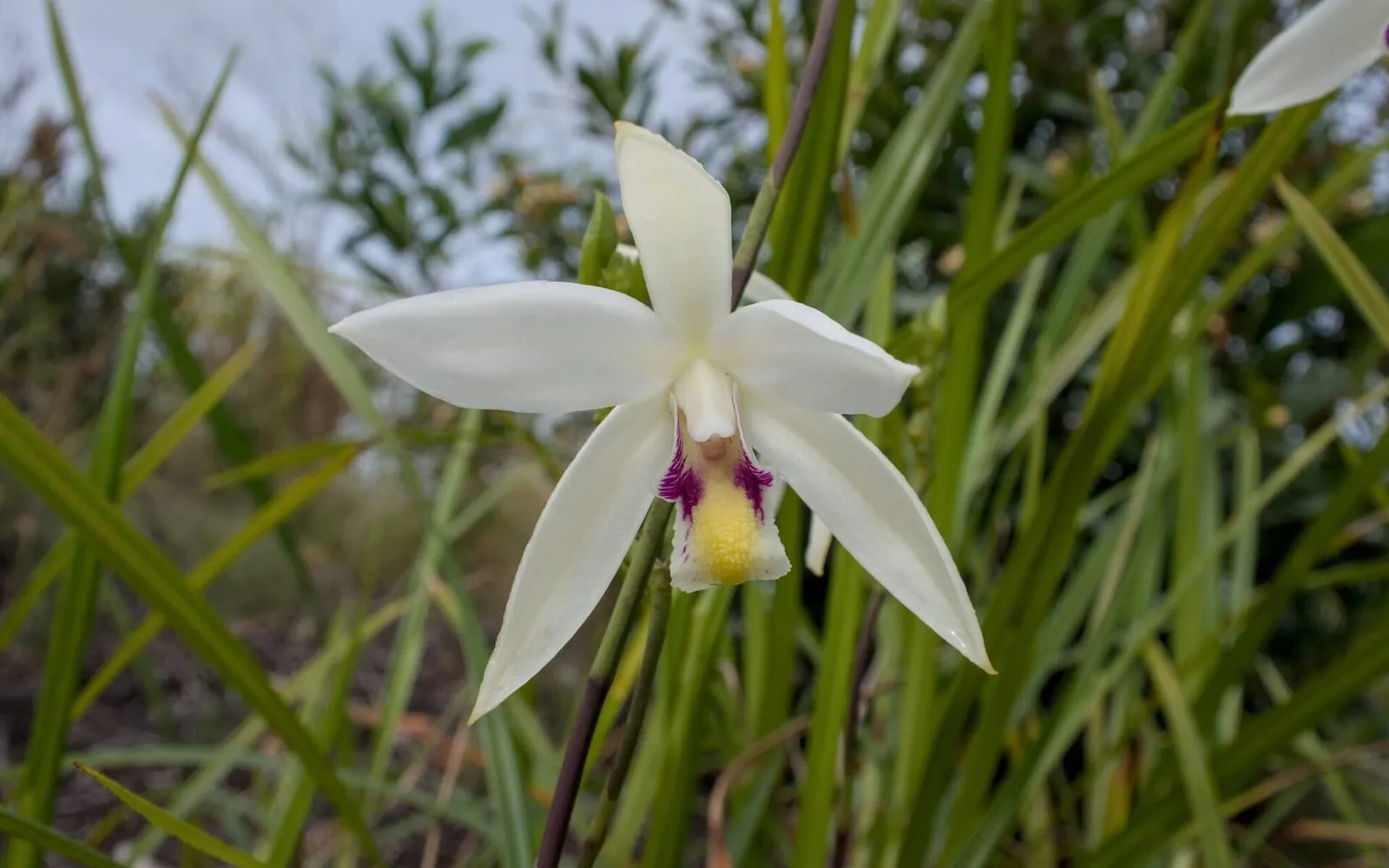
Bromheadia finlaysoniana, the pale reed orchid, is a tall, reed-stemmed terrestrial orchid from Southeast Asia. Its slender leafy canes make it look more like a reed or bamboo than a typical orchid. It grows in open, sandy and grassy places, in heath and on disturbed ground, and it can also perch on rocks or trees. Its white flowers, marked with yellow and purple on the lip, have an unusual habit. Across a whole population they can open together on the same day, triggered by a drop in temperature after rain. Each bloom lasts only a day.
Appearance and character
The plant produces tall, slim, upright stems clothed with two ranks of narrow, leathery leaves. This gives it a reed-like or bamboo-like appearance, unlike a rosette or pseudobulb orchid. Flowers appear at or near the top of the stems, which end in a short, flattened, zig-zag tip that carries the blooms and bears two pollinia in each flower. They are white, with a lip patterned in yellow and purple-violet, and they open flat but briefly. Because the blooms are short-lived and synchronised, a stand can go from bare to flowering and back again within days. Between those brief flowering episodes, the reed-like leafy canes are the main identifying feature.
Where it is from
The species is native to Southeast Asia, its range running from Indochina and Thailand south through the Malay Peninsula to Sumatra, Borneo and the Philippines, where it grows widely in open sunny habitats. It grows on sandy flats, in grassland, heath and scrub, on disturbed roadsides, and occasionally as a lithophyte or low epiphyte. Its climate is warm and humid year round, with frequent rain, and it grows more or less continuously instead of taking a seasonal dormancy. In cultivation it needs strong light, warmth, humidity and moisture at the roots without waterlogging. Treat it more like a sun-loving marginal plant than a shade-dwelling orchid.
How it grows
The plant grows from a rhizome, extending tall leafy canes and branching to form clumps. It is evergreen in its warm, humid climate. Its gregarious flowering responds to environmental cues: a sudden fall in temperature after rain can synchronise bud development across a population, so many plants bloom on the same morning some days later. Each flower opens for only a day, and seed capsules follow successful pollination. In cultivation, division of the clump or stem growths is more practical than relying on the fine, fungus-dependent seed.
Through the seasons
Warm wet weather drives continuous cane growth, since the plant does not take a true dormancy in its equatorial climate.
A temperature drop after rain synchronises the buds, so that a stand flowers together some days later.
Flowering day sees the white blooms open across the population, each lasting only about a day.
Between flowerings the reed-like canes grow on steadily in warm, bright, humid conditions.
Care difficulty
This is challenging mainly because of its size and its need for strong light and constant warmth, not because of a tricky dormancy. It needs bright light, high humidity, year-round warmth and a freely drained but moisture-retentive medium. It dislikes cold, deep shade and stagnant wet. The practical difficulty is giving a tall, light-hungry plant enough space and sun under cover, and flowering may depend on natural temperature cues. In a warm, bright, humid position it grows readily, though the brief flowers take patience.
Watering
Keep the plant moist and growing throughout the year, since it takes no seasonal rest. Water so the free-draining medium stays evenly moist while the canes are in active growth, using clean low-mineral water, and never let it either dry out hard or sit in stagnant water. In its equatorial home rain is frequent, so consistent moisture with good drainage suits it best. A slight easing in cooler or duller spells is all the seasonal variation it needs, instead of a deliberate dry rest.
Warning signs, diseases and pests
Weak, drawn canes and a failure to flower usually mean too little light, since this is a sun-loving plant. Blackened roots and rotting stem bases indicate stagnant waterlogging or cold. Under cover, scale and mealybugs shelter along the canes and leaf axils, spider mites appear in dry air, and aphids may attack the flower buds. Give it strong light, treat pests promptly, and keep the medium moist but freely drained, with warm moving air.
Growing environment
Provide bright light, even some direct sun, along with year-round warmth and high humidity, in a warm greenhouse or a bright warm conservatory that can accommodate its height. The medium should be free-draining yet moisture-retentive, based on coarse bark, grit and a little organic matter, reflecting the sandy open ground it grows in. Cold and deep shade are both unsuitable. Space to grow tall and plenty of light are the main practical needs, along with the warmth and humidity of a tropical setting.
Feeding
Feed regularly but at modest strength through the year, since the plant grows more or less continuously. A dilute balanced orchid feed every few waterings while the canes are active suits it, and heavy feeding leaves salts that harm the roots. Ease off a little during cooler or duller spells when growth slows, but there is no dormancy that calls for stopping feed altogether.
Troubleshooting
Why did all the flowers open at once? The species flowers gregariously, synchronised by a temperature drop after rain, so a whole stand blooms together some days later.
Why do the flowers last only a day? Each bloom is naturally short-lived, opening for about a day, which is normal for the species.
Why won’t it flower? Most often too little light, or the absence of the natural temperature cue that triggers synchronised budding.
How do I propagate it? By dividing the clump or from stem growths, which is more reliable than the fine fungus-dependent seed.
Is it toxic to pets? No serious toxicity is recorded for the genus, though keeping pets from chewing the canes is sensible.
Pale Reed Orchid problem guides
Not sure what is wrong? See the common houseplant pests guide.