
Outdoor plant
Irish Moss
Sagina subulata
Also known as Awl-leaved Pearlwort, Heath Pearlwort
How to grow Irish moss, Sagina subulata, a tiny flowering plant, not a true moss, grown as a mat between paving stones and in lawns that take light foot traffic.
At a glance
- Difficulty
- Moderate
- Water
- Regularly, especially in dry spells, keeping the mat from drying out
- Light
- Full sun to partial shade; benefits from midday shade in a hot climate
- Temperature
- Fully hardy, to about -15 deg C
- Humidity
- Average outdoor humidity; dislikes prolonged heat and drought
- Hardiness
- USDA 4-8, RHS H5, hardy to -15 C
- Type
- Hardy evergreen perennial
- Height
- 2-5 cm
- Native to
- Western Europe, including Britain and Ireland
The zone number tells you it survives an ordinary temperate winter, not that it is easy. Sagina subulata dislikes intense heat, drought and waterlogging in roughly equal measure, so a garden with a hot, dry summer or heavy, poorly drained soil will lose patches of it faster than frost ever would.
Hardiness zones describe winter cold alone. Summer heat, humidity, rainfall and the length of the growing season decide as much, so treat the range as the outer limit rather than as a recommendation.
Not known to be toxic
Sagina subulata carries no toxicity listing from the RHS or the ASPCA, and no case of poisoning in a person or an animal is documented for the species. As a plant grown to be walked on, in paving joints and small lawns, it is functionally treated as safe for a garden with children and pets underfoot rather than merely tolerated near them.
Sources: RHS (Sagina subulata, heath pearlwort), ASPCA Toxic and Non-Toxic Plant List
About
Irish moss is not a moss. It is a small flowering plant in the pink family, Caryophyllaceae, related to carnations and to snow-in-summer, and it only earned a moss-like common name because it forms a dense, low, emerald mat that looks convincingly bryophyte-like from a few feet away. Look closely in early summer and it gives itself away with tiny white five-petalled flowers, which no true moss ever produces.
Confusingly, an entirely unrelated organism also goes by the name Irish moss in a food and cooking context: Chondrus crispus, a red seaweed harvested off the coast of Ireland and used as a source of carrageenan, a thickener in dairy products. The two share nothing beyond a common name and a passing resemblance in colour.
This plant is useful in a garden because it tolerates being stepped on. Planted between paving stones or as a small-scale lawn substitute, it handles light foot traffic that would flatten most groundcover, springing back rather than staying crushed.
Appearance and character
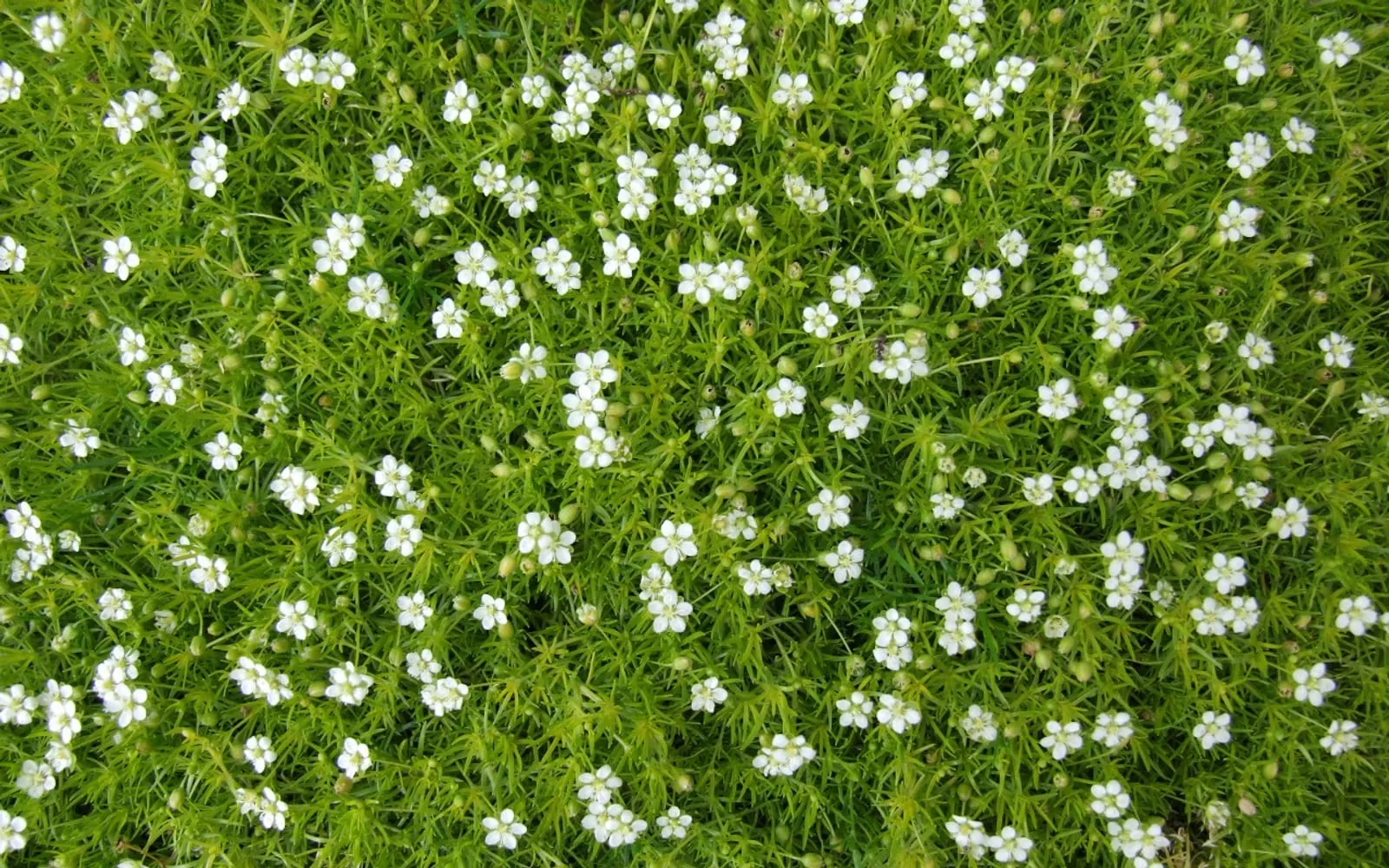
Growth is extremely fine and dense, made up of narrow, awl-shaped leaves only a few millimetres long, packed so closely together that a mature patch reads as a continuous, slightly springy green surface rather than as individual plants.
Small white flowers, around 5 to 8 mm across with four or five notched petals, appear scattered across the mat from late spring into summer, easy to overlook individually but noticeable in aggregate on a large planting.
The golden-leaved form, commonly sold as Scotch moss, is a cultivar of this same species with chartreuse to lime-green foliage rather than the deep emerald of the plain green plant, and it is generally slightly less vigorous.
Height stays extremely low, 2 to 5 cm at most. Combined with its dense growth habit, that helps it tolerate being walked across without snapping the way a taller groundcover would.
Where it is from
Sagina subulata is native to western Europe, including Britain and Ireland, where it grows naturally on heaths, in short turf, and among rocks and gravel in open, sunny positions with reasonably moist but free-draining ground. Heath pearlwort is its established English common name in that native range.
It has been grown in gardens for its usefulness as a fine-textured filler between paving and stones for a long time. Its low growth, its tolerance of poor and gritty soil, and its resilience under occasional pressure are the same qualities that suit it to open heath in the wild.
Its adoption as a lawn substitute is a more recent development, driven by interest in alternatives to conventional turf grass that need less mowing and less water, though it suits only small areas with light use rather than a family lawn that sees daily heavy traffic.
How it grows
Spread happens by the mat thickening and extending outward at its edges as individual stems branch and root into the surrounding soil, a slower and more contained process than the long rooting runners of several other groundcover species, which is part of why it stays neatly within bounds rather than escaping a planting.
Plant small divisions or plugs 10 to 15 cm apart for reasonably full cover within a season on suitable soil, closer for paving joints where faster closure is wanted. Growth is markedly slower in poor conditions, particularly in prolonged heat or in soil that swings between waterlogged and bone dry.
Between paving slabs, work a gritty, moisture-retentive planting medium into the joints before planting, and keep new plantings consistently watered through their first weeks while the fine roots establish in a comparatively small volume of soil.
Through the seasons
Spring is the main planting and establishment period, with new growth thickening the mat as temperatures rise and small white flowers beginning to appear toward the end of the season.
Summer brings the main flowering display along with the greatest risk to the plant, since prolonged heat and drought are what damage it most severely. Watch for patches turning brown and crisp in a hot spell and water promptly rather than waiting for full recovery to become necessary.
Autumn suits further planting and division while temperatures remain mild, and it is a good time to weed out anything that has seeded into the mat before winter dormancy sets in.
Winter leaves the evergreen mat largely unchanged in a normal season, though standing water on heavy soil over winter is a more realistic threat to it than cold itself.
Care difficulty
Moderate rather than easy, which sets it apart from most of the groundcover in this group. It sits in a narrower band of conditions than a tolerant spreader like periwinkle or bugle, disliking heat, drought and waterlogging in close to equal measure, so getting the site right matters more here than with most of its neighbours on a groundcover shortlist.
Watering is the main ongoing task, since the shallow, dense mat dries out faster than deeper-rooted groundcover and shows stress quickly once it does. In a hot climate or an exposed sunny position, that can mean watering through summer rather than treating it as an occasional task.
Foot traffic tolerance is real but limited. Light, occasional walking across a paving joint planting is fine; a route walked daily wears through even a well-established patch.
Watering
Water regularly, keeping the mat consistently moist rather than letting it swing between wet and dry, which is the pattern it tolerates worst.
In a hot or dry spell, check more often than the schedule suggests, since the shallow root system and fine, densely packed foliage give the plant little buffer against a missed watering compared with deeper-rooted groundcover.
Avoid waterlogging just as carefully as drought. Standing water, particularly in winter on heavy soil, rots the crown, so the balance to aim for is consistently moist rather than either extreme.
Warning signs, diseases and pests
Leaf scorch, browning and crisping of patches, most often follows heat and drought stress rather than any pest or disease, and prompt watering at the first sign usually limits the damage.
Crown rot follows the opposite problem, waterlogged soil, particularly over a wet winter on heavy or poorly drained ground. Improving drainage before replanting is the only real fix once it has set in.
Slugs and snails occasionally graze the fine foliage, more of a nuisance on a small planting than a serious threat to an established mat.
Weeds germinating into the fine texture of the mat are a persistent practical problem, since they are difficult to remove without damaging the surrounding Sagina, and prevention through clean ground before planting matters more here than with a coarser groundcover.
Growing environment
Full sun suits it in a cool or temperate climate, while some midday shade is worth providing in a hotter one, since intense sustained heat is one of the plant’s clearest limits.
Soil should be moderately fertile, consistently moist and well drained, acid to neutral in pH. It performs poorly on either extreme, struggling in soil that dries out fully between waterings and equally in ground that holds water after rain.
Paving joints, small-scale lawn substitutes, rock gardens and the gaps in stone steps all suit its scale and its tolerance of light pressure, and it is a poor choice for a large open area needing to establish quickly or to withstand heavy use.
Feeding
A light balanced feed once in spring supports steady growth through the season, particularly on ground that is not naturally fertile.
Avoid heavy feeding, which can push soft growth more vulnerable to the heat and drought stress that already trouble this plant more than most groundcover.
A planting between paving stones, with a smaller soil volume than an open bed, benefits from a slightly more attentive feeding schedule than one grown in open ground, since the limited root run exhausts nutrients faster.
Troubleshooting
Patches have turned brown and crisp in summer. Heat and drought stress, the most common failure with this plant. Water thoroughly and promptly, and consider some midday shade if this happens repeatedly in a hot position.
The centre has died and gone soggy. Likely crown rot from waterlogging, usually following a wet winter on heavy soil. Improve drainage before replanting, working grit into the soil if it is holding water.
Weeds have grown up through the mat. A common and difficult problem given how fine the foliage is. Weed by hand while seedlings are small, and keep the ground weed-free before planting to avoid the issue building up.
Is it safe to walk on regularly? Light, occasional foot traffic is fine; daily heavy use wears it through. Use it for paving joints and low-traffic areas rather than as a path in constant use.
How is it different from Scotch moss? Scotch moss is a golden-leaved cultivar of the same species, generally a little less vigorous than the plain green form but grown and cared for in the same way.
Is it related to the seaweed sold under the same name? No. That is Chondrus crispus, a completely different organism, a red seaweed used as a food thickener. The two share a common name and nothing else.
Can I use it as a full lawn? Only on a small scale with light use. It suits stepping-stone paths, courtyards and small feature areas better than a family lawn that takes daily heavy traffic and regular mowing.