
Houseplant
Mexican Firecracker
Echeveria setosa
Also known as Echeveria setosa
How to grow Echeveria setosa, the mexican firecracker, from its hairy rosette and red lantern flowers to watering, feeding and siting it through the year.
At a glance
- Difficulty
- Easy
- Water
- When the mix has dried right through
- Light
- Full sun to bright light
- Temperature
- Warm; keep frost-free
- Humidity
- Low
- Hardiness
- USDA 9-11, RHS H2, hardy to 5 C
- Type
- Perennial
- Height
- 8-15 cm
- Native to
- Mexico
A succulent from Mexico, storing water in fleshy tissues against drought. It needs full sun, very sharp drainage and long dry spells, and rots in cold, wet compost. Its frost tolerance depends on its origin, and it is safest kept frost-free unless known to be hardy.
Hardiness zones describe winter cold alone. Summer heat, humidity, rainfall and the length of the growing season decide as much, so treat the range as the outer limit rather than as a recommendation.
Not known to be toxic
Echeveria setosa, the mexican firecracker, is not recorded among the seriously toxic plants, and related plants in its group are not listed as toxic by the ASPCA or the RHS. A pet or child that chewed a leaf would be unlikely to have more than a possible mild stomach upset.
Sources: ASPCA toxic and non-toxic plants, RHS potentially harmful garden plants
About
Echeveria setosa is the fuzzy member of a group known for smooth, waxy rosettes. Its species name means bristly, and the plant is covered in fine white hairs that stand up from every leaf. From the highlands of Puebla and Oaxaca in Mexico, it forms a low, stemless rosette that clumps outward with age into a cushion of hairy green.
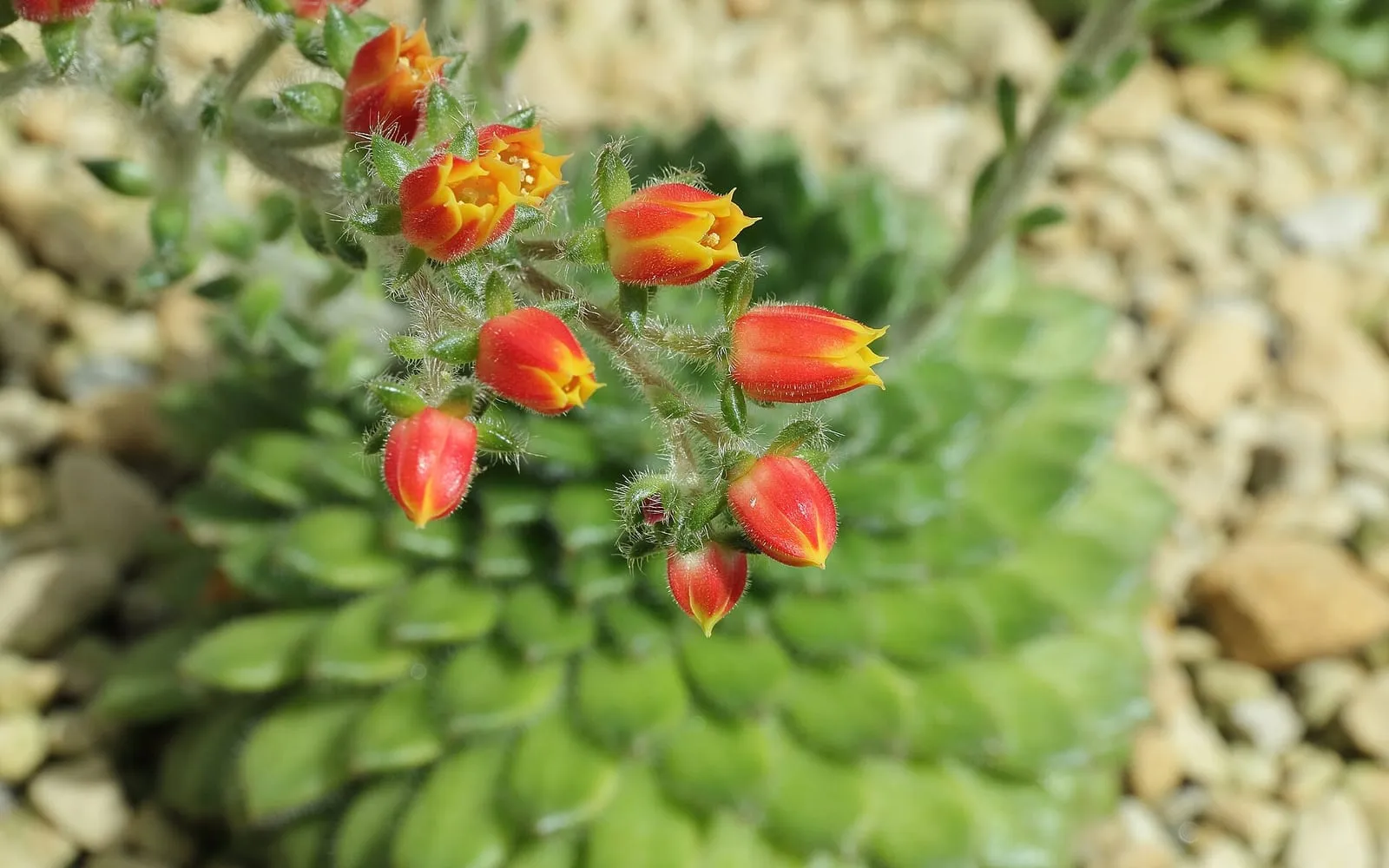
The common name comes from the flowers. In late spring the plant sends up arching red stalks tipped with narrow, lantern-shaped blooms, scarlet at the base and yellow at the mouth. They sit above the fuzzy leaves like small firecrackers. In the wild these draw hummingbirds, and indoors they are the most colourful part of the plant.
It is an easy, tidy succulent for a bright sill, carrying no serious toxicity. Its hairs add one care point that smooth echeverias do not have: keep water out of the crown.
Appearance and character
The rosette is flattish and dense, made of many narrow, spoon-shaped leaves that taper to a fine point, each one green and thickly clothed in short, soft white bristles. Those hairs give the plant a frosted, felted look and a distinct texture under the fingertip.
Unlike a farina-coated echeveria, the covering here is fine hair, not powder. It does, however, trap water and dust between the leaves, which matters for how you water.
With age the rosette offsets around its base, building a low colony of hairy rosettes instead of a single crown. The flower stalks arch out sideways before curving up, and the plant may bloom for several weeks in a good year.
Where it is from
Echeveria setosa grows on rocky outcrops and cliff ledges in the mountains of central and southern Mexico, at altitude where the light is strong, the drainage is sharp and the nights are cool. Rain is seasonal. The plant stays dry through the dry months and grows when rain returns, always with its roots in fast-draining mineral grit instead of heavy soil.
Give it bright light, a very free-draining mix, and a proper dry-out between waterings, with warmth in growth and cooler, drier conditions through winter. Cold, wet roots are the main danger in a pot.
How it grows
The plant grows through spring and summer, adding leaves to the rosette and pups around the base, then rests over the coldest, darkest weeks. Water stored in the fleshy leaves carries it through dry spells, so it tolerates a forgotten watering better than an overzealous one.
Give it strong light, a gritty pot and dry air, and it needs little more. Poor light is the usual problem, loosening the rosette so the leaves stretch and pale. Water sitting in the hairy crown encourages rot at the very centre of the plant.
Propagation is easy from offsets, which can be twisted off and re-rooted, or from whole leaves laid on gritty mix to strike.
Through the seasons
Spring starts growth and flower stalks. Resume watering as the mix dries, and enjoy the lantern flowers as they open.
Summer is the main growing spell. Keep it in bright light, water when the mix has dried right through, and give plenty of air movement in the heat.
Autumn slows it down. Reduce watering and stop feeding as the light fades.
Winter is a cool, dry rest. Keep it bright and frost-free, water barely at all, and take special care to keep the crown dry.
Care difficulty
The mexican firecracker is an easy succulent with one extra rule. Bright light, sharp drainage and sparing water cover the basics, and its stored water makes it tolerant of a missed drink. The hairs hold moisture in the crown, so overhead watering that lingers can rot the centre. Water at the base and it is as easy as most echeverias.
Watering
Water only when the gritty mix has dried right through, then soak it and let it drain completely. Direct the water to the compost instead of over the rosette, since droplets caught among the hairs sit against the leaves and encourage rot. In summer that may mean a soak every couple of weeks; in winter, once a month or less. Let the firmness of the leaves guide you, watering when they begin to lose their tautness instead of to a fixed date.
Warning signs, diseases and pests
A blackening, mushy centre is rot, often from water trapped in the hairy crown or from cold wet compost. Cut out the rotten heart, and if the crown is lost, re-root sound offsets or leaves instead of trying to save it.
Mealybugs shelter among the leaf bases and can be hard to spot against the white hairs, so check the crown closely. Dab them out with a spirit-soaked swab. Watch too for a loosening, stretching rosette, which means the light is too weak and the plant needs moving to a sunnier spot.
Growing environment
Bright light keeps the rosette tight and the hairs dense, so a south or west window, or a summer spell outdoors in a sheltered sunny place, suits it. It likes warmth in growth and cool, dry conditions in winter, and ordinary room air is fine because it needs low humidity, not misting.
Pot it in a very free-draining mix, a cactus compost with extra grit or pumice, in a shallow pot with a clear drainage hole. Terracotta helps the mix dry between waterings. Repot only when the clump has filled its pot, lifting and dividing the offsets at the same time if you want more plants.
Feeding
Feed sparingly in spring and summer with a dilute, low-nitrogen cactus food, once or twice over the whole season. The plant grows in lean mineral ground in the wild and needs little, and heavy feeding produces soft, pale growth that spoils the compact rosette. Give nothing in autumn and winter, and rely on fresh mix to support a newly potted or divided plant.
Troubleshooting
Why has the centre of the rosette gone black and soft? Rot, usually from water caught in the hairy crown or a cold wet pot. Cut it out and re-root clean offsets or leaves.
The rosette has opened up and the leaves look pale and stretched. Too little light. Move it to a much brighter spot and the new growth will tighten.
There are white specks I cannot brush off among the hairs. Likely mealybugs hiding against the white hair. Treat with a spirit-soaked swab and check regularly.
How do I make more plants? Twist off an offset and re-root it, or lay a whole leaf on gritty mix until it strikes.
Is it safe around pets? Echeverias are not among the toxic plants, so a nibble is unlikely to cause more than mild stomach upset. It is still sensible to keep any houseplant out of a chewing pet’s reach.
Mexican Firecracker problem guides
Not sure what is wrong? See the common houseplant pests guide.