
Houseplant
Pulido's Echeveria
Echeveria pulidonis
Also known as Echeveria pulidonis
How to grow Echeveria pulidonis, pulido's echeveria, a red-edged blue rosette that carries yellow bells in spring.
At a glance
- Difficulty
- Easy
- Water
- When the mix has dried right through
- Light
- Full sun to bright light
- Temperature
- Warm; keep frost-free
- Humidity
- Low
- Hardiness
- USDA 9-11, RHS H2, hardy to 5 C
- Type
- Perennial
- Height
- 8-15 cm
- Native to
- Mexico
A succulent from Mexico, storing water in fleshy tissues against drought. It needs full sun, very sharp drainage and long dry spells, and rots in cold, wet compost. Its frost tolerance depends on its origin, and it is safest kept frost-free unless known to be hardy.
Hardiness zones describe winter cold alone. Summer heat, humidity, rainfall and the length of the growing season decide as much, so treat the range as the outer limit rather than as a recommendation.
Not known to be toxic
Echeveria pulidonis, the pulido's echeveria, is not recorded among the seriously toxic plants, and related plants in its group are not listed as toxic by the ASPCA or the RHS. A pet or child that chewed a leaf would be unlikely to come to serious harm beyond a possible mild stomach upset.
Sources: ASPCA toxic and non-toxic plants, RHS potentially harmful garden plants
About
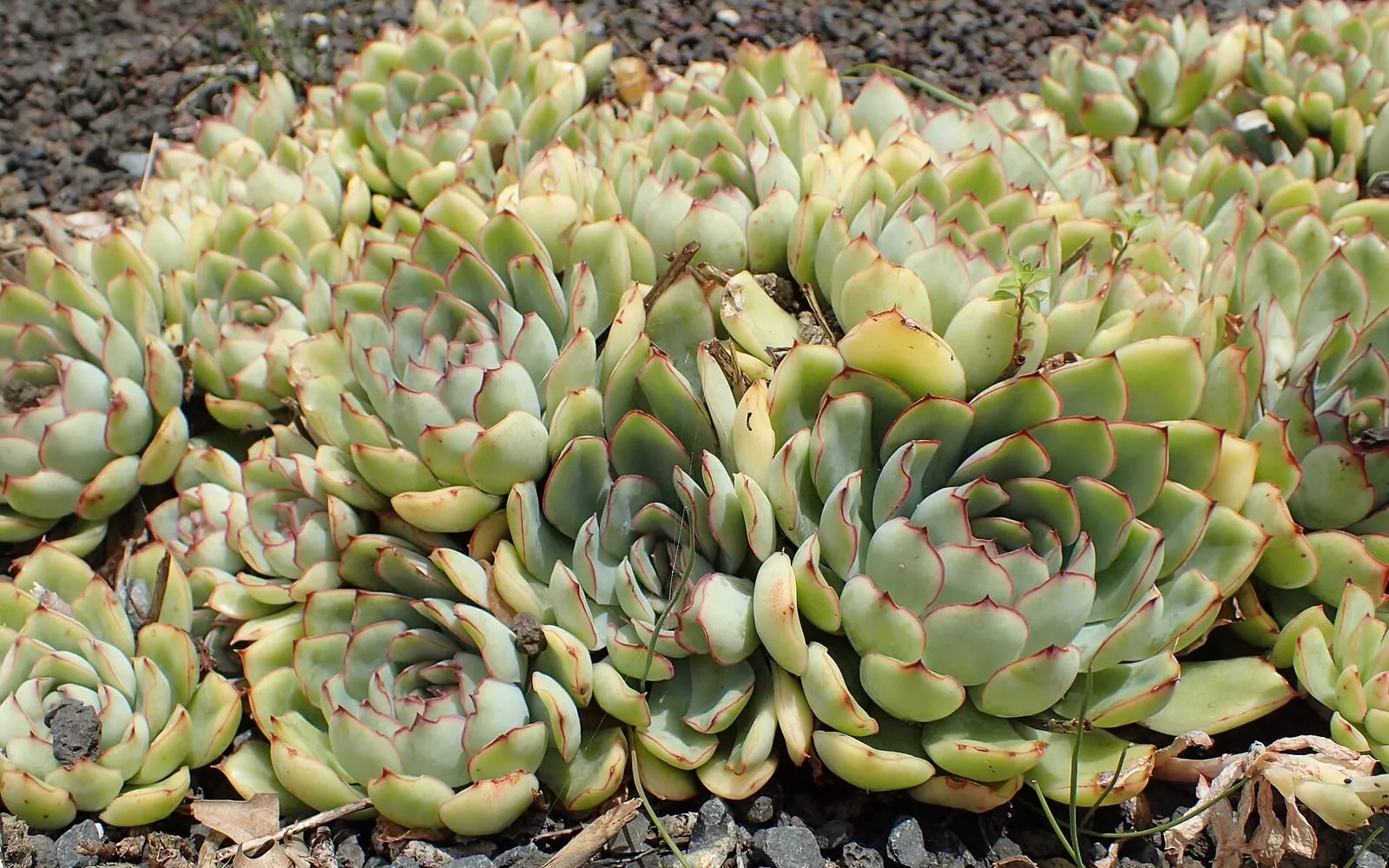
Echeveria pulidonis is a compact rosette succulent from Mexico, prized for the clean red line that outlines each of its pale, blue-green leaves. It is one of the tidier echeverias, holding a flat, symmetrical rosette of firm, upturned leaves, and it takes a strong red edge and a red-tipped point when the light is good. A soft, powdery bloom, the farina, coats the leaves and gives the whole plant its chalky blue cast.
It comes from the dry, rocky uplands of central Mexico and is adapted to drought, storing water in its swollen leaves and enduring long rainless spells. In spring it produces arching stalks of nodding yellow bell flowers, held to one side of the stem, which stand out against the cool blue foliage.
Easy, slow and neat, it is a good first echeveria. It carries no serious toxicity, though its farina is fragile and marks permanently at a touch, so it is a plant to admire more than to handle.
Appearance and character
The rosette is low and flat, a neat spiral of thick, obovate leaves that curve up and inward, each ending in a small pointed tip. The colour is a soft chalky blue-green from the farina, sharpened by a thin red margin that runs round the leaf and deepens at the tip in bright light.
The farina is a living wax the plant lays down against sun and water loss, and once a fingerprint or a splash of water disturbs it, that patch stays dull; only new leaves come in fully coated. The plant offsets modestly from the base, forming a small cluster of rosettes over time instead of a large clump.
Its flowers appear in spring on slender, arching red stalks, a row of pendent yellow bells opening along one side, lasting for weeks and often drawing early pollinators outdoors.
Where it is from
The plant grows on limestone slopes and rocky ledges in the highlands of central Mexico, in bright sun and sharp-draining mineral ground. Rainfall is seasonal, so the plant stores water in the wet months and uses that reserve through the dry ones, with its roots in fast-draining grit instead of moisture-holding soil.
Those origins explain its care in a pot. Bright light keeps the rosette tight and the red edge strong, a gritty free-draining medium keeps the roots healthy, and a long dry-out between waterings mimics the rhythm of its home. Cold, wet compost is the main thing to avoid, because it rots the plant.
How it grows
Pulido’s echeveria grows steadily through spring and summer, adding leaves to the rosette and pushing out the occasional offset, then rests over the darker, colder weeks. The water stored in its leaves helps it cope with drought, but constant damp is a problem.
Give it strong light, a sharp mineral mix and dry air, and it needs almost no attention. Weak light is the usual problem, loosening the rosette, drawing the leaves up on a bare stem and washing out the red edge. Watering over the top of the plant, meanwhile, spoils the farina and can pool in the crown.
It propagates well from offsets and from whole leaves, which are gently twisted off, dried, and laid on gritty mix to root.
Through the seasons
Spring brings growth and the yellow flower stalks. Water as the mix dries and let the blooms run their course before removing the spent stalk.
Summer is the strongest growing spell. Keep it in bright light, water when the mix has dried right through, and give it plenty of air.
Autumn slows it. Ease off watering and stop feeding as the days shorten.
Winter is a cool, dry rest. Keep it bright and frost-free, water very little, and keep the crown dry.
Care difficulty
This is a straightforward succulent for a beginner. Bright light, sharp drainage and a sparing hand with water are the essentials, and its stored water buys patience with an irregular routine. The commonest fault is overwatering, which softens the base and rots it, closely followed by too little light, which spoils the rosette. Water at the base to protect the farina and it is easy to keep.
Watering
Wait until the gritty mix has dried right through, then water thoroughly and let all the surplus drain away. Aim the water at the compost, not over the leaves, both to protect the farina and to keep water out of the crown. In summer the plant may want a soak every fortnight or so; in winter it can go a month or more. Judge by the leaves, which stay firm and full when the plant is content and soften slightly when the plant is short of water.
Warning signs, diseases and pests
A soft, discoloured base or a blackening crown is rot from wet, cold compost or water standing in the rosette. Cut back to firm tissue, and if the crown is gone, re-root sound offsets or leaves instead of nursing the collapsed plant.
Mealybugs tuck into the leaf bases and the crown as white woolly specks; remove them with a spirit-dipped swab and check new plants before shelving them. A loosening, stretching rosette with faded colour means weak light, so move the plant to a brighter spot and let the new leaves come back tight and well-edged.
Growing environment
Strong light gives the tightest rosette and the boldest red margin, so a south or west sill, or a summer spell outdoors in a sheltered sunny position, suits it best. It likes warmth in growth and cool, dry conditions in winter, with low humidity and no misting. Good air movement helps keep rot at bay.
Grow it in a very free-draining mix, cactus compost bulked with grit or pumice, in a shallow pot with a clear drainage hole. Terracotta speeds the dry-down. Repot only when the cluster has filled its pot, dividing the offsets at the same time if you want more.
Feeding
Feed lightly in spring and summer with a dilute, low-nitrogen cactus food, once or twice across the whole season. The plant grows in poor mineral ground and needs little, and heavy feeding forces soft, lax growth that loses the compact form and clear edge colour. Give nothing in autumn and winter, and let fresh mix support a newly potted or divided plant.
Troubleshooting
Why has the base gone soft or the centre turned black? Rot from overwatering, a cold wet pot, or water pooling in the crown. Cut back to firm tissue and re-root offsets or leaves.
The blue leaves have marked where I touched them. Will they recover? No, the farina does not regrow once rubbed off. New leaves emerge fully coated, so handle the plant by the pot.
The rosette has opened and the red edge has faded. Too little light. Move it somewhere much brighter and the fresh leaves will tighten and colour up.
How do I make more plants? Twist off an offset and re-root it, or take a whole leaf, dry the cut, and set it on gritty mix.
Is it safe around pets? Echeverias are not on the toxic lists, so a nibble is unlikely to cause serious harm, though keeping any houseplant away from a chewing pet is wise.
Pulido's Echeveria problem guides
Not sure what is wrong? See the common houseplant pests guide.