
Houseplant
Rattlesnake Plant
Goeppertia insignis
Also known as Goeppertia insignis
Growing Goeppertia insignis, the rattlesnake plant, a tall Brazilian prayer plant with wavy lance leaves marked in snakeskin blotches over a maroon back.
At a glance
- Difficulty
- Easy
- Water
- When the top few centimetres of mix have dried
- Light
- Bright indirect light to light shade
- Temperature
- Warm; keep above about 13 deg C
- Humidity
- Average to high
- Hardiness
- USDA 10-12, RHS H1b, hardy to 13 C
- Type
- Perennial
- Height
- 40-75 cm
- Native to
- Brazil
A tender tropical foliage plant from Brazil, growing in warm, humid, shaded to filtered light. It needs warmth, humidity and bright indirect light, and it cannot take frost or chill. It is safest above about 13 deg C, and cold, wet compost or dry air spoils it.
Hardiness zones describe winter cold alone. Summer heat, humidity, rainfall and the length of the growing season decide as much, so treat the range as the outer limit rather than as a recommendation.
Not known to be toxic
Goeppertia insignis, the rattlesnake plant, is not recorded among the seriously toxic plants, and related plants in its group are not listed as toxic by the ASPCA or the RHS. A pet or child that chewed a leaf would be unlikely to come to serious harm beyond a possible mild stomach upset.
Sources: ASPCA toxic and non-toxic plants, RHS potentially harmful garden plants
The name and the snakeskin
Its common name comes from the markings, which resemble the patterned scales along a rattlesnake’s back. Botanists know it as Goeppertia insignis, though many older labels, books and plant lists still call it Calathea lancifolia, a name that refers to the narrow, lance-shaped blade. The genus was split apart in 2012 and this species moved into Goeppertia, so both names still appear in the trade. Among the patterned prayer plants it stands out for shape as well as colour, growing taller, slimmer and more upright than the round-leaved kinds.
Reading the leaf
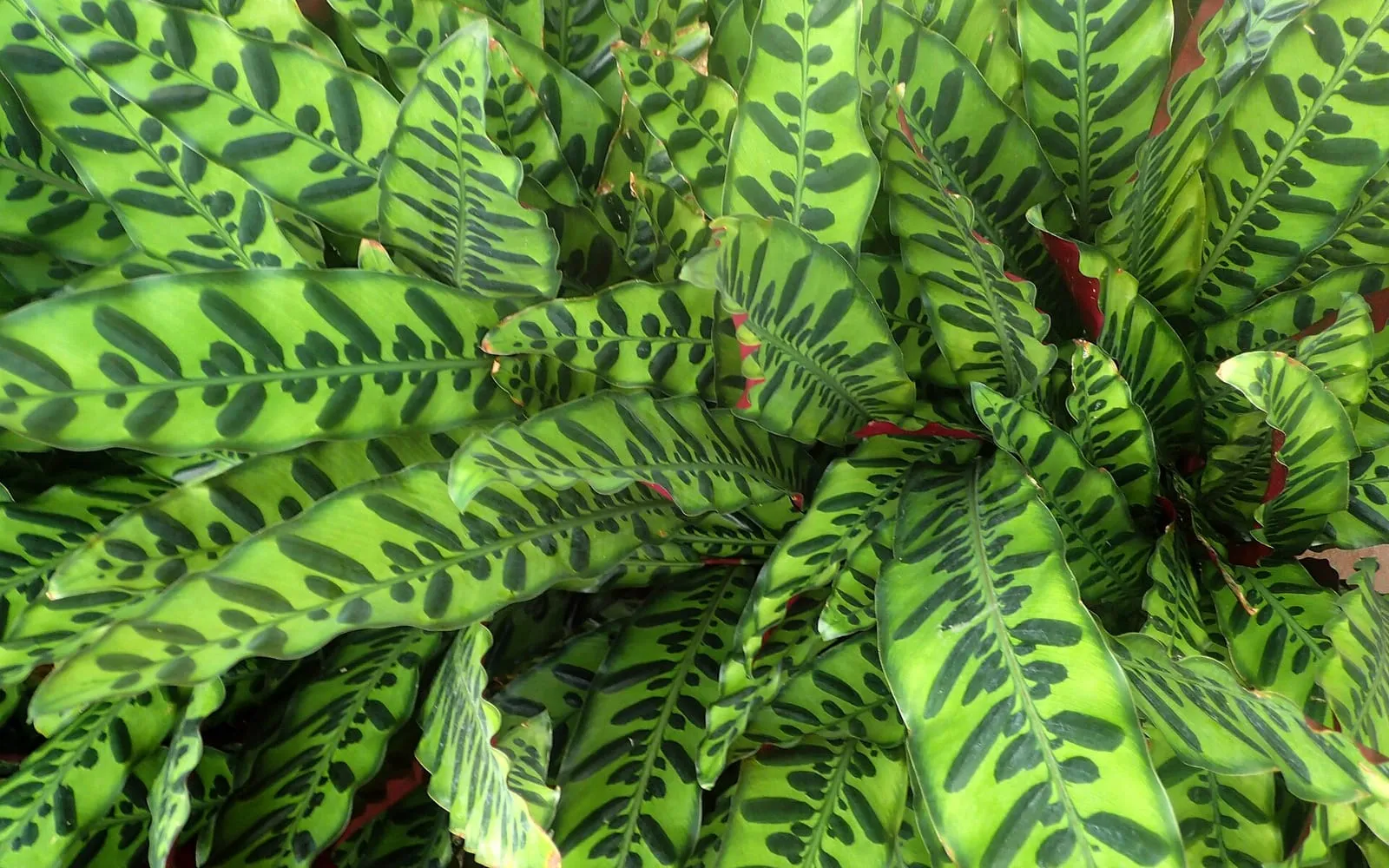
Each leaf is long and narrow, tapering to a point, with a softly wavy or scalloped margin that ripples along its length. The ground colour is a fresh, light green, and down each side of the midrib runs an alternating row of dark green blotches, large ones set between smaller ones, so the pattern resembles markings laid along the blade. Turn a leaf over and the underside is a deep maroon-purple, which shows whenever the plant lifts its leaves. A mature clump can send up many of these tall, wavy blades from a crowded base, giving it more height and movement than its flatter relatives.
The prayer movement
This species has a clear nightly leaf movement. As the light fades its narrow leaves swing sharply upward, closing almost vertical, then lower and spread again by morning. That daily raising and folding is nyctinasty, controlled by a swollen band of cells called the pulvinus at the foot of each blade, which moves water from side to side to lever the leaf up or down. The long, light blades make the motion easy to see as the room darkens.
Where it grows wild
Goeppertia insignis is native to Brazil, growing wild in the humid coastal forest of the Rio de Janeiro region among the leaf litter of the shaded forest floor. There the air stays warm and moist all year, rain is plentiful, and the canopy filters the sun to a soft, broken light. No frost reaches it and no dry season forces it to rest, so its indoor care comes from that forest floor: warmth, humidity, gentle light and compost that stays damp without turning boggy.
Light and position
Offer it strong daylight that stops short of direct sun, perhaps a good arm’s length in from an easterly window or filtered through a thin drape where the aspect is brighter. Fierce noon sun pales the snakeskin blotches and scorches the thin blades, while a gloomy spot flattens the colour, stalls growth and produces limp, sagging leaves. Light arriving from several sides keeps the tall clump upright, so turn the pot a little each week whenever it begins tipping towards the pane.
Watering and water quality
Let the surface layer of the mix, the top inch or two, lose its damp before you water, then soak the whole rootball and pour off the run-through so the roots stay damp but never drowned. Water chemistry matters to this plant, and hard water marks the foliage quite quickly. The fluoride, chlorine and lime dissolved in mains water can brown the rippled edges, so rainwater, filtered water or water left open for a night suit it better. Pull the watering right back through the dim, chilly stretch of the year, when growth slows and a cold, waterlogged pot rots the roots quickly.
Warmth and humidity
An indoor range near eighteen to twenty-six degrees C keeps it growing well, and the temperature should not drop under about thirteen degrees C. Keep it away from draughts, warm radiators and the chill of winter glass. Dry household air is what typically turns the leaf edges brittle. Raise the moisture nearby by resting the pot over a shallow dish of wet grit, grouping it with other foliage, or using a compact humidifier. A light misting perks the leaves up only briefly and can leave watermarks, so a wet dish, grouped plants or a humidifier is more reliable.
Feeding, potting and increase
During spring and summer, apply a general-purpose houseplant feed every two weeks, cut to half the label dose, as full-strength feed can scorch the slender roots. Withhold all feeding once winter arrives. Move it to a bigger pot in spring after roots have filled the current one, going up just one size into a springy, well-aerated, peat-free medium mixed with bark, coir and perlite for quick drainage. Raise more plants by dividing the clump in spring: draw the plant out, divide its creeping stems into portions each holding roots and a growing tip, and keep them in warm, humid air until they root.
Common problems
A dry, brittle leaf rim usually means dry air or hard water, both helped by damper surroundings and a change of water. Yellow leaves above wet, sour-smelling compost mean the roots cannot breathe, so let the medium dry and give it freer drainage. A blade held tightly rolled all day is usually too dry or sunburnt. In warm, dry air, spider mites mark the undersides with tiny pale flecks and fine webs, while mealybugs settle into white fluffy clumps at the leaf joints. Rinse mites off and treat them early, and lift mealybugs clear with a cotton bud soaked in dilute alcohol.
Safe around pets and children
There are no dangerous toxins on record in Goeppertia insignis, and the ASPCA marks the prayer-plant family safe for cats and dogs alike, so a bitten leaf is unlikely to cause more than a mild and short-lived stomach upset. That makes it an easy plant to live with where pets or children roam. Even then, keep it beyond casual reach, because damaged leaves spoil the display.
Quick answers
Why does it stand so much taller than my other calatheas? Its leaves are naturally long, narrow and upright, so a mature clump grows into a tall fountain instead of a low rosette.
Why are the leaf edges browning? Dry air, hard water or both. Raise the humidity and switch to rainwater or filtered water.
How do I make more plants? Divide the rhizome clump in spring, leaving roots and a shoot on each piece.
Why do the leaves stand up at night? That is the family’s nightly leaf movement, and this species folds especially upright. It is a sign of a healthy plant.
Rattlesnake Plant problem guides
Not sure what is wrong? See the common houseplant pests guide.