
Houseplant
Medallion Calathea
Goeppertia veitchiana
Also known as Goeppertia veitchiana
Growing Goeppertia veitchiana, the medallion calathea, an Andean prayer plant whose leaves carry a target of light and dark greens over a burgundy back.
At a glance
- Difficulty
- Easy
- Water
- When the top few centimetres of mix have dried
- Light
- Bright indirect light to light shade
- Temperature
- Warm; keep above about 13 deg C
- Humidity
- Average to high
- Hardiness
- USDA 10-12, RHS H1b, hardy to 13 C
- Type
- Perennial
- Height
- 60-90 cm
- Native to
- Ecuador
A tender tropical foliage plant from the Ecuadorian Andes, growing in warm, humid, shaded to filtered light. It needs warmth, humidity and bright indirect light, and it cannot take frost or chill. It is safest above about 13 deg C, and cold, wet compost or dry air spoils it.
Hardiness zones describe winter cold alone. Summer heat, humidity, rainfall and the length of the growing season decide as much, so treat the range as the outer limit rather than as a recommendation.
Not known to be toxic
Goeppertia veitchiana, the medallion calathea, is not recorded among the seriously toxic plants, and related plants in its group are not listed as toxic by the ASPCA or the RHS. A pet or child that chewed a leaf would be unlikely to have more than a possible mild stomach upset.
Sources: ASPCA toxic and non-toxic plants, RHS potentially harmful garden plants
A Victorian introduction and its name
Goeppertia veitchiana carries the name of the Veitch nursery, the Chelsea and Exeter firm whose collectors introduced many exotic plants to Victorian glasshouses, including this species. Its everyday name, medallion calathea, describes the leaf better than the Latin does: each blade has a broad decorative disc ringed like a coin or medal. As with the rest of its relatives, the plant sat under Calathea for well over a century. The reclassification of 2012 moved it into Goeppertia, so both names remain in circulation on labels and in catalogues.
Reading the leaf
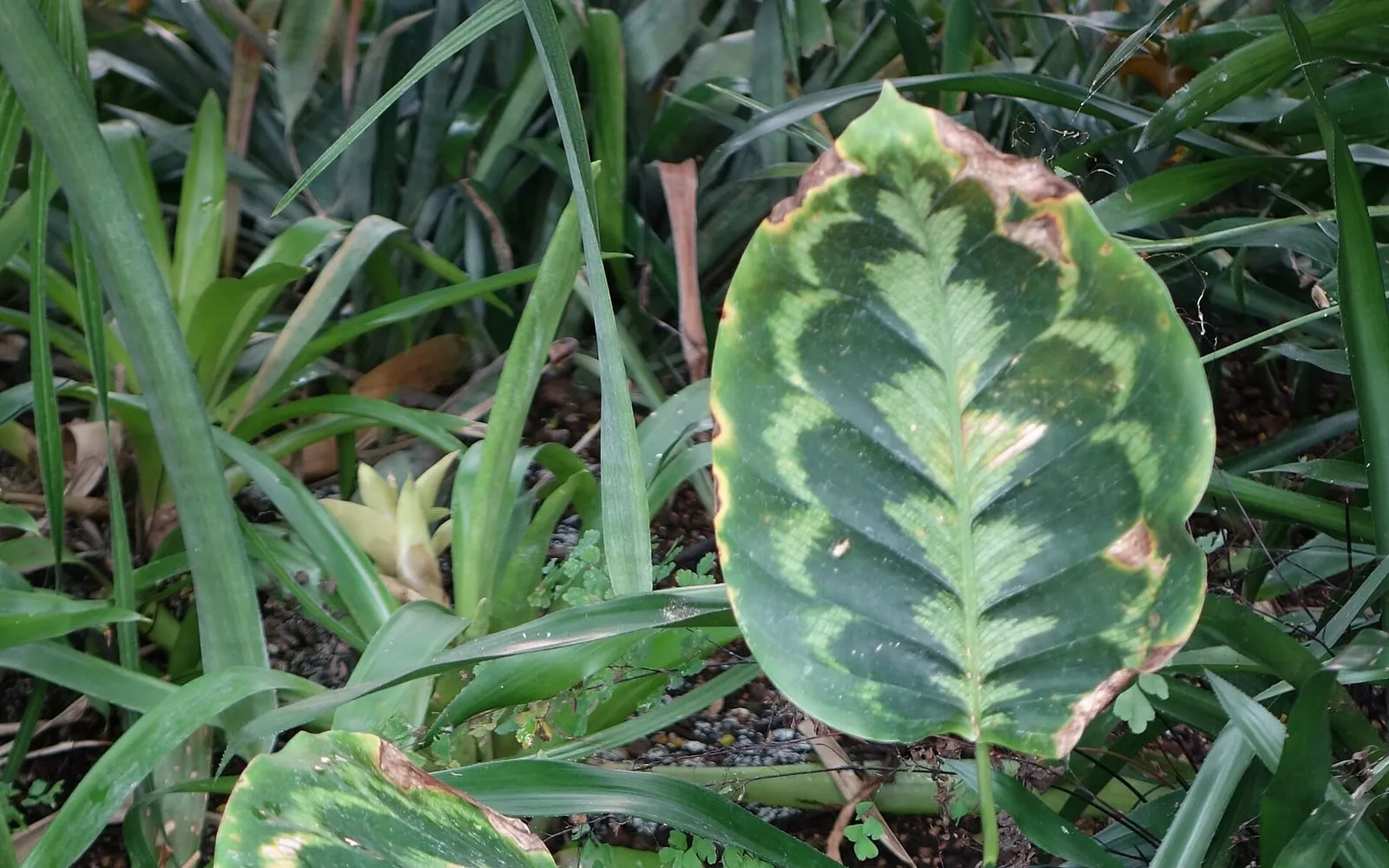
The blade is large, broadly oval and softly pointed, with several tones of green arranged in concentric zones. A dark, feathered band runs around the outer margin and sends short green fingers inward. Inside that is a paler, almost lime ring, with a deeper green centre marked by a fine herringbone of veins. Tilt the leaf and the underside shows a rich burgundy-purple, often visible at the edges from above. Fresh leaves emerge rolled into a tight cylinder, often flushed pink or bronze before the mature banding settles into place.
The prayer movement
At nightfall the leaves lift from their daytime spread and fold upward, with the burgundy backs facing out. They relax open again through the morning. Botanists call this daily raising and lowering nyctinasty. In prayer plants it is controlled by a swollen joint of tissue, the pulvinus, where the blade meets its stalk. The joint moves water between opposite sides of its cells, and the change in pressure tips the leaf like a hinge. On the medallion, the effect is easy to see because the flat patterned clump becomes a bundle of upright, purple-backed leaves once the light drops.
Where it grows wild
The species is endemic to the forested Andean foothills of Ecuador, found at roughly 400 to 1,200 metres near Cuenca, where warm, wet air rises off the lowlands and cloud drifts through the trees. It roots in the deep leaf mould of the forest floor, shaded by the canopy and rarely touched by direct sun, in ground that stays damp without drying hard. Frost is unknown there, and the temperature stays warm through the year. Those foothill origins explain its indoor needs. It needs constant warmth, moist air, soft light and roots that are damp but never waterlogged.
Light and position
Position it where daylight is bright but direct sun does not land on the foliage, perhaps on a shelf set back from an east-facing sill or behind a fine blind on a sunnier wall. Harsh light dulls the concentric bands and crisps the surface, while deep shade brings slow, stretched shoots and muddy colour. To keep the disc-shaped rosette even, turn the container slightly every few days if it starts leaning towards the brightest wall.
Watering and water quality
Hold off until the upper inch or so of the mix feels dry to a fingertip, then drench the rootball and let the surplus drain before the pot goes back on its saucer. Tap water marks this species faster than it marks many houseplants, because the minerals collect in the leaf edges. Fluoride, chlorine and lime can burn the rim to a brittle tan, so use collected rainwater, filtered water or water left open for a day if you can. Once daylight shortens and the room cools, scale the watering right down, as saturated compost around cold roots causes rot.
Warmth and humidity
A living-room range of about eighteen to twenty-six degrees C suits it, and the temperature should never fall below roughly thirteen degrees C. Keep it away from draughts, hot radiators and frosted winter glass. Dry air scorches the leaf margins. Raise the local humidity with a pebble-filled saucer topped up with water beneath the pot, a group of other leafy plants around it, or a small humidifier nearby. A quick spray only dampens the surface for a few minutes and can blemish the leaves, so the wet saucer and grouped plants are steadier options.
Feeding, potting and increase
Across the warmer half of the year, offer a general houseplant food diluted to half its stated dose about every two weeks, because a concentrated feed scorches the delicate roots. Set the bottle aside for the winter months. Move it to a larger pot in spring only once roots have packed the old one. Choose a container one size up and a light, breathable, peat-free blend loosened with bark, coir and perlite so water drains through. New plants come from splitting the crown in spring: ease the plant out, tease the underground stems into pieces that keep both roots and at least one bud, and grow each piece in warm, sheltered, moist air until it roots.
Common problems
A brittle tan rim points to dry air or a salt load from hard water. Raise the humidity and use softer water. When leaves pale to yellow above a soggy, stale-smelling mix, the roots are short of air. Dry the compost out and improve the drainage. A blade that stays furled shut through daylight is usually short of water or catching too much sun. Heat and low humidity together encourage spider mites, whose feeding freckles the leaf backs and leaves a thin web, along with mealybugs that gather in pale cottony knots at the leaf joints. Rinse mites away quickly, and pick off mealybugs with a swab moistened in weak alcohol.
Safe around pets and children
No dangerous compounds are recorded in Goeppertia veitchiana, and the ASPCA files the broader prayer-plant family as safe for both cats and dogs. A stray mouthful should cause no more than a short bout of mild indigestion. That makes it suitable for a household with animals or young children. All the same, stand it somewhere hard to reach, since damaged leaves lose their markings and rough handling can disrupt the plant’s evening movement.
Quick answers
Why has the medallion pattern gone pale? Too much direct sun bleaches it. Move the plant to bright but filtered light and the markings deepen again.
Why are the leaf edges turning brown? Dry air, hard water or both. Raise the humidity and water with rainwater or filtered water.
How do I make more plants? Divide the rhizome clump in spring, leaving roots and a shoot on each division.
Where does it come from? The Andean foothills of Ecuador, where it grows on the shaded, humid forest floor.
Medallion Calathea problem guides
Not sure what is wrong? See the common houseplant pests guide.