
Houseplant
Peacock Plant
Goeppertia makoyana
Also known as Goeppertia makoyana
How to grow Goeppertia makoyana, the peacock plant, a Brazilian prayer plant whose leaves are painted with dark brushstrokes above and wine-red beneath.
At a glance
- Difficulty
- Easy
- Water
- When the top few centimetres of mix have dried
- Light
- Bright indirect light to light shade
- Temperature
- Warm; keep above about 13 deg C
- Humidity
- Average to high
- Hardiness
- USDA 10-12, RHS H1b, hardy to 13 C
- Type
- Perennial
- Height
- 30-60 cm
- Native to
- Brazil
A tender tropical foliage plant from Brazil, growing in warm, humid, shaded to filtered light. It needs warmth, humidity and bright indirect light, and it cannot take frost or chill. It is safest above about 13 deg C, and cold, wet compost or dry air spoils it.
Hardiness zones describe winter cold alone. Summer heat, humidity, rainfall and the length of the growing season decide as much, so treat the range as the outer limit rather than as a recommendation.
Not known to be toxic
Goeppertia makoyana, the peacock plant, is not recorded among the seriously toxic plants, and related plants in its group are not listed as toxic by the ASPCA or the RHS. A pet or child that chewed a leaf would be unlikely to come to real harm beyond a possible mild stomach upset.
Sources: ASPCA toxic and non-toxic plants, RHS potentially harmful garden plants
The plant and its name
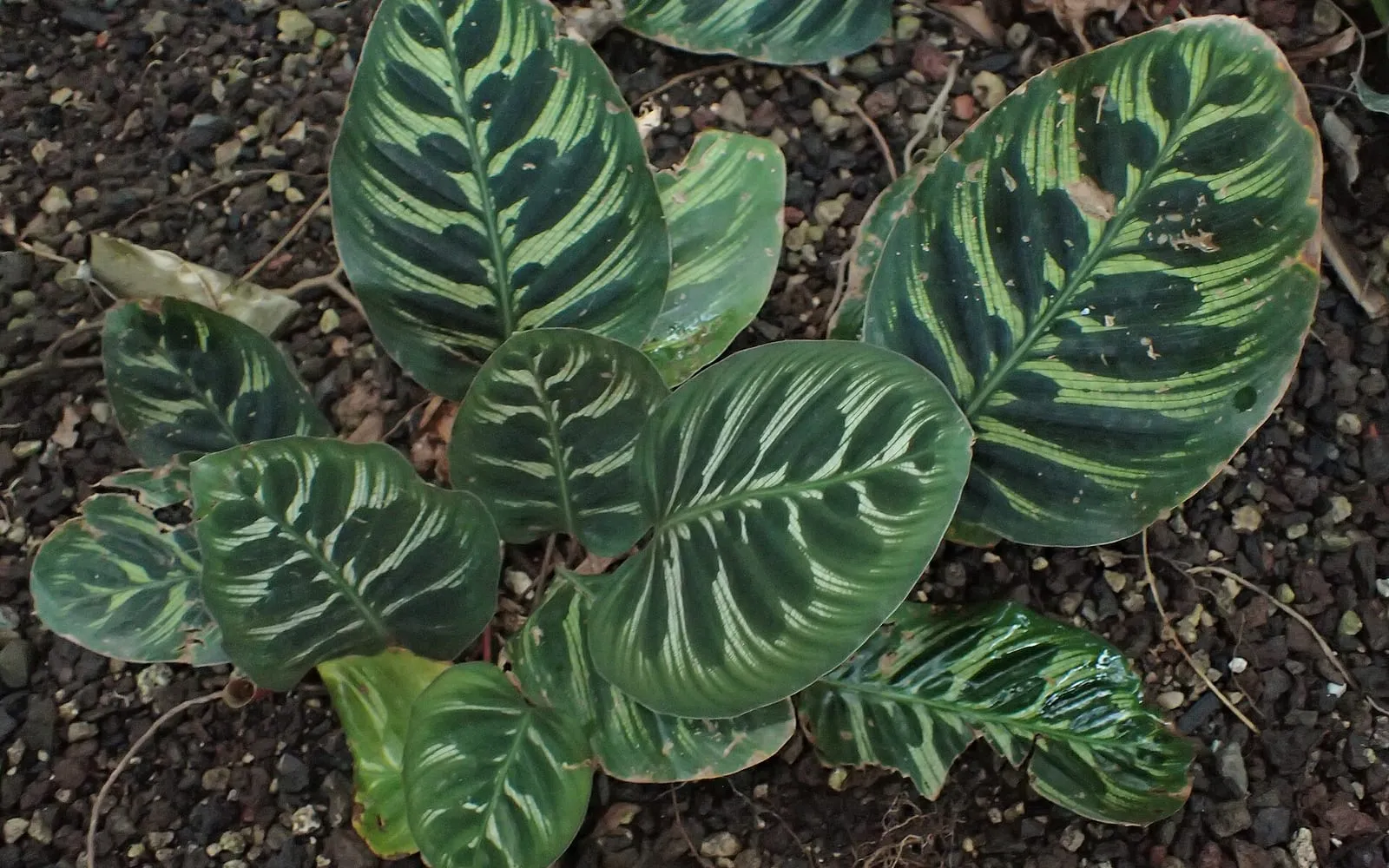
Goeppertia makoyana gets its garden name from the leaves. A pale silvery surface carries dark green brushstrokes that radiate along the veins and end in a fine scalloped border, recalling the markings on a peacock’s tail. The species commemorates Jacob Makoy, a nineteenth-century Belgian nurseryman whose Liege firm distributed many of these Brazilian foliage plants across European glasshouses. Botanists moved it out of Calathea and into Goeppertia in 2012, so older labels, catalogues and books still list the same plant as Calathea makoyana.
Reading the leaf
Each blade is thin enough to let light pass through it, oval, and carried almost horizontally on a slim upright stalk. The upper face shows two greens at once: a translucent creamy green between the veins, overlaid with darker olive ovals and a feathered midrib line. Turn a leaf over and the identical pattern repeats in wine-red and maroon on the underside, so a clump seen against a window glows in two colours. A swollen joint called a pulvinus sits where each stalk meets its blade, and this hinge drives the nightly movement covered further down. New leaves unfurl from a tight rolled tube, often showing a rosy flush before the mature colours settle in.
The prayer movement
At dusk the blades swing upward and draw together into loose vertical pairs, lifting to expose their claret undersides, then lower and flatten again by mid-morning. This daily rise and fall is called nyctinasty. In the prayer-plant family, cells in the pulvinus pump water in and out to change their pressure and move the leaf. A peacock plant that closes in the evening is usually in good condition. A plant short of water or badly chilled may hold its leaves stiff or let them flag without the tidy fold.
Where it grows wild
The species is native to eastern Brazil, where it roots in the leaf litter of humid lowland forest and lives in the dappled, ever-shifting light that filters through a closed canopy. Rain is frequent, the air stays moist, and the temperature holds within a narrow warm band the year round with no cold season to trigger dormancy. Those origins explain every line of its care: it never met frost, never dried to a crisp, and never stood in blazing overhead sun, so a home that mimics a shaded forest floor suits it and a bright dry windowsill does not.
Light and position
Give it steady, diffused brightness of the kind found a metre or two back from an east or north window, or behind a sheer curtain on a sunnier aspect. Direct midday rays scorch the thin blades and bleach the markings towards a flat, washed-out green, while deep gloom slows growth and stretches the stalks. A spot with even light on all sides keeps the clump symmetrical; give the pot a quarter turn each week if it starts leaning towards the glass.
Watering and water quality
Let the top two to three centimetres of compost dry before watering, then moisten the whole rootball and tip away whatever drains through. This species is touchy about what comes out of the tap. Fluoride, chlorine and dissolved lime can build up in the leaf and burn the margins to a papery brown, so rainwater, filtered water or water left to stand overnight is kinder than hard mains water. Ease right off in the darker months, when growth slows and cold wet compost quickly harms the roots.
Warmth and humidity
Ordinary room warmth of eighteen to twenty-six degrees C suits it, and it must stay above roughly thirteen degrees C, clear of draughts, radiators and a cold pane of glass in winter. Dry indoor air is the commonest reason the edges crisp. Stand the pot on a wide tray of damp gravel, group it among other foliage plants, or run a small humidifier nearby to lift the moisture around the leaves. Misting helps only for the minutes it lasts and can spot the leaves, so the tray and the grouping do more lasting good.
Feeding, potting and increase
From spring to early autumn feed fortnightly with a balanced houseplant fertiliser diluted to half the label rate, since the fine roots scorch on a strong dose. Hold off entirely through winter. Repot in spring only when roots crowd the pot, moving up one size into a loose, airy, peat-free mix opened up with bark, coir and perlite so water runs through freely. Increase your stock by division: in spring, ease a mature clump from its pot, tease the rhizomes into sections that each keep roots and a few leaves, and pot them separately in warm, humid conditions until they take hold.
Common problems
Brown, brittle leaf edges point to dry air or mineral build-up from hard water; raise the humidity and switch to rainwater. Whole leaves yellowing and a sour, wet compost mean the roots are drowning, so let the mix dry further and check the drainage. Curled or tightly rolled blades that fail to open through the day signal thirst or scorch. In warm dry air spider mites may stipple the undersides with fine pale speckling and spin faint webbing; rinse the foliage, raise humidity and treat early. Mealybugs lodge as white tufts in the leaf joints and wipe away with a cotton bud dipped in dilute alcohol.
Is it safe around pets and children
Goeppertia makoyana carries no serious toxins and its wider family is listed as non-toxic to cats and dogs by the ASPCA, so a curious nibble is likely to cause nothing worse than a mild passing stomach upset. That makes it a sound choice for a home with animals or small children. Site it out of reach anyway, since torn leaves spoil the display and disturbance interrupts the plant’s daily rhythm.
Quick answers
Why are the leaf edges turning brown? Dry air, hard water or a mix of both. Lift the humidity and water with rainwater or filtered water.
Why has it stopped folding at night? The plant is thirsty, chilled or in too little light. Correct the conditions and the movement returns within a few days.
How do I make more plants? Divide the rhizome clump in spring, keeping roots and leaves on each piece.
Does it flower? It can raise small, insignificant white flowers, but it is grown for its foliage, and blooms are rare and unremarkable indoors.
Peacock Plant problem guides
Not sure what is wrong? See the common houseplant pests guide.