
Houseplant
Cigar Calathea
Goeppertia lutea
Also known as Goeppertia lutea
Growing Goeppertia lutea, the cigar calathea, a large prayer-plant relative with tall paddle leaves and a chalky waxed underside.
At a glance
- Difficulty
- Easy
- Water
- When the top few centimetres of mix have dried
- Light
- Bright indirect light to light shade
- Temperature
- Warm; keep above about 13 deg C
- Humidity
- Average to high
- Hardiness
- USDA 10-12, RHS H1b, hardy to 13 C
- Type
- Perennial
- Height
- 1-3 m
- Native to
- Central and South America
A tender tropical foliage plant from Central and South America, growing in warm, humid, shaded to filtered light. It needs warmth, humidity and bright indirect light, and it cannot take frost or chill. It is safest above about 13 deg C, and cold, wet compost or dry air spoils it.
Hardiness zones describe winter cold alone. Summer heat, humidity, rainfall and the length of the growing season decide as much, so treat the range as the outer limit rather than as a recommendation.
Not known to be toxic
Goeppertia lutea is not listed as toxic by the RHS, and the ASPCA lists calatheas (prayer plants) as non-toxic to cats, dogs and horses. No poisoning is documented for this species. A pet or child that chewed a leaf is unlikely to be badly harmed, though mild stomach upset is possible.
Sources: ASPCA toxic and non-toxic plants, RHS potentially harmful garden plants
The giant of the group and how it got its name
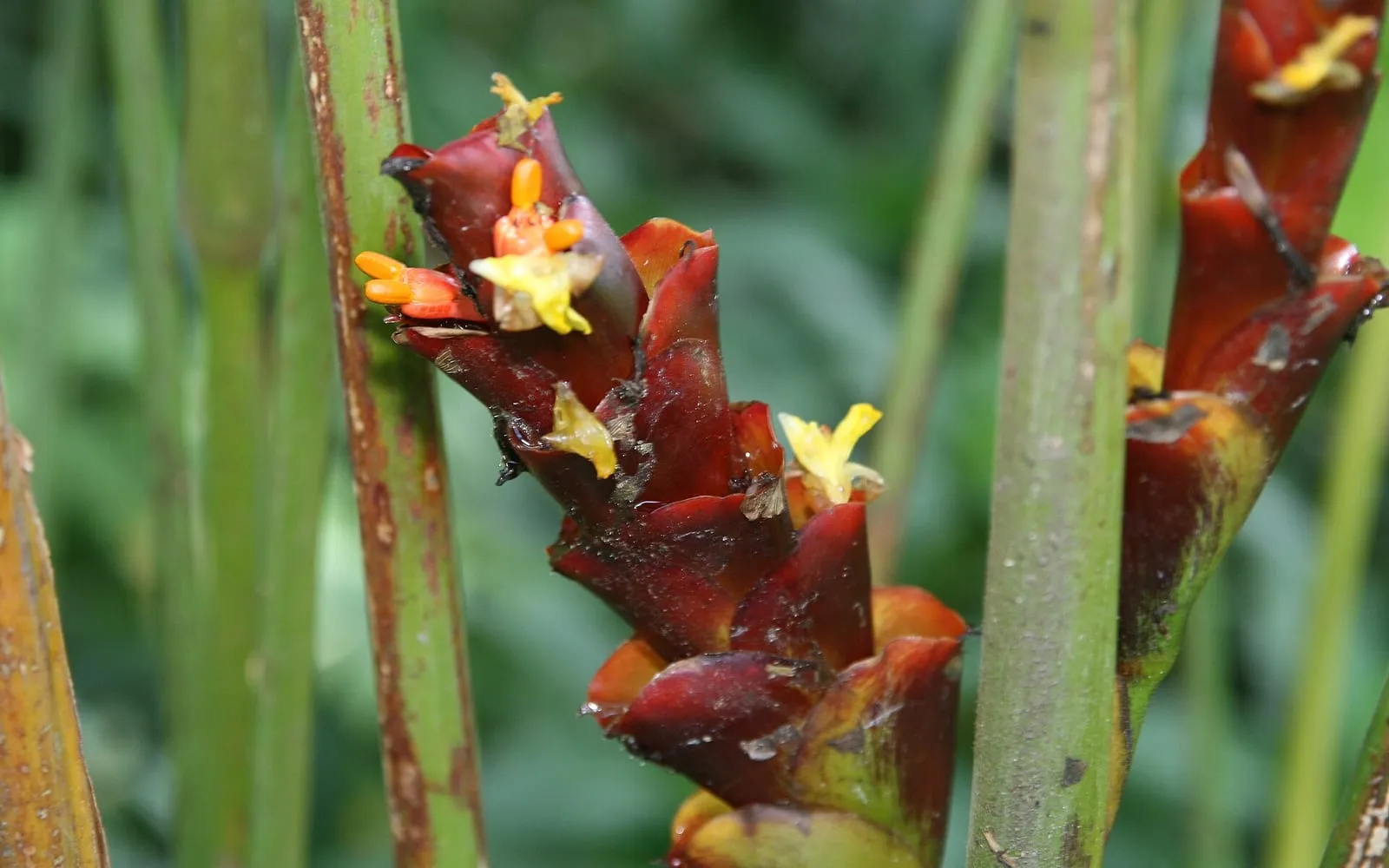
Most prayer plants are grown for intricate markings on modest leaves. Goeppertia lutea is different because of its size. In warm tropical ground it produces leaf blades on tall stalks that top two to three metres, forming a stand more like a young banana clump than the low rosette a windowsill grower expects. Botanists shifted the whole genus out of Calathea and into Goeppertia in 2012, so shops, plant labels and older reference books still sell and list this same species as Calathea lutea. The common name points not at the leaf but at the flower. Its blooms sit inside flattened, overlapping bracts of brown and dull yellow that stack into a plaited column, and to early observers that column looked like a rolled cigar or a flat woven braid.
Reading the leaf
The blade is huge, upright and paddle-shaped, tapering to a rounded point, and a mature one can run longer than an outstretched arm. The upper surface is matt mid-green, with no silvering, banding or feathered markings, so the plant relies on size rather than pattern. Flip a leaf and the underside has a dense chalky bloom, pale and faintly bluish, that rubs off on a finger like the coating on a plum. Across tropical America that wax was once scraped from the foliage and gathered as a usable material, sold under names such as cauassu or Mexican wax. The broad, tough blades have also been used for wrapping food and thatching shelters.
The prayer movement
In the evening the clump changes position. Blades that lie open through the day tilt upward on their stalks and gather closer, then drop and spread again after sunrise. That daily movement is nyctinasty, the same rhythm Darwin catalogued in sleeping plants, and it runs on a thick hinge of tissue called the pulvinus where each stalk joins its blade. Cells in the pulvinus shift water from one side to the other, changing their turgor and levering the leaf up or down. On a plant this large the motion is easy to see once the air is warm enough.
Where it grows wild
Goeppertia lutea ranges through the lowland tropics of Central and South America, from Mexico down through the Amazon basin, favouring damp ground along riverbanks, swamp margins and the wetter edges of open forest. It roots in soil that stays moist and rich with rotting litter, under light that is bright yet broken by taller growth overhead. No frost reaches it and no true dry rest interrupts the year, so a potted plant does badly with chill and should never dry out hard.
Light and position
Of all its relatives this one takes the most light. A bright room with generous indirect sun suits it, and it will accept an hour or two of gentle early sun that would scorch a thinner-leaved calathea. Full midday glare through unshaded glass still bleaches and burns the blade, so filter the strongest light. Give a large specimen space to arch its leaves without crowding a wall, and rotate the pot every week or two so it stands evenly instead of leaning towards the window.
Watering and water quality
Water when the top few centimetres of the mix feel dry, soaking the pot until water runs from the base, then emptying the tray so the roots never sit in water. A big plant in active growth drinks steadily through the warm months and needs far less once light fades. This species is more forgiving of hard tap water than the fussier patterned kinds, yet fluoride, chlorine and dissolved lime can still scorch the leaf edges over time, so collected rainwater or filtered water keeps the margins cleaner. In the cool of winter, hold back sharply, because sodden compost around chilled roots is what rots them.
Warmth and humidity
Steady warmth between about eighteen and twenty-eight degrees C keeps it growing, and it must never drop below roughly thirteen degrees C or sit in a draught from a door or a cold pane. Coming from humid riverside ground, it likes moist air, though its thicker leaves cope with ordinary room dryness better than the tissue-thin peacock or rattlesnake types. If the tips brown in a dry, heated room, stand the pot on a wide tray of wet pebbles or run a humidifier near it. Grouping several plants together also raises the local moisture.
Feeding, potting and increase
From spring into early autumn, feed every few weeks with a balanced houseplant fertiliser at half the stated strength, since a heavy dose can damage the roots. Stop feeding through winter. A vigorous plant fills its pot fast, so repot in spring when roots crowd the surface, moving up one size into an open, peat-free blend loosened with bark and perlite. Increase it by division: lift a mature clump in spring, split the rhizome into pieces that each keep roots and one or two growing points, and pot them up in warm, humid air until they root.
Common problems
Browned, papery leaf edges usually mean dry air or a build-up of minerals from hard water, so raise humidity and change your water source. Whole yellow leaves with soft, sour compost point to waterlogged roots; let the mix dry more between waterings and improve drainage. In warm, dry conditions spider mites may speckle the undersides and spin fine webbing, while mealybugs tuck white woolly patches into the leaf joints. Wipe mealybugs off with a cotton bud dipped in dilute alcohol and rinse mites away before treating.
Safe around pets and children
Goeppertia lutea has no serious poisoning record, and its family is listed as non-toxic to cats and dogs by the ASPCA, so a nibbled leaf should cause nothing worse than a brief stomach upset. It is a safe choice for a household with animals or young children. A big specimen is easy for a curious pet to reach, so place it where torn leaves and disturbed roots are less likely.
Quick answers
Why is my cigar calathea so much bigger than other calatheas? It is naturally one of the largest species in the group, grown for size rather than fine markings.
What is the pale coating under the leaves? A natural chalky wax, historically scraped off and collected for use.
How do I make more plants? Divide a mature clump in spring, keeping roots and a growing point on each piece.
Does it need as much humidity as other prayer plants? It appreciates moist air but tolerates ordinary rooms better than the thin-leaved kinds.
Cigar Calathea problem guides
Not sure what is wrong? See the common houseplant pests guide.