
Houseplant
Rainbow Plant
Byblis liniflora
Also known as Rainbow Sundew
How to grow Byblis liniflora indoors. Sticky thread-like leaves that flash rainbow colours in sunlight, and why this carnivorous plant lives for one season only.
At a glance
- Difficulty
- Moderate
- Water
- Keep constantly damp through active growth; the plant naturally dries out and dies back as seed matures
- Light
- Very bright light, ideally several hours of direct sun or strong grow lights
- Temperature
- 20-35 deg C; does not tolerate cold
- Humidity
- Moderate to high humidity supports the best growth
- Hardiness
- USDA 10-12, RHS H1b, hardy to 12 C
- Type
- Tender annual
- Height
- 15-25 cm
- Native to
- Australia, New Guinea
Native to the monsoonal tropics of northern Australia and New Guinea, where a hot, wet summer is followed by a pronounced dry season. It has essentially no cold tolerance and must be kept warm year-round, either in a heated greenhouse or on a bright, warm windowsill, since a garden outdoors in a temperate climate offers nothing close to the sustained heat and light it needs to complete its short life cycle.
Hardiness zones describe winter cold alone. Summer heat, humidity, rainfall and the length of the growing season decide as much, so treat the range as the outer limit rather than as a recommendation.
Not known to be toxic
Rainbow plant has no toxicity listing from the RHS or the ASPCA. The mucilage on its leaves is a trap for insects rather than a compound with any documented effect on people or pets, and there is no recorded case of it causing harm.
Source: RHS
About
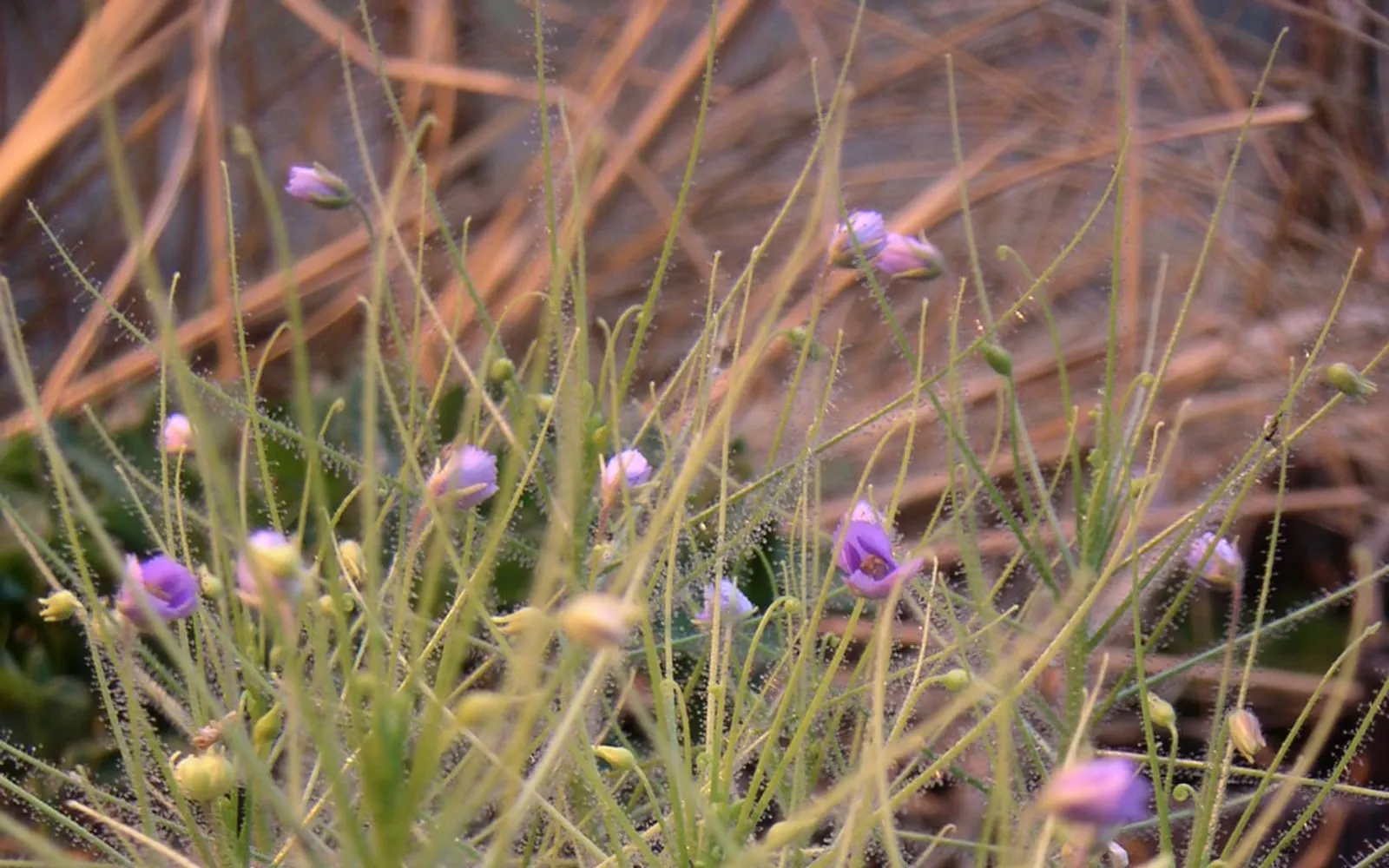
The rainbow plant earns its name from an effect best seen with the sun behind you rather than in front. Each of its narrow, thread-like leaves is covered in short-stalked glands, and the beads of mucilage they hold catch and split sunlight the way a prism does, throwing tiny flashes of colour across the surface of the plant. Sundews glisten in a similar way, but Byblis is not a sundew at all and is not even closely related to one; it sits in its own small family, more distantly connected to butterworts than to Drosera, and its resemblance to a sundew is a case of two unrelated plants arriving at a similar sticky solution independently.
It is also, unusually for a carnivorous plant, an annual. Most sundews, pitcher plants and butterworts are perennials that persist for years, regrowing season after season, but Byblis liniflora typically germinates, grows, flowers, sets seed and dies within a single season, racing through its whole life during the short wet-season window its native monsoon climate provides.
Most other Byblis species need smoke or a chemical smoke substitute to germinate reliably, a legacy of growing in a landscape shaped by seasonal bushfires. This species is the exception: its seed germinates readily without any fire cue at all, which is a large part of why it is the one most often grown and the easiest of the genus to raise from a packet of seed.
Appearance and character
The whole plant is built from narrow, almost wiry, cylindrical leaves that can reach 15 cm or more, growing upright in a loose, slightly untidy clump rather than a tidy rosette. Every leaf is coated from base to tip in sticky glands, and a plant grown in strong light develops a faintly reddish tinge across the foliage on top of its usual pale green.
Flowers are small but striking, five-petalled and typically pale violet with a cluster of yellow, off-centre stamens, opening in succession along the upper part of the plant through the growing season. This species self-pollinates readily as its flowers close, which is a large part of why it sets seed so reliably and so quickly compared with the several other Byblis species that depend on visiting bees for buzz pollination.
There is no visible movement to the trap itself; unlike a sundew, the thread-like leaves do not curl or bend around captured prey; the sticky surface alone does the work of holding and slowly digesting whatever lands on it.
Where it is from
Sandy, seasonally wet ground near streams and floodplains across the monsoonal tropics of northern Australia and southern New Guinea, where the climate runs warm year-round but swings sharply between a hot, humid wet season and a pronounced dry one. Seeds germinate fast in the first heavy rains, and the whole plant is built to grow, flower and set the next generation of seed before the ground dries out again.
That single-season strategy, rather than any lack of hardiness, is why it behaves so differently in cultivation from most other carnivorous plants: it is not trying to survive indefinitely, only to reproduce quickly while conditions are good.
How it grows
From germination, growth is fast by carnivorous plant standards, with seedlings reaching a noticeable size within weeks given consistent warmth, strong light and constant moisture. The plant branches modestly as it grows, producing more leaves and, before long, its first flowers, often within two or three months of germination under good conditions.
As the growing season progresses and seed pods mature, the plant naturally begins to decline, yellowing and drying from the base upward even under continued good care. This is the normal end of its single-season life cycle rather than a sign anything has gone wrong, and by the time the last seed pods have ripened and been collected, the parent plant is usually finished.
Propagation is almost always from seed, sown on the surface of a damp, sandy, low-mineral mix and kept warm and bright; germination typically takes one to three weeks, faster with a light smoke-water soak, though this species germinates acceptably without it.
Through the seasons
Because it lives for a single season rather than persisting year to year, this species does not follow the same spring-to-winter pattern most carnivorous plants do. Instead, growers usually stagger sowings to keep plants at different stages through the year.
Spring is a good time to start a fresh sowing, giving seedlings the longest run of increasing daylight to grow through before flowering.
Summer is when an established plant grows fastest, flowers most freely, and sets the bulk of its seed, provided it has strong light and constant warmth.
Autumn often sees an established plant beginning its natural decline as seed pods finish ripening, even with unchanged care.
Winter is not survived by the plant itself in most home setups, since it has no dormancy strategy and completes its life cycle instead. Collect seed before the parent dies back, and either sow it straight away in a heated, well-lit spot or store it dry and cool for a spring sowing instead.
Care difficulty
Moderate. Growing it well is not complicated: strong light, warmth and constant moisture cover most of what it needs. The annual life cycle needs a different mindset, because a decline that would signal a problem in a Sarracenia or a Pinguicula is this species finishing its season on schedule.
Watering
Keep the compost constantly damp throughout active growth, standing the pot in a shallow tray of rainwater or distilled water and topping it up regularly; this species has little tolerance for drying out while it is actively growing. As the plant naturally begins its end-of-season decline, watering can be reduced gradually rather than kept at full pace, mirroring the drying conditions its native wet season gives way to.
Tap water and mineral-rich water both damage the fine roots over time, in the same way they do for most other carnivorous plants, so rainwater or distilled water is worth sourcing even for a plant that will only live a few months.
Warning signs, diseases and pests
Aphids occasionally colonise the flower stalks and softer new growth near the tips. Remove them by hand or with a gentle rinse; a light infestation rarely threatens an otherwise healthy, fast-growing plant.
Spider mites can become a problem in warm, dry indoor air, showing as fine stippling on the leaves and faint webbing between them. Raising the humidity around the plant and rinsing the foliage periodically helps prevent an infestation from taking hold.
Botrytis can develop on the lower stem in still, overly humid conditions, particularly as the plant begins its natural late-season decline. Improving airflow around the base of the plant is more useful than treating it as a disease at that stage of its life.
A plant that yellows and dies back within a few months of sowing, having flowered and set seed, is not a sign anything went wrong. This species is completing its normal annual cycle.
Growing environment
Very bright light is essential; this species comes from open, sunny tropical ground and performs poorly in anything less than several hours of strong direct sun or an equivalent grow light, becoming thin and sparse-flowering in shade. Moderate to high humidity supports the fastest growth, though it tolerates drier air better than many tropical carnivorous plants provided the roots stay damp.
Keep it consistently warm, ideally 20 to 35 deg C, and avoid any prolonged exposure below about 12 deg C, since this species has essentially no cold tolerance at any life stage. Use a nutrient-poor, sandy, low-mineral mix, such as peat-free sphagnum combined with coarse sand, kept damp but with enough drainage to avoid waterlogging.
Feeding
No fertiliser applied to the compost. The sticky leaves catch fruit flies and other small flying insects on their own, and a plant grown near a window with a reasonable amount of passing insect life usually needs no supplementary feeding at all through its short growing season.
Troubleshooting
The plant is yellowing and dying after a few months of good growth. Expected, not a fault. This species is an annual and dies back naturally after flowering and setting seed; collect seed to sow again.
Seeds have not germinated after several weeks. Try a shorter soak in diluted smoke water before sowing; while this species germinates without it, treated seed tends to come up faster and more evenly.
Fine webbing and speckled leaves have appeared in dry indoor air. Spider mites. Raise the humidity around the plant and rinse the foliage with water to discourage them.
The plant is thin, sparse and flowering poorly. Almost always insufficient light. Move it to the brightest spot available or add a dedicated grow light.
Leaves have stopped producing sticky dew. Usually dryness or a drop in humidity. Increase watering frequency and check the compost is not being allowed to dry out.
Can I keep one plant going for more than one season? Not reliably. This is a true annual, and even with ideal care it will complete its life cycle and die back within roughly six months to a year of germination.
Is it worth buying a mature plant rather than growing from seed? Either works, but because the whole life cycle is short, many growers find seed more practical in the long run, since a single healthy plant produces enough seed for several future sowings.
Rainbow Plant problem guides
Not sure what is wrong? See the common houseplant pests guide.