
Houseplant
Australian Pitcher Plant
Cephalotus follicularis
Also known as Albany Pitcher Plant
How to grow Cephalotus follicularis, a pitcher plant restricted to a small corner of Western Australia, whose lid confuses prey with false windows of light.
At a glance
- Difficulty
- Difficult
- Water
- Keep the compost consistently damp, easing off slightly in winter
- Light
- Bright light with some direct sun; strong light produces the deepest pitcher colour
- Temperature
- 15-28 deg C in summer; a cool winter rest around 5-10 deg C is important
- Humidity
- High humidity with good airflow; stagnant air encourages rot
- Hardiness
- USDA 8-10, RHS H2, hardy to -2 C
- Type
- Tender herbaceous perennial
- Height
- 5-10 cm; pitchers to about 5 cm
- Native to
- Australia
Restricted in the wild to peaty swamps around Albany in the far southwest corner of Western Australia, a tiny range for such a widely grown plant, under a Mediterranean-type climate of warm dry summers and cool wet winters. It tolerates a light frost when fully dormant but has no reliable cold hardiness beyond that, and is better treated as a cool greenhouse or windowsill plant than as anything grown outdoors in a frost-prone garden.
Hardiness zones describe winter cold alone. Summer heat, humidity, rainfall and the length of the growing season decide as much, so treat the range as the outer limit rather than as a recommendation.
Not known to be toxic
Australian pitcher plant has no toxicity listing from the RHS or the ASPCA. The fluid inside the pitchers is water and digestive enzymes rather than anything documented as harmful to a person or a pet.
Source: RHS
About
Cephalotus follicularis is the only species in its genus and its own plant family, found nowhere on Earth outside a narrow strip of peaty swamp around Albany, on the far southwest coast of Western Australia. It is thought to be an ancient Gondwanan relict, a survivor from a time when this part of Australia had a much warmer, wetter climate, and its closest relatives are scattered oddly across the plant world rather than sitting neatly beside any other pitcher plant.
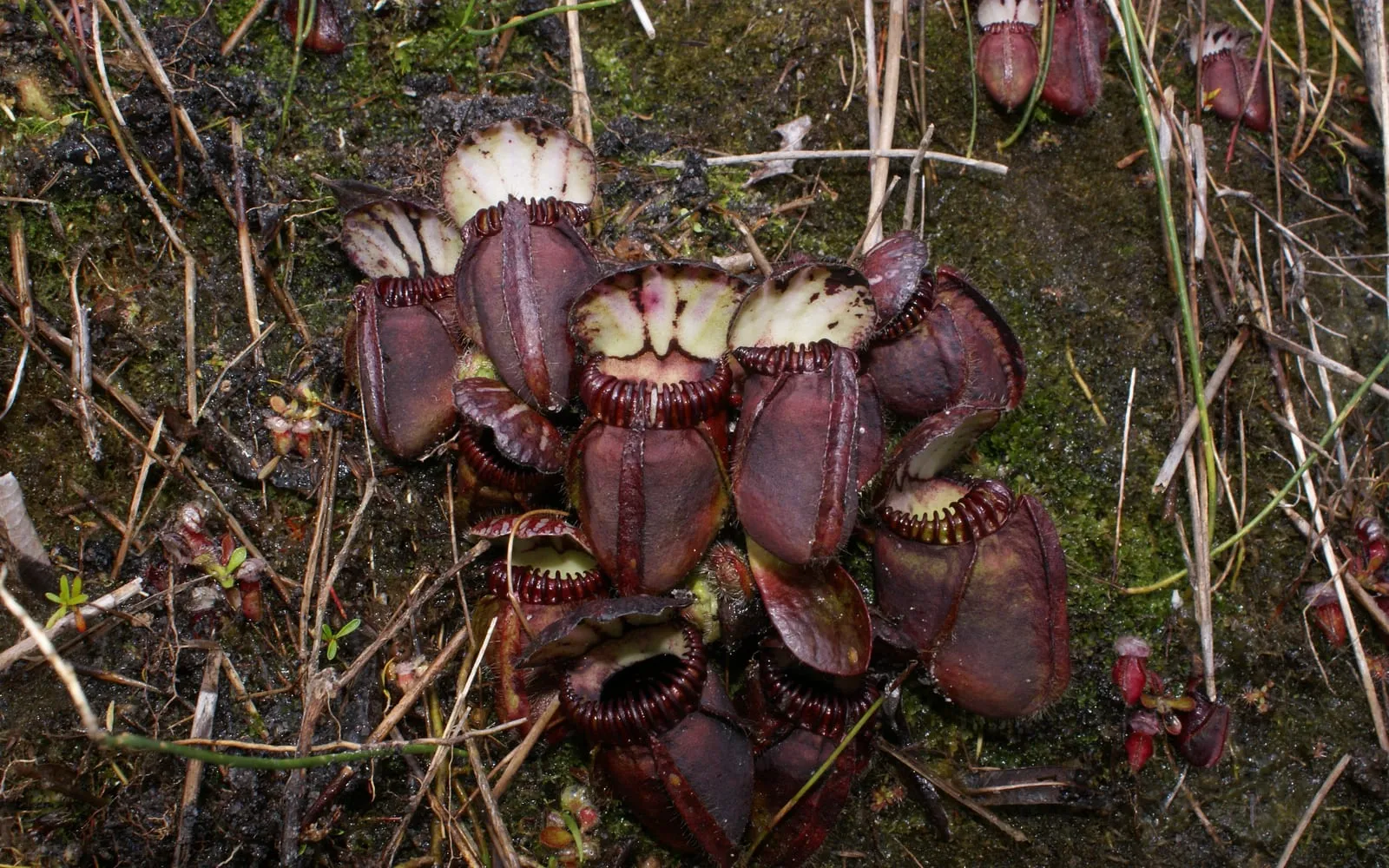
Its trap works on the insect’s sense of direction rather than on any stickiness or speed. A hinged lid, called an operculum, sits over the opening of each squat pitcher and is studded with pale, translucent patches that let light through. An insect that has fallen into the trap and is searching for a way out heads instinctively towards the brightest light it can see, which is usually one of these false windows in the lid rather than the real exit below it. It repeatedly strikes the underside of the lid, tires, and eventually drops back down past the sharply toothed, downward-pointing ribs that line the rim, from which there is no climbing back out.
Because of its small range and the demand for it among collectors, all flora in Western Australia is protected under state legislation, and it was once listed on CITES Appendix II before being removed in 2000 once nursery-propagated plants, rather than wild-collected ones, came to supply almost all of the international trade.
Appearance and character
Each plant alternates between two entirely different kinds of leaf. Flat, oval, non-carnivorous leaves handle most of the plant’s ordinary photosynthesis, while separate leaves develop into the traps. These are small, squat, urn-shaped pitchers with a heavily ribbed, fanged-looking rim and a domed, patterned lid held above the opening. Well-grown pitchers in strong light develop deep burgundy-red colouring around the rim and lid, fading to green in shadier conditions, and the overall shape has earned it comparisons to everything from a tiny moccasin to a set of jaws.
The balance between the two leaf types shifts with the season, and a plant producing mostly flat leaves is not unwell so much as focused on photosynthesis rather than trapping at that point in its cycle. Small, star-shaped, cream-coloured flowers appear on a tall, wiry stalk held well above the foliage, though flowering is comparatively rare in cultivation and the tiny blooms are easy to miss next to the pitchers.
Where it is from
Permanently damp, peaty, acidic swamps and seepage areas in the far southwest corner of Western Australia, under a climate with warm, dry summers and cool, wet winters rather than the tropical conditions many carnivorous plants come from. Rainfall is concentrated in winter, and summer drought is offset by a consistently high water table rather than by rain.
That combination, summer warmth with permanently wet roots, followed by a cooler, still-damp winter, is the pattern to aim for in cultivation, and it is different enough from a typical tropical carnivorous plant’s needs that treating it the same way as a Nepenthes or a sundew tends to go badly.
How it grows
Growth is slow and steady rather than rapid, with new leaves, whether flat or pitchered, emerging from the centre of the rosette over the course of weeks rather than days. A plant typically produces more pitchers during the warmer months when insect prey is more abundant, switching towards flat, purely photosynthetic leaves as the light and warmth of summer fade.
The rhizome creeps very slowly, and an established plant eventually forms small offsets around the base that can be separated once they have their own roots, though disturbing the root system at all is something this species tolerates poorly and division should be done only when necessary.
Propagation from leaf cuttings, using a flat, non-carnivorous leaf pressed into damp, low-mineral compost, is the more common method among growers, though it is slow, often taking several months to show any sign of a new plantlet.
Through the seasons
Spring brings a resumption of active growth after winter’s rest, with new leaves, gradually more of them pitchers rather than flat foliage, emerging as temperatures rise.
Summer is the period of fastest growth and the best pitcher production, provided the roots stay consistently damp without becoming waterlogged. Strong light through this period produces the deepest pitcher colouring.
Autumn sees growth slow and often a shift back towards flat, photosynthetic leaves as the plant prepares for its cooler rest.
Winter calls for a genuine but mild dormancy. Give it cooler temperatures, around 5 to 10 deg C, reduced light and slightly less frequent watering, for roughly three to four months. This species does not need anything close to a hard freeze, but skipping the cool rest altogether tends to weaken it and reduce flowering and pitcher production the following year.
Care difficulty
Difficult. It sits awkwardly between the tropical and cold-hardy carnivorous plant groups, wanting warmth and humidity through summer but a distinctly cooler, still-damp winter rest, and it is markedly less tolerant of disturbance to its roots than most other carnivorous plants, making repotting and division riskier than with a Sarracenia or a sundew.
Good airflow combined with high humidity, rather than either alone, is the detail that trips up the most growers, since stagnant, humid air around this species readily tips over into rot.
Watering
Keep the compost consistently damp throughout spring, summer and autumn, using a shallow tray of rainwater or distilled water beneath the pot topped up regularly, and ease off slightly in winter so the compost stays damp rather than saturated during the cooler rest.
Avoid letting the pot stand permanently flooded at any time of year; unlike a bog-native Sarracenia, this species prefers damp rather than fully waterlogged conditions and its roots are more prone to rot in standing water. Rainwater or distilled water only, since tap water’s dissolved minerals build up quickly in the low-nutrient mix it needs.
Warning signs, diseases and pests
Mealybugs can hide in the crown among the developing leaves, showing as small white cottony patches. Remove them carefully with a cotton bud dipped in diluted washing-up water, working gently given how easily this species’ roots and crown are disturbed.
Scale insects sometimes appear on older pitchers as small brown discs and can usually be scraped away by hand without needing any chemical treatment.
Root rot is the most serious risk, usually following waterlogged compost, poor airflow, or a mix that holds too much moisture for too long. A plant that has stopped producing new leaves and feels loose in its pot should be checked; any soft, blackened roots need to be trimmed back to healthy tissue before repotting into a fresher, more open mix.
A plant producing only flat leaves for an extended period, with no pitchers at all, is more often a light or seasonal issue than disease, and usually resolves once conditions improve.
Growing environment
Bright light, including some direct sun, produces the strongest pitcher colour and the best trapping performance; a shaded plant produces mostly flat leaves and pale, undersized pitchers. High humidity suits it well, and it also needs good airflow around the foliage, since the combination of stagnant, damp air most often leads to rot in cultivation.
Keep it within 15 to 28 deg C for most of the year, with a cooler winter rest as described above. Use a low-nutrient, free-draining mix, such as peat-free sphagnum combined with sand and perlite, in a pot that drains well rather than one designed to hold standing water.
Feeding
No fertiliser applied to the compost, which damages this species’ roots more readily than it does most other carnivorous plants. Nitrogen instead comes from insects caught in the pitchers.
A small dead insect, such as a fruit fly or a tiny ant, dropped into an open, fluid-filled pitcher once or twice a month during the growing season is plenty; overfeeding a pitcher can cause it to blacken and die back early.
Troubleshooting
Pitchers are small, pale and undersized. Usually not enough light. Move the plant somewhere it gets bright light with some direct sun.
The plant is producing only flat leaves, no pitchers at all. Often seasonal, particularly in autumn and winter, or a sign of insufficient light. Check both before assuming a problem.
Roots feel mushy and the plant is loose in its pot. Root rot, usually from compost that has stayed too wet for too long with poor airflow. Trim back to healthy roots and repot into a fresher, more open mix.
Leaves are yellowing and dropping from the base. Can indicate either overwatering or the natural dieback of older leaves; check whether new growth at the centre still looks healthy before assuming the worst.
A fed pitcher has blackened and died early. Overfeeding. Offer smaller or fewer insects, and let the pitcher’s own capture do most of the work rather than supplementing heavily.
The plant has not flowered in years of cultivation. Common; flowering is comparatively rare in cultivated Cephalotus even under good conditions, and its absence is not on its own a sign anything is wrong.
Can I keep it in a fully enclosed terrarium? Only with active ventilation. This species’ need for airflow alongside humidity makes a sealed, unvented terrarium one of the more reliable ways to lose it to rot.
Australian Pitcher Plant problem guides
Not sure what is wrong? See the common houseplant pests guide.