
Houseplant
Puttyroot
Aplectrum hyemale
Also known as Aplectrum hyemale
How to grow Aplectrum hyemale, the puttyroot, an eastern North American forest orchid with one pleated leaf in winter that withers by late spring.
At a glance
- Difficulty
- Difficult
- Water
- Evenly moist in growth; ease off for any rest
- Light
- Dappled shade; winter sun under a bare canopy
- Temperature
- Hardy; cool woodland conditions
- Humidity
- High
- Hardiness
- USDA 4-8, RHS H7, hardy to -25 C
- Type
- Perennial
- Height
- 30-55 cm
- Native to
- eastern North America
A woodland orchid of eastern North America that is fully hardy where deciduous forest gives it cool, moist, humus-rich soil. It needs the winter light of a leafless canopy and cool summers, and it fails in heat and in soil without its fungal partners, so winter cold is not what limits it.
Hardiness zones describe winter cold alone. Summer heat, humidity, rainfall and the length of the growing season decide as much, so treat the range as the outer limit rather than as a recommendation.
Not known to be toxic
Aplectrum hyemale, the puttyroot, is not recorded among the seriously toxic plants, and related plants in its group are not listed as toxic by the ASPCA or the RHS. A pet or child that chewed a leaf would be unlikely to come to serious harm beyond a possible mild stomach upset.
Sources: ASPCA toxic and non-toxic plants, RHS potentially harmful garden plants
An orchid with separate leaf and flower seasons
Aplectrum hyemale has an unusual annual cycle. In autumn it unfurls a single broad, pleated, dark green leaf, silvered with fine white veins, and that one leaf photosynthesises all winter beneath the bare canopy of an eastern North American hardwood forest. By late spring the leaf withers away, and only then does the plant push up a leafless stalk of modest greenish-purple flowers. The specific name hyemale, meaning of winter, refers to that lone overwintering leaf, and the English name puttyroot comes from the sticky, glue-like paste inside its corms, once used to mend broken pottery.
Recognising it
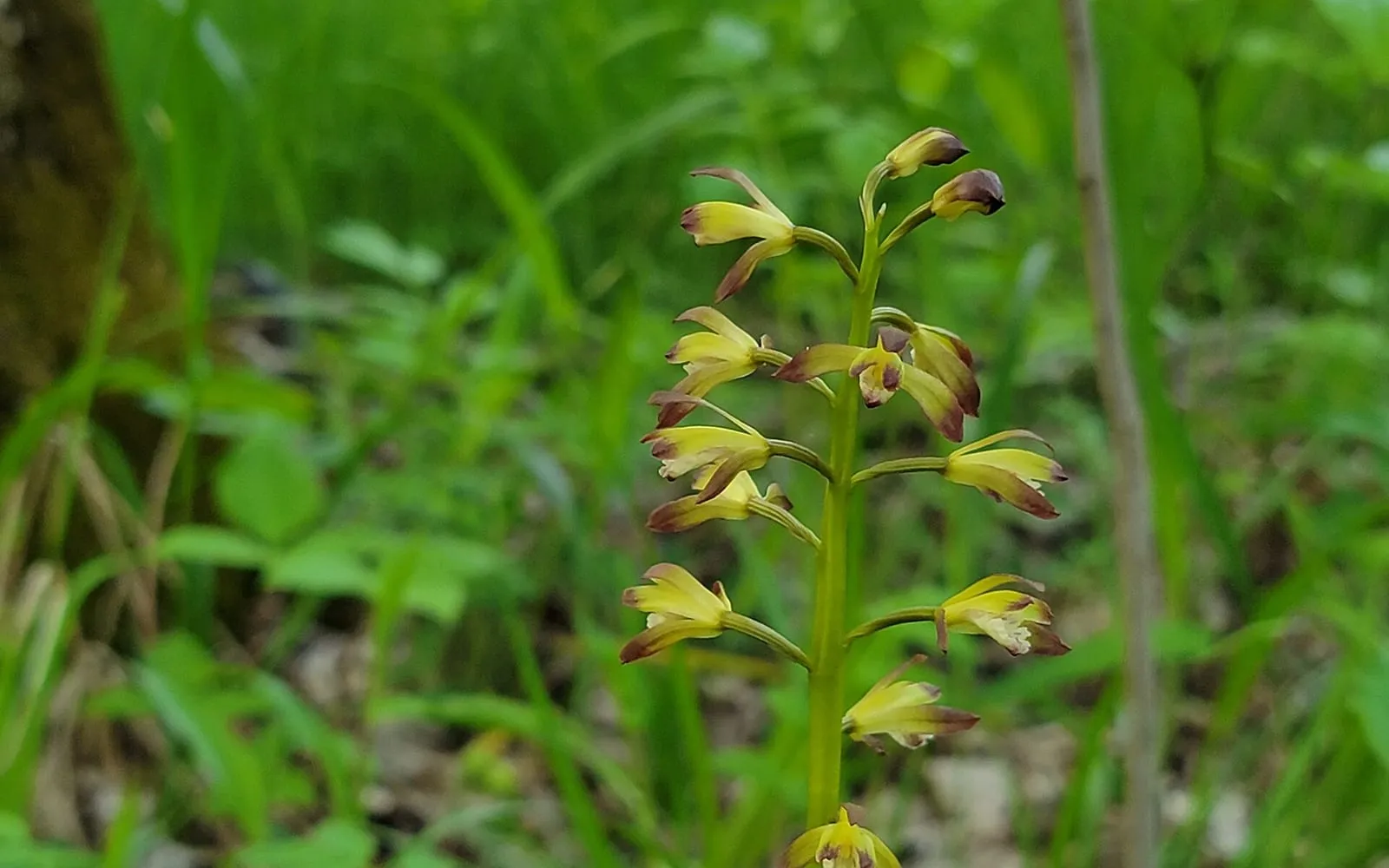
For most of the year the plant is a single leaf on the woodland floor, elliptical, strongly ribbed and up to a hand-span long, easy to overlook among fallen leaves except for its pale veining. The flowering stem, appearing after the leaf has gone, is slender and carries a loose spike of small flowers, each with greenish-yellow to brownish sepals and petals tinged purple, and a whitish, purple-marked, three-lobed lip. Underground, the rounded corms grow in a connected chain, each year’s linked to the last, which gives rise to another folk name, Adam-and-Eve.
Its woodland home
Puttyroot grows in moist, shady deciduous and mixed woodland, especially in rich, damp bottomland forest, beech and maple woods and along wooded stream terraces, on humus-rich soils that stay cool and moist. It needs the leaf litter and the seasonal light window of a deciduous canopy, taking in sun through winter and early spring before the trees leaf out and shade the floor. Its range covers much of eastern North America, from southern Canada through the eastern and central United States, though it is nowhere common and is easily missed.
Flowering and pollination
The greenish flowers are not showy and produce only a little scent, and pollination is often sparse; small bees are among the visitors, and many spikes set few seeds. Those that are fertilised ripen capsules of the fine, dust-like seed characteristic of orchids. Much of the plant’s persistence comes not from prolific seeding but from the slow vegetative increase of its chain of corms, which lets an established plant stay on the forest floor over many years.
Why it will not transplant
Puttyroot depends on woodland fungi both to germinate and to grow. Its seeds carry no food reserve and sprout only when a soil fungus enters them, and the plant retains a strong reliance on that fungal partnership through its life. A corm dug from the forest is cut off from the fungal network and from the cool, moist, humus-rich conditions it needs, so it declines and dies. It is difficult to raise or establish away from its habitat, and wild plants should be left where they grow; digging them up harms slow-growing colonies and, on protected land, may be unlawful.
Conservation
Puttyroot is uncommon and localised, and it suffers where rich woodland is logged, cleared, drained or invaded by aggressive non-native plants and browsing deer that strip the forest floor. It is listed as rare or of conservation concern in a number of states and provinces. Because it grows slowly and depends on undisturbed woodland soil, disturbance has lasting effects, and collecting is discouraged everywhere. All orchids are covered by CITES trade controls. Mature, moist hardwood forest with an intact leaf-litter layer is the habitat it needs.
A leaf for winter, a flower for spring
Puttyroot has the reverse pattern of many woodland plants. It sends up a single broad, pleated leaf in autumn and holds it green all through the winter, photosynthesising in the low light that reaches the floor of a leafless forest, when the trees above are bare and nearby plants are dormant. As spring arrives and the canopy begins to close, the leaf yellows and dies, and only then does the plant raise its flowering stalk. The leaf and flower are rarely seen together, which makes the winter leaf one of the easiest ways to recognise the plant.
Adam and Eve underground
Beneath the surface, puttyroot grows a string of rounded corms, each year’s new corm joined to the previous one, so that a mature plant carries a little chain of them like beads. The paired or linked corms gave rise to the old name Adam-and-Eve, and the sticky, mucilaginous paste inside them supplied the name puttyroot, because settlers are said to have used the glue-like substance to cement broken crockery and to fix parts together. The corms store the food the plant makes through its winter of photosynthesis, supporting the leafless spring flower spike.
A plant of rich, undisturbed woods
Puttyroot is a plant of mature, moist hardwood forest, favouring the rich, humus-laden soils of beech and maple woods and shaded stream terraces, where a deep layer of leaf litter and a stable, undisturbed floor let it persist. It depends on that continuity, and it fares badly where woods are logged, where deer browse the floor bare, or where aggressive introduced plants smother the ground layer. Because it grows slowly and spreads mainly by adding to its corm chain, a colony represents many years of growth, and once lost it is slow to return.
Questions people ask
Why does it flower after its leaf dies? It photosynthesises through winter with a single leaf, then flowers in late spring once that leaf has withered, using stored reserves in its corms.
Where does the name puttyroot come from? The corms contain a sticky, glue-like paste that was once used as a cement for mending crockery.
What is the Adam-and-Eve name about? The corms grow in a connected pair or chain, one linked to the next, suggesting two figures side by side.
Can I move it to my shade garden? No. It relies on woodland fungi that cannot be transplanted and on cool, moist forest soil.
When does it flower? In late spring, around May and June, after the overwintering leaf has faded.
Puttyroot problem guides
Not sure what is wrong? See the common houseplant pests guide.