
Houseplant
Purplish Beard Orchid
Calochilus robertsonii
Also known as Calochilus robertsonii
How to grow Calochilus robertsonii, the purplish beard orchid, an Australian ground orchid with a long purplish-bronze bearded lip.
At a glance
- Difficulty
- Difficult
- Water
- Evenly moist in growth; ease off for any rest
- Light
- Open, bright light in growth
- Temperature
- Cool, wet growing season and dry summer rest; tolerates light frost
- Humidity
- Average, with good airflow
- Hardiness
- USDA 8-10, RHS H3, hardy to -5 C
- Type
- Perennial
- Height
- 15-40 cm
- Native to
- southeastern Australia, New Zealand
A tuberous orchid of southeastern Australia and New Zealand that grows through the cool, wet months and rests dry underground in summer. It takes light frost, but it rots in warm, wet compost and depends on soil fungi, so the zone says little about whether it will survive cultivation.
Hardiness zones describe winter cold alone. Summer heat, humidity, rainfall and the length of the growing season decide as much, so treat the range as the outer limit rather than as a recommendation.
Not known to be toxic
Calochilus robertsonii, the purplish beard orchid, is not recorded among the seriously toxic plants, and related plants in its group are not listed as toxic by the ASPCA or the RHS. A pet or child that chewed a leaf would be unlikely to come to serious harm beyond a possible mild stomach upset.
Sources: ASPCA toxic and non-toxic plants, RHS potentially harmful garden plants
About
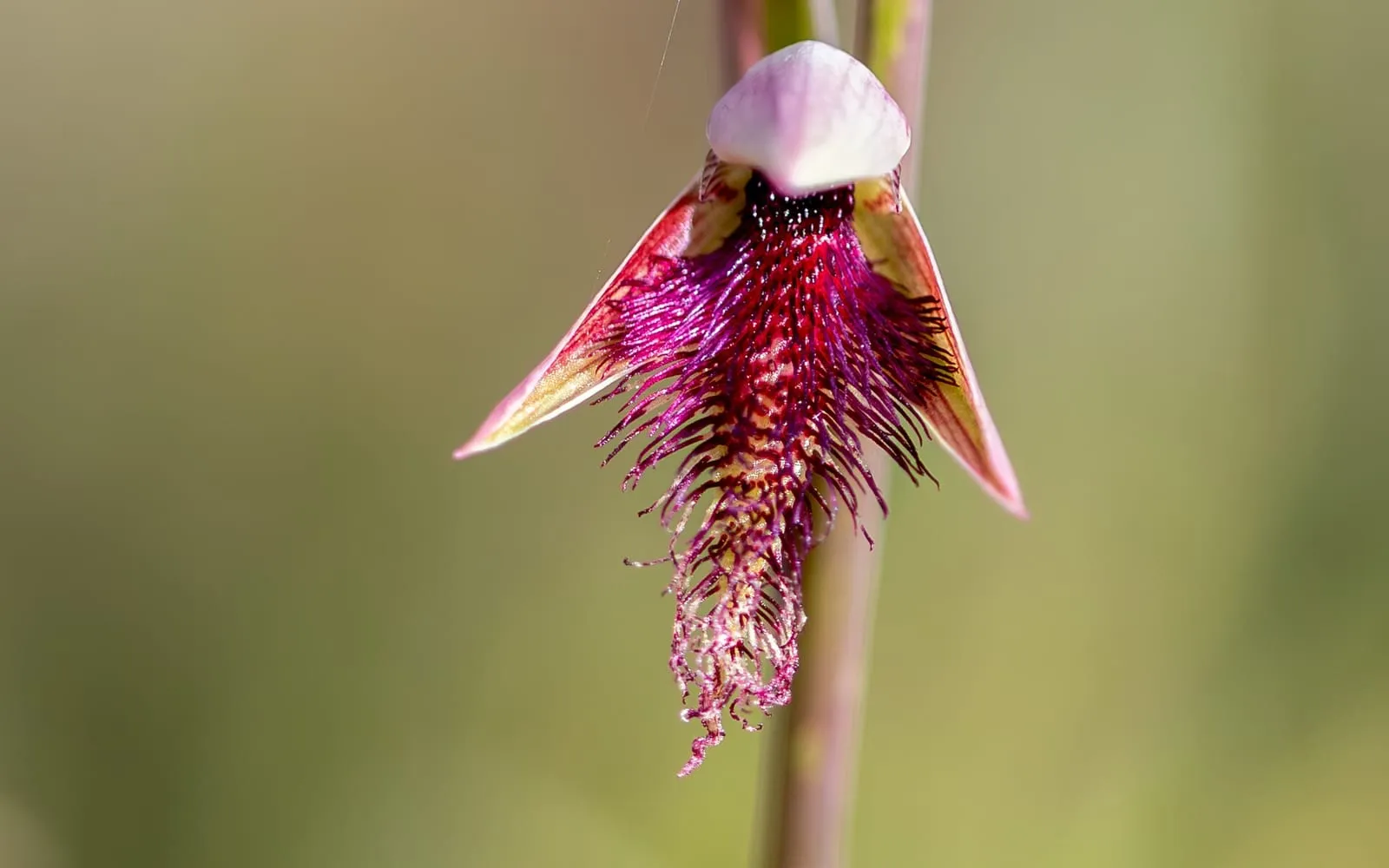
Calochilus robertsonii is the common beard orchid of southeastern Australia, extending also to New Zealand, and it is the species most people picture when they hear the name. Its labellum bears the long dense hairs typical of the genus, here in shades of purplish-bronze and greenish-purple that give it the common name purplish beard orchid. A tuberous ground orchid, it grows in forest, woodland and heath through the cooler wetter months and retreats to its tuber over the dry summer. Beard orchids are difficult to keep in cultivation because they depend on soil fungi and a specialised pollination system, so this is mainly a guide to recognising and understanding the plant.
Appearance and character
The plant produces a single erect, fleshy, grooved leaf and a flowering stem carrying up to about nine blooms, which open widest on warm sunny days. Each flower centres on the bearded lip, densely covered in long purplish to metallic greenish hairs, with the sepals and petals behind it greenish and marked with reddish-brown lines. The flower resembles an insect, which explains its slightly bizarre appearance to human eyes. The lone upright leaf, present only during the growing season, is a reliable identifying feature, and the overall plant is slender and easy to overlook among forest-floor herbs until the beard-tipped flowers open.
Where it is from
The species is native to southeastern Australia and New Zealand, growing in eucalypt forest, woodland, heath and grassy places on well-drained soils. Its climate brings cool moist winters and warm dry summers, and the orchid grows through the cooler wetter part of the year, resting underground when the ground dries. As with its relatives, it depends on particular soil fungi that its seed needs to germinate and its tuber relies on, and that dependence is central to why it does not take to cultivation.
How it grows
Growth comes each year from an underground tuber. The single leaf and then the flower stem develop through the cool wet season, the tuber is renewed, and the plant dies down for summer after flowering. Its blooms mimic a female wasp, and males that try to mate with them may move pollen from flower to flower, though Calochilus robertsonii most often pollinates itself when no wasp visits. The seed is fine as dust and germinates only in the presence of the right fungus, so plants build slowly in the wild and are very hard to raise deliberately without symbiotic laboratory methods.
Through the seasons
Autumn ends the summer rest as rain and cooler air return, and the solitary leaf pushes up from the tuber.
Winter through early spring is the active growing phase, the leaf feeding the tuber and the flower stem forming in cool bright moist conditions.
Spring is flowering time, the purplish beards opening to draw in their wasp pollinators.
Summer brings full dormancy; the leaf dies away, water is withheld, and the tuber rests until the wet season returns.
Care difficulty
This is among the most challenging orchids to cultivate. The plant’s reliance on specific mycorrhizal fungi means it rarely survives digging or potting, and it will not tolerate departures from its cool-wet-growth, hot-dry-rest cycle. The best advice is to appreciate it where it grows and leave it undisturbed, since even skilled growers of Australian terrestrials struggle to maintain beard orchids, and taking plants from the wild both fails and harms populations. The care notes here are mainly for context.
Watering
Should a plant be kept, watering must track the growing season closely. Moisture is given as the leaf emerges in autumn and continued through the cool winter and spring while growth and flowering proceed, always with clean low-mineral water in a sharply drained medium so the tuber is never left in stagnant wet. As the leaf ages in late spring, watering stops, and the tuber is held dry through the summer dormancy. Wet conditions during rest are a frequent cause of loss among tuberous terrestrials.
Warning signs, diseases and pests
A tuber that rots or fails to re-emerge usually reflects watering out of season, disturbance, or the absence of its fungal partner, and recovery is often impossible once decline begins. In artificial culture, aphids may gather on the soft flower stem, and fungus gnats indicate compost kept too wet. Because so much of the plant’s health depends on unseen soil biology, the practical defences are limited to clean, cool, airy, correctly timed conditions and to disturbing the tuber as little as possible.
Growing environment
In nature the plant occupies open forest and heath with free-draining soil that is moist in winter and dry in summer and carries the fungi it needs. Any cultivation attempt calls for bright cool conditions, a very free-draining sandy mix and, ideally, soil or inoculum bearing the appropriate mycorrhiza. Warmth and stagnant moisture are quickly fatal. Assembling these conditions on purpose is difficult.
Feeding
Feeding matters little to this orchid. Much of its nourishment in the wild comes through its fungal associate from thin forest and heath soils, so any feeding under cover should be minimal and very dilute to avoid harming both the roots and the fungal partnership. No feed is given during dormancy, when the tuber is taking nothing from the medium.
Troubleshooting
Why can’t I keep it alive? It depends on specific soil fungi for germination and health, so it seldom survives away from its natural setting.
Can I dig one up to grow at home? No. Wild plants rarely survive transplanting and removing them harms fragile colonies, so leave them in place and photograph them.
What is the beard for? The dense purplish hairs help the flower imitate a female wasp, drawing males that carry pollen while trying to mate.
Is a summer-bare pot a failure? If the tuber lives, dormancy is normal, though these orchids often do not persist once disturbed.
Does it harm pets? No serious toxicity is recorded for the genus, but discourage pets from chewing it.
Purplish Beard Orchid problem guides
Not sure what is wrong? See the common houseplant pests guide.