
Houseplant
Heath Spotted Orchid
Dactylorhiza maculata
Also known as Dactylorhiza maculata
How to grow Dactylorhiza maculata, the heath spotted orchid, a marsh orchid of acid moor and heath with boldly blotched leaves.
At a glance
- Difficulty
- Difficult
- Water
- Evenly moist in growth; ease off for any rest
- Light
- Full sun to light shade
- Temperature
- Fully hardy to about -25 deg C; dislikes hot summers
- Humidity
- High
- Hardiness
- USDA 5-9, RHS H7, hardy to -25 C
- Type
- Perennial
- Height
- 15-45 cm
- Native to
- Europe, North Africa
A hardy terrestrial orchid of cool, wet, acid moors and heaths across Europe and North Africa, which survives winters well below -20 deg C as a dormant tuber. It needs cool, constantly moist summers, low-nutrient acid ground and its soil fungus, and it fades in hot, dry summers and in rich or limy soil.
Hardiness zones describe winter cold alone. Summer heat, humidity, rainfall and the length of the growing season decide as much, so treat the range as the outer limit rather than as a recommendation.
Not known to be toxic
Dactylorhiza maculata, the heath spotted orchid, is not recorded among the seriously toxic plants, and related plants in its group are not listed as toxic by the ASPCA or the RHS. A pet or child that chewed a leaf would be unlikely to have more than a possible mild stomach upset.
Sources: ASPCA toxic and non-toxic plants, RHS potentially harmful garden plants
The orchid of acid moor and heath
Dactylorhiza maculata is a marsh orchid of acid moor and heath rather than lime-rich fen. Where its close relatives crowd into lime-rich wetlands, the heath spotted orchid spreads across acid moorland, damp heaths, boggy pasture and the margins of upland flushes, from Europe into North Africa. It is one of the commonest wild orchids over much of that range, and on a good July hillside its pale, finely marked spikes can dot the ground in their hundreds among the heather and purple moor-grass.
Telling it apart
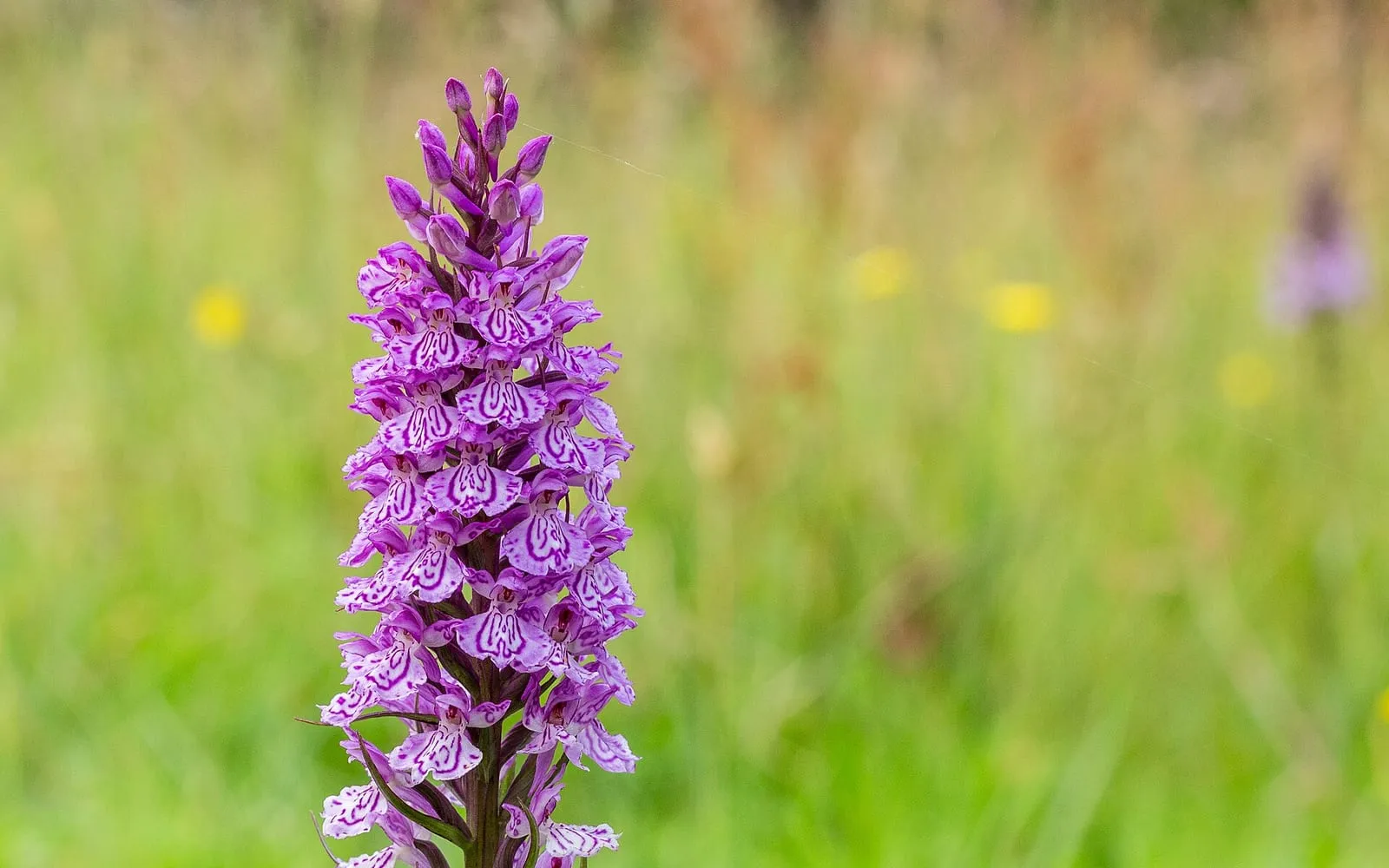
The leaves explain the name: narrow, keeled and boldly marked with rounded dark blotches and bars, hence maculata, meaning spotted. The flower spike is broad and rather flat-topped at first, opening into a conical head of pale flowers. Each bloom is white to soft lilac, marked with fine broken lines and dots of darker purple, and the lip is broad and shallowly three-lobed, with a small central tooth flanked by two much wider rounded side lobes. That broad, weakly toothed lip separates it from the common spotted orchid, whose central lobe is longer and more sharply projecting.
Its home ground
The species keeps to acid and neutral soils, the reverse of most marsh orchids, growing on wet heathland, blanket bog margins, moorland flushes, damp acid grassland and open birch or willow scrub over peat. It needs ground that stays moist but not stagnant, with the low fertility and open sward that heathland provides. It grows through the cooler, wetter parts of Europe, thriving in the west and north where high rainfall and thin acid soils suit it, and reaching south into the mountains of North Africa.
Flowering and seed
Bumblebees, honeybees and various flies visit the spikes, drawn by the patterned lip. As in the other marsh orchids the reward is small, so pollination depends partly on the flowers resembling nectar-rich blooms nearby. Successful flowers ripen slender capsules packed with seeds as fine as powder, which the wind lifts and scatters across the open moor. Below ground the plant carries the divided, finger-like tuber that names the genus, renewing it each season to support the following year’s spike.
Why it is not a windowsill orchid
The heath spotted orchid depends on habitat conditions that no windowsill can copy. Its dust seeds carry no reserves and sprout only when a compatible soil fungus enters them, and the young orchid depends on that fungus underground for a long spell before its first leaf appears. A wild plant dug from a bog is cut off from the fungus and from the acid, moist peat it needs and it dies. Skilled growers occasionally raise marsh orchids from seed for a suitable garden bog, but the plant is unforgiving and wild collecting is both harmful and, without consent, unlawful.
Looking after the habitat
Because it is still widespread, the heath spotted orchid is not among the rarest orchids, yet it declines wherever heath and moor are drained, fertilised, afforested or overgrazed. In Britain the Wildlife and Countryside Act 1981 forbids uprooting any wild plant without the landowner’s permission, and wider protection of heathland and blanket bog helps keep the species common. National laws apply across Europe and CITES governs orchid trade. Light grazing and a high water table on acid ground are the conditions it needs.
How it differs from the common spotted orchid
The heath spotted orchid and the common spotted orchid are close cousins separated largely by soil chemistry. The common spotted orchid grows on lime-rich chalk downs and calcareous clays, while the heath spotted orchid grows on peaty heaths, moors and bogs where its relative is less suited. The clearest difference is in the lip: the heath spotted orchid’s is broad and shallow with a tiny central tooth set between two much wider rounded lobes, while the common spotted’s central lobe is longer and juts forward. Colour and marking overlap, so the lip and the soil together give the safest identification.
An orchid of the wet west
The heath spotted orchid reaches its greatest abundance in the cool, wet, oceanic parts of its range, where high rainfall and thin acid soils create the boggy heath it needs. On a damp moorland in early summer its pale, finely dotted spikes can carpet the ground among cotton-grass and heather, a reminder that not every orchid is rare. Because it can be common in the right habitat, people can see a wild orchid without visiting a protected reserve, and it flowers late enough to follow the spring orchids of drier ground.
Slow to build, quick to lose
Common though it is, the heath spotted orchid still grows slowly from seed, spending its early life underground with its fungus before leafing, so a colony builds up over many seasons. That slow growth is lost quickly when heath is drained, ploughed, fertilised or planted with conifers, because the plant cannot recolonise altered ground fast. Its abundance therefore depends on the survival of large, unbroken tracts of acid heath and moor, and it thins wherever those habitats are fragmented, even if scattered plants remain for a while at the edges.
Common questions
How do I distinguish it from the common spotted orchid? The heath spotted orchid has a broad lip with a tiny central tooth and prefers acid soil, while the common spotted has a longer, more pointed central lobe and favours lime.
Are the leaf spots always present? Usually, but the markings vary in size and boldness, and occasional plants are almost unspotted.
Can I lift a clump from a moor? No. Uprooting is unlawful without permission and the plant will not survive apart from its fungus and its acid peat.
Why does it grow on acid ground when its relatives like lime? It has adapted to low-fertility acid soils, so it dominates heath and moor instead of fen.
When is it in flower? Chiefly June and July, later into summer at high altitude.
Heath Spotted Orchid problem guides
Not sure what is wrong? See the common houseplant pests guide.