
Houseplant
Early Spider Orchid
Ophrys sphegodes
Also known as Ophrys sphegodes
How to grow Ophrys sphegodes, the early spider orchid, a European chalk grassland orchid whose velvety brown lip mimics a spider or bee.
At a glance
- Difficulty
- Difficult
- Water
- Evenly moist in growth; ease off for any rest
- Light
- Bright indirect light
- Temperature
- Hardy; needs a cold winter and a cool, dry summer rest
- Humidity
- Average
- Hardiness
- USDA 6-9, RHS H5, hardy to -10 C
- Type
- Perennial
- Height
- 10-35 cm
- Native to
- Europe
A hardy orchid of short chalk and limestone grassland in Europe, which cold winters and cool, sunny springs suit. The zone numbers leave out its need for lime-rich, nutrient-poor soil, a soil fungus partner and a summer dormancy, which matter more to survival than winter cold does. Wet winter soil kills it before frost does.
Hardiness zones describe winter cold alone. Summer heat, humidity, rainfall and the length of the growing season decide as much, so treat the range as the outer limit rather than as a recommendation.
Not known to be toxic
Ophrys sphegodes, the early spider orchid, is not recorded among the seriously toxic plants, and related plants in its group are not listed as toxic by the ASPCA or the RHS. A pet or child that chewed a leaf would be unlikely to have more than a possible mild stomach upset.
Sources: ASPCA toxic and non-toxic plants, RHS potentially harmful garden plants
A flower that mimics an insect
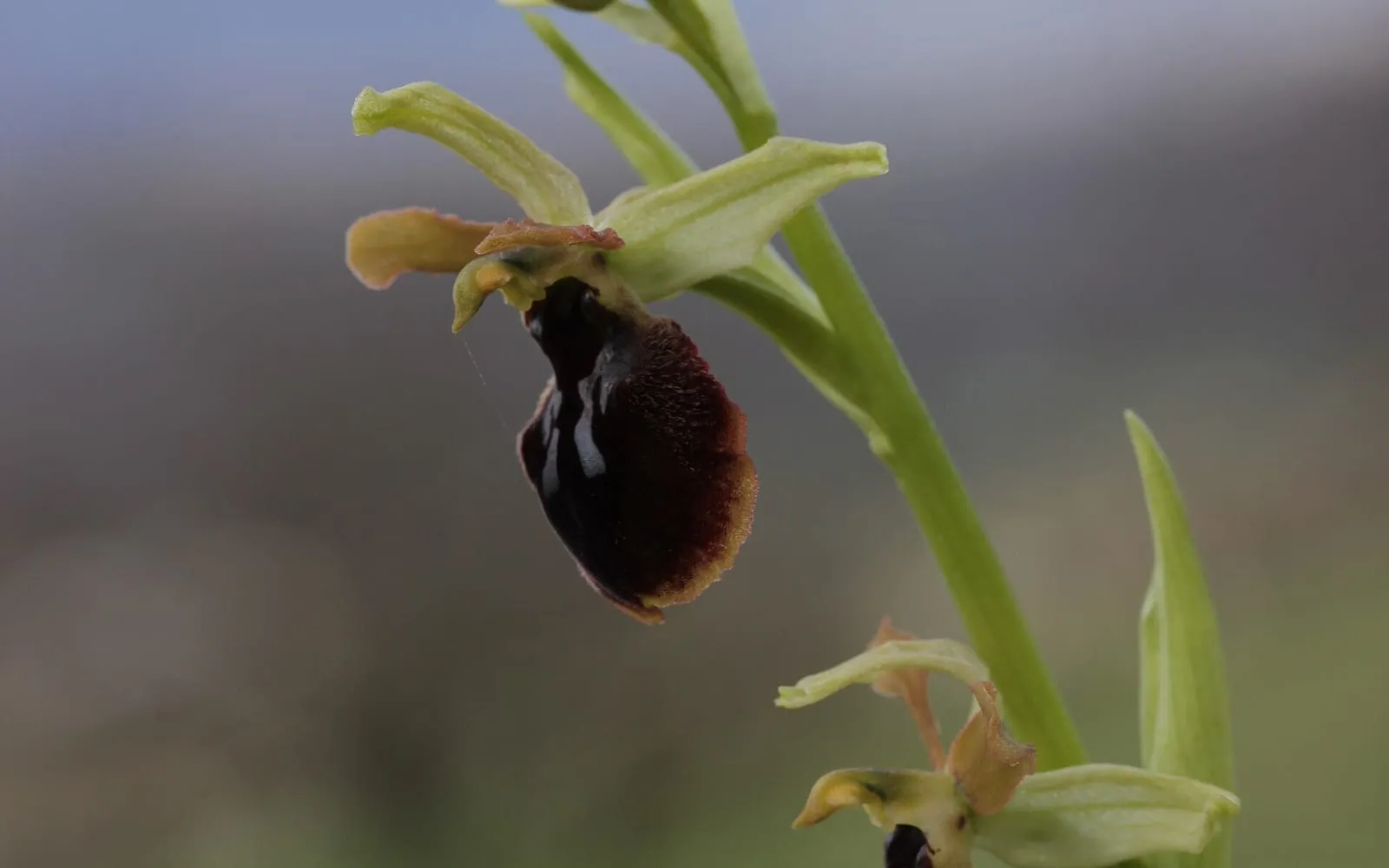
The lip of Ophrys sphegodes is a plump, velvety brown cushion crossed by a smooth, bluish, shield-shaped mark that often traces the outline of a Greek letter H or the letter pi. Set below three broad green sepals and two short greenish petals, the flower resembles a spider or a resting bee on a leaf. That likeness helps the plant reproduce. This is one of the earliest orchids of the European year, opening on warm chalk turf while much of the grassland around it is still winter-brown.
Identifying it
A ground rosette of grey-green leaves forms in autumn and overwinters, and the stem carries only a few large flowers, sometimes just two or three, well spaced up its length. The sepals are yellowish-green and blunt, the petals narrow and greenish, and the domed lip is dark chocolate to reddish-brown, covered in fine hairs, with the shiny grey speculum near its base. There is no fringe or tail to the lip, which helps separate it from the later spider orchids. A plant is short, seldom more than a hand tall, and easy to miss on a busy slope.
Habitat
The early spider orchid is a specialist of short, sun-warmed chalk and limestone grassland close to the coast and on inland downs, along with the tops of soft sea cliffs where grazing or exposure keeps the turf thin. It needs open, low vegetation, full sun and a soil that warms early in the year, and it cannot tolerate shade or rank growth. Its range runs from southern England through France and central Europe to the Mediterranean, becoming less common towards the cool northern edge where late frosts and dull springs limit it.
Deceived by a female bee
Pollination follows the usual Ophrys pattern. The flower emits a blend of scent compounds that imitate the sex pheromone of a female mining bee of the genus Andrena, and its hairy lip mimics the texture of the insect. Male bees, active before the females, are attracted to the flower and try to mate with the lip. During the attempt, the pollen packets attach to the bee’s body and are carried to another bloom. The flower offers no nectar, and its early flowering is timed to the period when males are active but females are still scarce.
Not a plant for the greenhouse
The early spider orchid has the same cultivation problem as many wild terrestrial orchids. Its seeds are dust with no food reserve, germination depends on infection by a soil fungus, and the seedling spends a long underground phase supported by that fungus. Lift the plant and the partnership is broken, so a transplanted tuber starves. Even under expert flask culture the species is difficult and is rarely raised in quantity. Leave wild colonies undisturbed, and choose easier, laboratory-grown species if you want a spring orchid for cultivation.
A protected rarity
Because of its scarcity and its narrow habitat, the early spider orchid is one of the plants given the highest protection in Britain, listed on Schedule 8 of the Wildlife and Countryside Act 1981, so that picking, uprooting or destroying it is an offence. Its cliff-top and downland sites are managed by grazing to keep the sward open. It is protected by national law elsewhere in Europe, and all orchids are covered by CITES trade controls. Coastal erosion, scrub encroachment and the ending of grazing are its main threats, and steady conservation grazing helps maintain its habitat.
Timed to the male bee
The early spider orchid flowers weeks before most other orchids because it depends on male mining bees in the brief period before females appear. As the season warms, male Andrena bees patrol the turf looking for mates, and the orchid’s lip, scented and hairy to imitate a female, attracts them during those first days. If it flowers too late, real females are already active, males lose interest, and pollination is less likely. This close link with early insect activity is why the plant flowers in the cold, uncertain weeks of very early spring.
Reading the speculum
The shining mark at the base of the lip, the speculum, is not just decorative. Its bluish sheen reflects ultraviolet light in patterns a bee can detect, adding a visual cue to the scent cue. Its shape varies from plant to plant, in figures that observers have likened to the letter H, the Greek pi, or a horseshoe. That variation makes each flower slightly individual and has long interested botanists, though to the bee the important signal is the same.
A plant of the sea’s edge
Many of the strongest early spider orchid colonies grow on soft coastal cliffs and cliff-top grassland, where sea winds and slumping ground keep the turf naturally thin and open. On these exposed slopes the soil warms early in spring, suiting the orchid’s early flowering, and the lack of tall competition lets its short spikes stand clear. The same instability that creates the habitat also threatens it, since a cliff fall can take a colony with it. Coastal conservation has to allow for a shifting habitat rather than a fixed one.
Frequently asked
Why does it flower so early? Its bee pollinators emerge in early spring, and the orchid times its bloom to the period when patrolling males are most easily fooled.
What is the shiny mark on the lip? It is the speculum, a smooth bluish patch that reflects light and helps the flower mimic an insect for a searching bee.
Can I take one for my rock garden? No. It is fully protected and, in any case, dies once removed from its fungal partner in the turf.
How is it different from the late spider orchid? The early species flowers weeks sooner, has no distinct appendage at the tip of the lip, and keeps to slightly different ground.
When is it at its best? From late March through April and into May, earlier than almost any other orchid on the same slopes.
Early Spider Orchid problem guides
Not sure what is wrong? See the common houseplant pests guide.