
Houseplant
Grass Pink Orchid
Calopogon tuberosus
Also known as Calopogon tuberosus
How to grow Calopogon tuberosus, the grass pink orchid, a North American bog orchid whose lip sits on top and mimics pollen-laden anthers.
At a glance
- Difficulty
- Difficult
- Water
- Evenly moist in growth; ease off for any rest
- Light
- Full sun
- Temperature
- Hardy; needs a cold winter dormancy
- Humidity
- High
- Hardiness
- USDA 3-9, RHS H6-H7, hardy to -30 C
- Type
- Perennial
- Height
- 25-50 cm
- Native to
- eastern North America
A bog orchid from eastern North America that dies back to a corm each winter and tolerates hard frost while dormant. It needs full sun and acidic, permanently wet peat and sand through the growing season, and it fails in dry or rich soil. Warmth without a cold winter weakens it.
Hardiness zones describe winter cold alone. Summer heat, humidity, rainfall and the length of the growing season decide as much, so treat the range as the outer limit rather than as a recommendation.
Not known to be toxic
Calopogon tuberosus, the grass pink orchid, is not recorded among the seriously toxic plants, and related plants in its group are not listed as toxic by the ASPCA or the RHS. A pet or child that chewed a leaf would be unlikely to have more than a possible mild stomach upset.
Sources: ASPCA toxic and non-toxic plants, RHS potentially harmful garden plants
An orchid with an upside-down flower
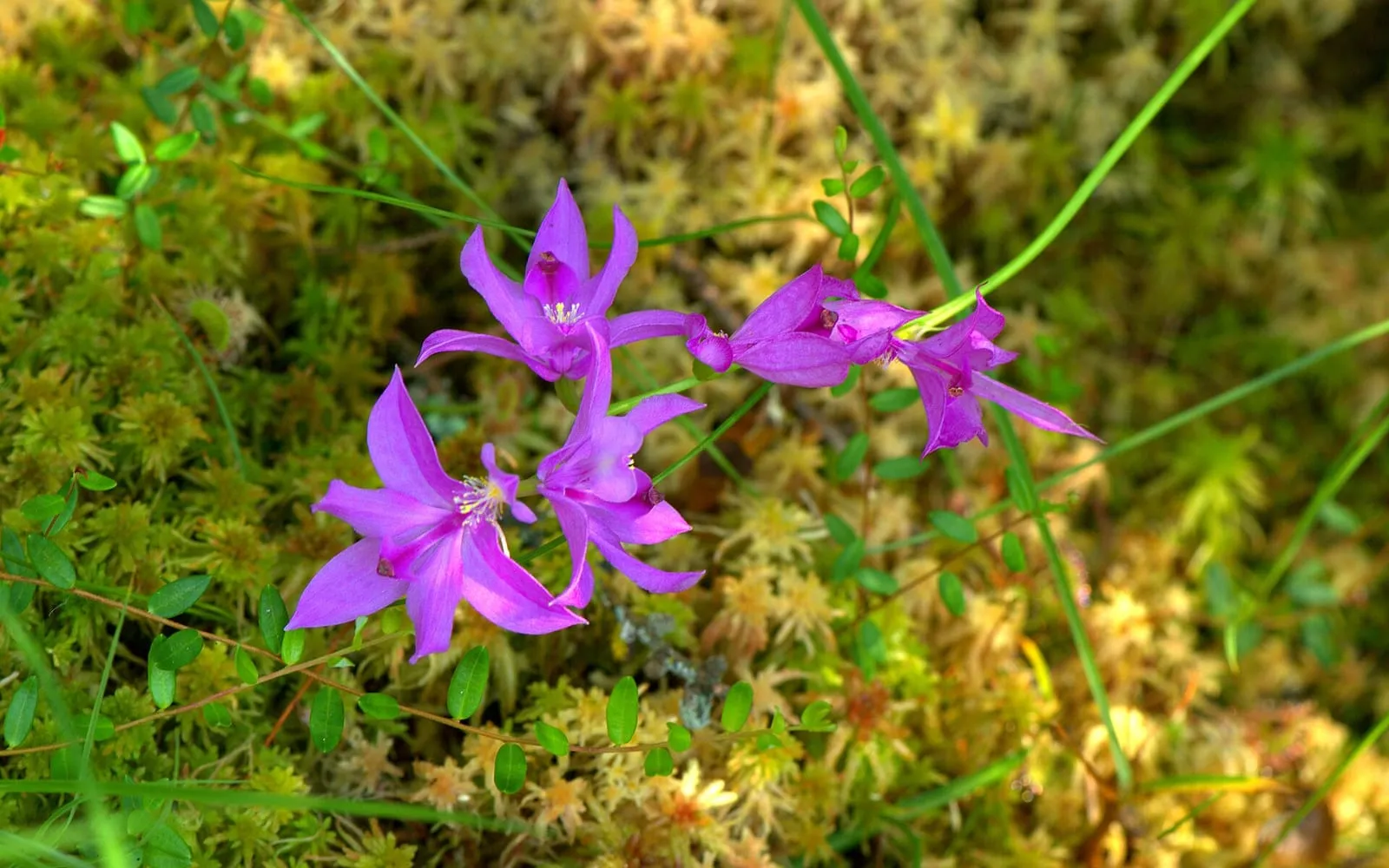
Calopogon tuberosus differs from most orchids in two clear ways. Where almost every orchid twists its flower so the lip hangs at the bottom, the grass pink holds the flower the other way up, with the showy lip on top. That lip has a brush of golden-yellow to orange bristles that mimics the pollen-laden anthers of an ordinary flower, attracting bees without giving them pollen. Native to eastern North American bogs and wet meadows, it carries several magenta-pink blooms on a slender stem above a single grassy leaf.
Recognising it
A grass pink has one long, narrow, grass-like leaf sheathing the base of the stem, which accounts for the common name, and above it a loose spike of two to a dozen bright rose-magenta flowers that open in succession. Each flower shows spreading pink segments and, uppermost, the paddle-shaped lip tipped with a dense cluster of yellow and orange club-shaped hairs. The upside-down flower, the vivid colour and the yellow-bearded upper lip identify it, and the genus name Calopogon, meaning beautiful beard, refers to that bristly lip.
Its wetland ground
Calopogon tuberosus grows in open, sunny, acidic wetlands, among them sphagnum bogs, wet meadows, fens, marshy pond edges, seepage slopes and damp pine savannas, on peaty or sandy soils kept permanently moist. It needs full sun, a high water table and the low fertility of bog and fen, and it cannot compete on rich or shaded ground. It is the most widespread of the North American grass pinks, ranging from Newfoundland and the Great Lakes south through the eastern United States to the Gulf coast, wherever suitable acid wetland survives.
A hinged lip for pollen-seeking bees
The pollination of the grass pink depends on the hinged upper lip. A bee, deceived by the yellow bristles into expecting pollen, lands on the upper lip, whose base springs downward under the insect’s weight. The bee is tipped backward onto the column below, where the pollen masses are pressed onto its back, and it is then released. Carrying that pollen, it visits another flower and is tipped again, transferring the pollen to the stigma. No pollen or nectar is given, so the plant relies on the bee mistaking the bristles for a reward.
Why it is difficult to cultivate
The grass pink shares the germination biology that keeps hardy terrestrial orchids out of the ordinary garden. Its dust-fine seeds hold no food and sprout only where a compatible soil fungus infects them and feeds the seedling underground before its first leaf. A plant dug from a bog loses that fungus and the wet, acid, sunny conditions it depends on, so transplants fail. Of the bog orchids it is one of the more approachable for skilled growers, who raise it from seed for acid bog gardens, but wild plants should be left in place and only responsibly propagated stock used.
Conservation
Calopogon tuberosus declines wherever acidic wetlands are drained, filled, mined for peat, enriched by run-off or lost to scrub as fire is suppressed, and it is listed as rare or of concern at the margins of its range. Bogs and fens are among the most threatened habitats, and orchid colonies within them recover slowly. Collecting from the wild is discouraged everywhere, and all orchids come under CITES trade controls. The grass pink does best when wetlands stay wet, acidic, sunny and periodically burnt where fire is natural.
Two rules broken at once
The grass pink is a useful teaching plant because it differs from two habits that are almost universal among orchids. Most orchids twist the flower stalk through half a turn as the bud develops, a movement called resupination, so that the lip ends up hanging at the bottom of the flower; the grass pink skips this twist, leaving the lip on top. Most orchids reward or at least appear to reward their pollinators; the grass pink offers nothing, using the yellow bristles on its raised lip only to imitate a cluster of pollen-bearing stamens. The result is a flower that looks upside down and gives bees a false pollen signal.
The spring-loaded lip
The mechanics of the grass pink’s deception are easiest to see by watching the lip. A bee, fooled by the yellow bristles into landing on the upper lip in search of pollen, tips the lip down under its weight, because the lip is hinged at its base. The insect falls backward onto the column below, where the pollen masses are pressed onto its back, and the lip then springs upright again. At the next flower the bee is tipped once more, and the pollen it is carrying is pressed onto the stigma. The whole sequence depends on the hinge and the false pollen signal.
A grass among the sedges
The single long, narrow, grass-like leaf that gives the plant its common name makes it easy to miss in its wetland home until it flowers, when the bright magenta spikes rise clear of the surrounding sedges and grasses. Calopogon tuberosus is the most widespread of the North American grass pinks and the one most likely to be met, ranging across a broad area of acid bogs, fens, wet meadows and damp savannas. Its wide distribution has not spared it from local decline, since the wetlands it needs are drained, filled and enriched when land is converted to other uses.
Questions people ask
Why is the flower upside down? Unlike most orchids, the grass pink does not twist its flower stalk, so the lip stays on top instead of hanging below.
How does the hinged lip work? A bee lured by the yellow bristles lands on the lip, which swings down and tips the insect onto the column, dusting its back with pollen.
Does it give any reward? No; the yellow bristles only imitate pollen, so the bee is deceived.
Can I grow it in an acid bog garden? Only from responsibly raised, flask-grown stock; a wild plant will not survive being lifted.
When does it flower? In early to mid summer, roughly June into August depending on latitude.
Grass Pink Orchid problem guides
Not sure what is wrong? See the common houseplant pests guide.