
Houseplant
Early Purple Orchid
Orchis mascula
Also known as Orchis mascula
How to grow Orchis mascula, the early purple orchid, a woodland orchid with reddish-purple spikes that opens in April and May among the bluebells.
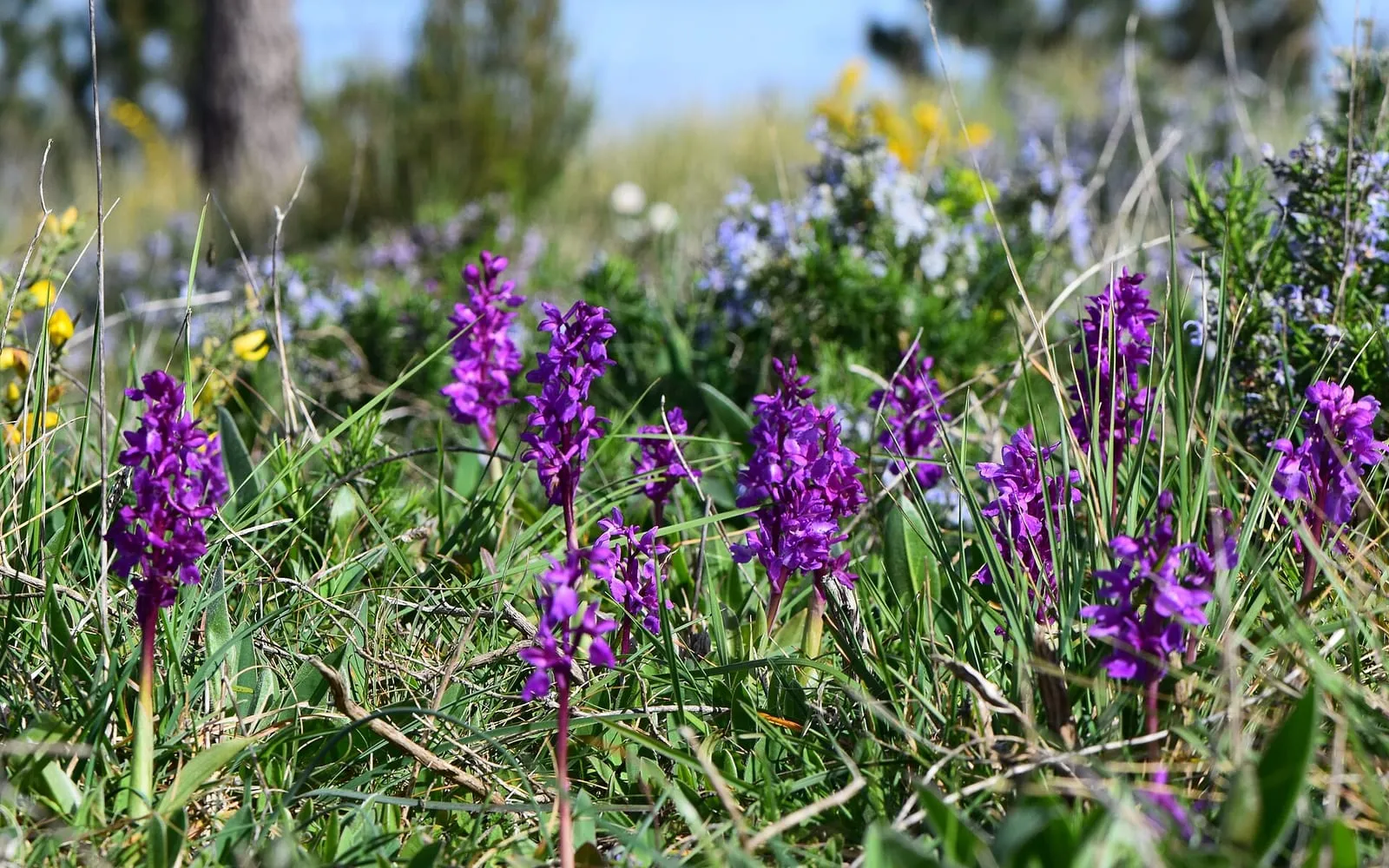
At a glance
- Difficulty
- Difficult
- Water
- Evenly moist in growth; ease off for any rest
- Light
- Bright indirect light
- Temperature
- Hardy; needs a cold winter and a cool, moist spring
- Humidity
- Average
- Hardiness
- USDA 5-8, RHS H6, hardy to -15 C
- Type
- Perennial
- Height
- 15-40 cm
- Native to
- Europe, western Asia
A hardy woodland and meadow orchid of Europe and western Asia, which leafs in late winter and needs a cold season to flower. The zone numbers leave out its dependence on a soil fungus partner, its summer dormancy after flowering and its dislike of hot, dry summers. Cold is not its limit, and it fails in warm climates and in pots.
Hardiness zones describe winter cold alone. Summer heat, humidity, rainfall and the length of the growing season decide as much, so treat the range as the outer limit rather than as a recommendation.
Not known to be toxic
Orchis mascula, the early purple orchid, is not recorded among the seriously toxic plants, and related plants in its group are not listed as toxic by the ASPCA or the RHS. A pet or child that chewed a leaf would be unlikely to have more than a possible mild stomach upset.
Sources: ASPCA toxic and non-toxic plants, RHS potentially harmful garden plants
A woodland orchid of early spring
Orchis mascula opens well ahead of most of its relatives, producing spikes of reddish-purple flowers through April and May while bluebells are still colouring the same woods. It is one of the more familiar wild orchids of Europe and western Asia, growing in coppiced woodland, on shaded hedge banks, in old hay meadows and along grassy limestone slopes. The Latin word mascula, meaning male, points to the paired underground tubers, which classical writers compared to testicles and which gave the whole orchid family its name.
Recognising it
A rosette of shining strap-shaped leaves opens at ground level in late winter, and most plants carry chocolate-brown blotches scattered over the blade, though plain green forms appear often. The flowering stem rises to a foot or so and holds a loose column of blooms. Each flower has a rounded hood built from the sepals and upper petals, a broad three-lobed lower lip with a paler dotted throat, and a thick spur that curves upward behind. Flower colour ranges from deep magenta to soft rose, with the occasional pure white. A freshly opened spike smells faintly of honey, and that scent turns rank, closer to a tomcat, once the flowers have been fertilised and start to wither. Chaucer and Shakespeare both knew the plant, the latter listing its blooms among Ophelia’s “long purples”.
Where it grows
The range reaches from Ireland and Scandinavia south to the mountains of North Africa and east as far as Iran. Ground that stays moist through spring yet drains freely afterwards suits it, and it favours base-rich soils over chalk, limestone and heavy clay. Coppiced woodland suits it well, because the cutting cycle lets sunlight reach the floor for a few seasons before the canopy closes again. In open landscapes it grows in unimproved pasture and on old banks that have not been ploughed or heavily fertilised.
How it is pollinated
Bumblebee queens hunting nectar in early spring are the main visitors. The spur holds no reward, so the flower relies on deception. A bee probes several blooms before learning that none of them will feed it, and during those first visits it picks up and carries away the sticky pollen masses. Fruit set stays low because of this, and a tall spike may develop only a handful of its flowers into seed capsules. Each ripe capsule then scatters many thousands of seeds as fine as flour.
Why it will not grow like a pot plant
Those seeds hold next to no food store. Out in the wild they sprout only once a strand of soil fungus enters the seed coat and nourishes the seedling through an underground phase that can run for several years before a single leaf shows above the surface. Reproducing that fungal relationship in a flowerpot is beyond ordinary gardening, and plants dug from a bank almost always die, because the fungal network they depend on cannot be lifted with the roots. A few specialist growers raise hardy orchids from seed sown on sterile nutrient jelly in flasks, and nursery-raised stock, never a wild-dug tuber, is the responsible route to owning one.
The law and its future
As with every wild plant across Britain, the early purple orchid may not be uprooted without the landowner’s agreement, a rule set out in the Wildlife and Countryside Act 1981. Across the rest of Europe it falls under various national statutes, and the international CITES agreement regulates trade in all members of the orchid family. Numbers have fallen where ancient woods have been felled or old grassland ploughed and reseeded, so photograph wild plants and leave the tubers where they are.
Names and old uses
The plant has gathered many country names over the centuries, among them cuckoo flower, for its arrival with the returning cuckoo, and gethsemane or cross-flower, from a legend that the spotted leaves grew beneath the cross. Its dried tubers were once ground into salep, a starchy flour used to thicken a warm drink called saloop that was sold on the streets of London before coffee and tea took over. That trade used wild-dug tubers and damaged colonies, and it is one reason the plant is now legally protected against uprooting.
A tuber for this year and one for next
Below ground the early purple orchid uses a two-tuber system. The old tuber, plump at the start of the season, feeds the current year’s leaves and flower spike and shrivels as it is spent, while a fresh tuber swells alongside it, storing food for the following year. This replacement cycle lets an established plant return to the same spot for many years, and it means the plant has next season’s growth stored by midsummer, before the leaves die down. The rosette of leaves reappears in midwinter, well ahead of the flowers, catching the low light of the leafless wood.
Telling it from its neighbours
On the same spring ground the early purple orchid can be confused with the green-winged orchid, which flowers at about the same time. The quickest checks are the leaves and the flower: the early purple carries its dark leaf blotches and an unmarked hood, while the green-winged orchid has plain green leaves and bold green veins running through the side of its hood. The early purple is also generally the taller and earlier of the two, and it favours woodland and shaded banks where the green-winged prefers open, sunny meadows.
Questions people ask
Can I dig up a plant from a roadside verge for my garden? No. Lifting it breaks the law without the owner’s permission, and it will die once separated from its fungal partner.
Why did my spike ripen so few seed pods? The flowers give no nectar, so visiting bees move on quickly and fertilise only a small share of them.
What compost suits a nursery-raised plant? A gritty, lime-rich mix that drains fast, kept damp while the leaves are active in spring and allowed to dry as they die down for summer.
When can I expect flowers? From April into the first days of June, earlier than the other orchids that share its ground.
Does the smell change? Yes. Newly open flowers carry a light honey note that sours to a musky, catty odour as they age and set seed.
Early Purple Orchid problem guides
Not sure what is wrong? See the common houseplant pests guide.