
Houseplant
Copper Beard Orchid
Calochilus campestris
Also known as Calochilus campestris
How to grow Calochilus campestris, the copper beard orchid, an Australian ground orchid with a coppery, bearded lip that depends on soil fungi.
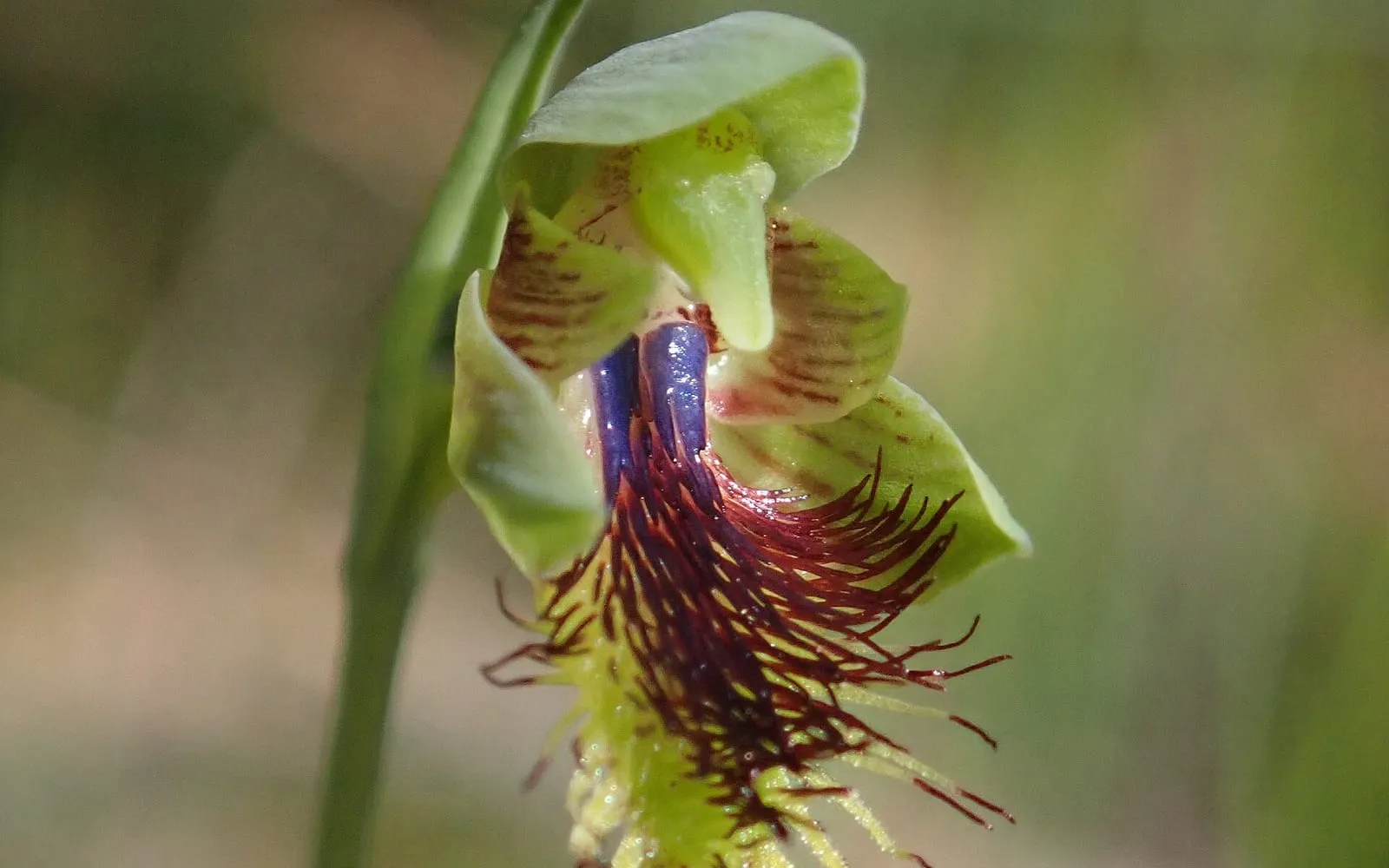
At a glance
- Difficulty
- Difficult
- Water
- Evenly moist in growth; ease off for any rest
- Light
- Bright light to part shade
- Temperature
- Cool wet winters, frost tolerated; dry and dormant in summer
- Humidity
- Average
- Hardiness
- USDA 8-10, RHS H3, hardy to -5 C
- Type
- Deciduous tuberous terrestrial orchid, dormant in summer
- Height
- 20-45 cm
- Native to
- eastern and south-eastern Australia
A tuberous terrestrial orchid of eastern and south-eastern Australia, from coastal heath to montane forest, growing through cool, wet winters and resting dry below ground in summer. The tuber tolerates light frost, but its survival depends on soil fungi, so the zone says little about whether a plant can be kept alive away from its native ground.
Hardiness zones describe winter cold alone. Summer heat, humidity, rainfall and the length of the growing season decide as much, so treat the range as the outer limit rather than as a recommendation.
Not known to be toxic
Calochilus campestris, the copper beard orchid, is not recorded among the seriously toxic plants, and related plants in its group are not listed as toxic by the ASPCA or the RHS. A pet or child that chewed a leaf would be unlikely to have more than a mild stomach upset.
Sources: ASPCA toxic and non-toxic plants, RHS potentially harmful garden plants
About
Calochilus campestris is one of the Australian beard orchids, a group named for the labellum covered in a dense mass of long coloured hairs resembling a beard. In this species those hairs have a coppery, metallic sheen, and the plant grows across eastern Australia in grassland, heath and open woodland, its species name meaning of the fields. It is a tuberous ground orchid that spends the dry months dormant below the soil and grows through the cooler, wetter part of the year. Beard orchids are extremely difficult to keep, because their survival depends on soil fungi and a particular pollination mechanism, so this guide is written to help identify the plant and explain the biology that makes it so hard to cultivate.
Appearance and character
A flowering plant produces a single fleshy, channelled leaf at the base and an upright stem carrying a few to several flowers. The bearded labellum is the main feature of each bloom: a broad lip covered in long, dense, metallic copper to reddish hairs, above which sit greenish and reddish-brown sepals and petals, sometimes with fine dark markings. The flowers are not brightly coloured. The solitary erect leaf, narrow and grooved, is the plant’s other identifying feature, present through the growing season and gone by the time summer sets in.
Where it is from
The species is native to eastern and south-eastern Australia (Queensland, New South Wales, Victoria and South Australia, with a doubtful Tasmanian record), growing in seasonally moist grassland, heathland and open sclerophyll woodland. Its climate has cool moist winters and warm to hot dry summers, and the orchid grows in the wetter, cooler months before resting underground through the summer drought. Like many Australian terrestrials it depends on specific mycorrhizal fungi in the soil. Without them, its seed cannot germinate and its tuber struggles, which is a direct reason it resists transplanting and pot culture.
How it grows
The plant regrows yearly from an underground tuber. A leaf and then a flowering stem develop through the cool wet season, the tuber is refilled, and after flowering and any seed set the plant dies down for summer. Its flowers mimic a female wasp closely enough in shape, colour and scent that male wasps attempt to mate with them and carry pollen between blooms, a strategy known as pseudocopulation. Seed is dust-fine and needs the right fungus to germinate, so natural increase is slow and deliberate propagation is extremely difficult outside specialist symbiotic techniques.
Through the seasons
Autumn to early winter ends dormancy as rain and cooler weather return, and the single leaf emerges.
Winter and early spring are the growing season, when the leaf builds the tuber and the flower stem develops in bright, cool, moist conditions.
Spring is the flowering period, when the bearded blooms open to attract their wasp pollinators.
Summer is complete dormancy; the leaf withers, moisture is withheld, and the tuber remains below ground through the heat and drought.
Care difficulty
Beard orchids are among the hardest orchids to grow. Their dependence on specific soil fungi means they seldom survive being dug or potted, and they often fail if their natural cycle of cool wet growth and hot dry rest is interrupted. Leave wild plants alone, since collection damages fragile populations. What follows describes its needs for completeness, not because cultivation is likely to succeed.
Watering
If a plant is held at all, watering follows the growing season strictly. Provide moisture as growth appears in autumn and maintain it through the cool winter and spring while the leaf and flower develop, using clean low-mineral water and a very open medium so the tuber never sits in stagnant wet. As the leaf yellows in late spring, reduce watering, and keep the tuber dry through summer dormancy. Overwatering, especially during rest, commonly kills tuberous terrestrials.
Warning signs, diseases and pests
A tuber that fails to reappear, or one that rots, usually reflects wrong-season watering, the loss of its fungal partner, or the shock of disturbance. There is often little a grower can do once the plant starts to fail, which is part of why these orchids are left in the wild. Under artificial conditions, aphids may attack the soft flower stem and fungus gnats breed in wet compost, both signs of a medium kept too moist. Clean, cool and airy growing conditions are the best defence available.
Growing environment
The natural setting is open, sunny to lightly shaded ground with free-draining soil rich in the appropriate fungi, moist in winter and dry in summer. Any attempt at cultivation needs bright cool conditions, a sharply drained sandy medium, and ideally soil or inoculum carrying the mycorrhizal fungus from established plants. Warmth and stagnation are fatal. These conditions are difficult to assemble deliberately, so the species is rarely cultivated.
Feeding
Feeding matters little. In the wild the plant gets much of its nutrition through its fungal partner from the soil, and the poor grassland and heath soils it inhabits are not rich. Any feeding in cultivation should be minimal and highly dilute, since strong feed harms both the fine roots and the delicate fungal relationship the plant depends on. During dormancy no feed is given at all.
Troubleshooting
Why is it so hard to grow? Its seed and tuber depend on specific soil fungi, and it also relies on wasp pseudocopulation for pollination, so it rarely survives digging or potting away from its natural setting.
Should I collect one from the wild? No. Wild collection almost always fails and damages vulnerable populations, so photograph it and leave it in place.
What does the beard do? The dense coppery hairs help the flower mimic a female wasp, luring males that transfer pollen while attempting to mate.
Is it dead in summer? If a tuber survives, summer dormancy is normal, but these orchids often do not persist once disturbed.
Is it toxic to pets? No serious toxicity is recorded for the genus, though as with any orchid, discourage chewing.
Copper Beard Orchid problem guides
Not sure what is wrong? See the common houseplant pests guide.