
Houseplant
Lady Orchid
Orchis purpurea
Also known as Orchis purpurea
How to grow Orchis purpurea, the lady orchid, a tall European orchid with a white-and-pink lip like a skirt under a dark maroon hood.
At a glance
- Difficulty
- Difficult
- Water
- Evenly moist in growth; ease off for any rest
- Light
- Dappled woodland shade, open before the canopy closes
- Temperature
- Hardy; needs a cold winter rest, dislikes sustained heat
- Humidity
- Moderate
- Hardiness
- USDA 5-8, RHS H5, hardy to -15 C
- Type
- Perennial
- Height
- 30-80 cm
- Native to
- Europe, western Asia
A woodland orchid of Europe and western Asia that survives winter cold of about minus 15 deg C as a dormant tuber. It needs a cold, dry-ish winter rest, cool springs and lime-rich soil, and it declines where summers are hot and winters mild. It depends on a soil fungus and does not transplant.
Hardiness zones describe winter cold alone. Summer heat, humidity, rainfall and the length of the growing season decide as much, so treat the range as the outer limit rather than as a recommendation.
Not known to be toxic
Orchis purpurea, the lady orchid, is not recorded among the seriously toxic plants, and related plants in its group are not listed as toxic by the ASPCA or the RHS. A pet or child that chewed a leaf would be unlikely to have more than a possible mild stomach upset.
Sources: ASPCA toxic and non-toxic plants, RHS potentially harmful garden plants
A tall European woodland orchid
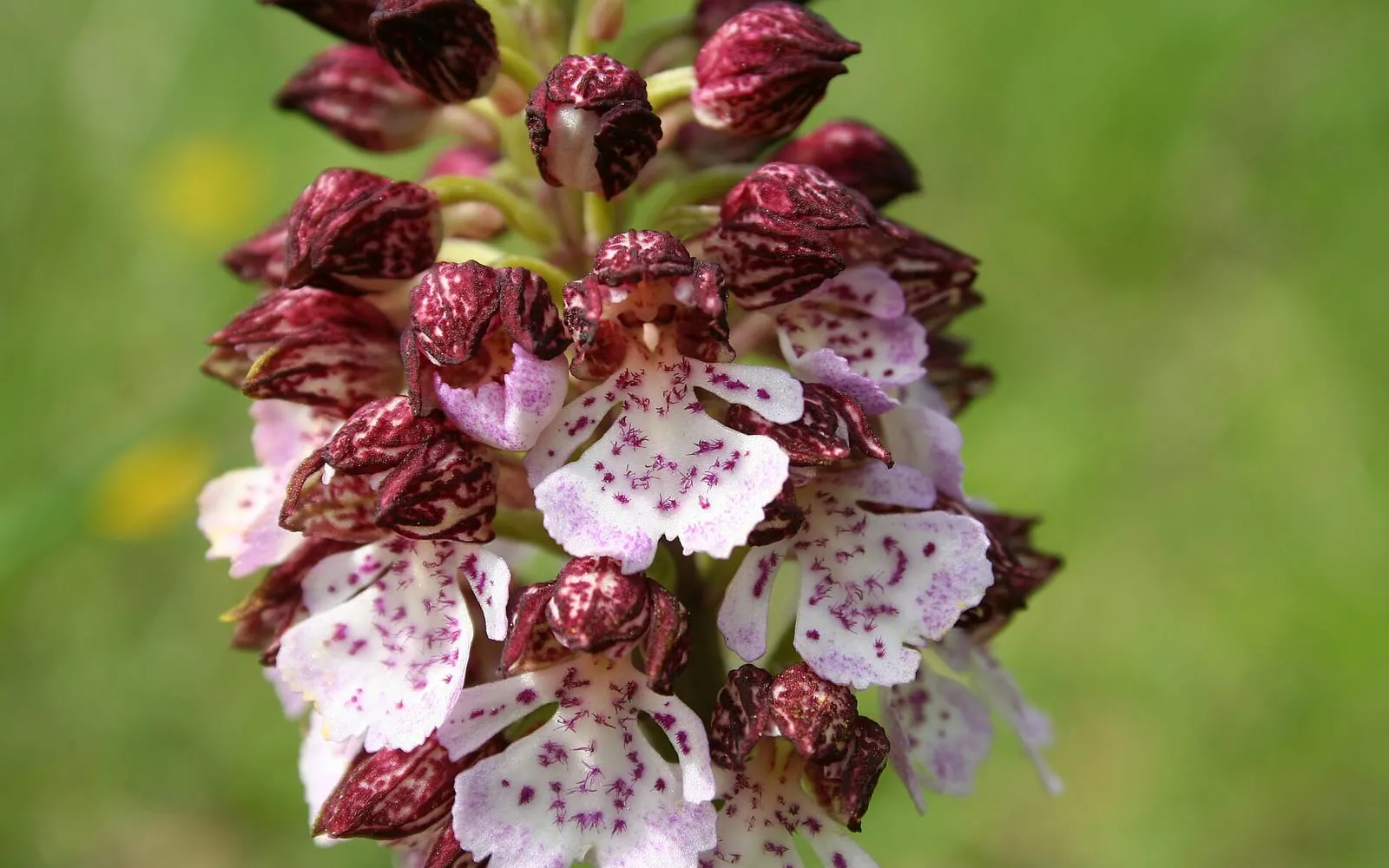
Orchis purpurea gets its common name from the flower, whose broad white-and-pink lip spreads below a dark maroon hood. Each bloom can look like a small figure with a bonnet and skirt. It is among the tallest European hooded orchids, producing dense pyramidal spikes that can carry a hundred flowers on a stem approaching knee height. The plant belongs to Europe and western Asia, and in Britain it is concentrated in the woods of Kent with a scatter of outlying sites.
Picking it out
Before the stem rises, a cluster of large, glossy, unspotted leaves forms a bold rosette on the ground, broader and shinier than those of most related orchids. The flower spike is stout and packed. Each bloom folds its sepals and upper petals into a deep reddish-brown or purplish helmet, while the lip below opens pale, dusted with tufts of tiny crimson hairs that form the “arms” and the divided “legs” of the figure. The overall effect is a two-tone flower, dark above and pale and speckled beneath, unlike anything else in a chalk wood.
Habitat
The lady orchid favours the dappled edge of beech and hornbeam woodland on chalk and limestone, along with scrubby banks and the margins of old rides where light filters through. It needs a soil rich in lime and a position that is neither baked nor sodden. Warm, well-drained slopes with a light leaf litter suit it, and it often grows alongside other calcium-loving plants of ancient woodland. The species is more widespread across France, Germany and the Balkans than at the cool northern edge of its range, where it stays local.
Bee pollination
Solitary and social bees do the pollinating, drawn by the bright, patterned lip that signals a meal. The short spur contains no nectar, so the flower deceives the visitor. A bee lands, searches, finds nothing and leaves, and in the movement it lodges the pollen masses against its head and carries them onward. Because there is no reward, insects learn to avoid the display, which keeps seed set low and helps explain why colonies expand so slowly even in a good site.
Growing it is close to impossible
Seed from those few capsules is microscopic and carries no built-in nourishment. Germination in the wild depends on infection by a suitable thread-like soil fungus, which feeds the developing orchid underground for a long, leafless spell before the first true leaf breaks the surface. That dependence is why a lady orchid cannot be potted up: the fungus does not travel with a lifted plant, and transplanted tubers rot or starve. Raising the species from flask-sown seed under laboratory conditions is done by specialists, and buying such a plant is the only acceptable way to grow one at home.
Rarity and safeguards
Britain treats every wild plant as protected from being dug up without the landowner’s consent under the Wildlife and Countryside Act 1981, and the lady orchid’s scarcity makes its sites especially important. On the Continent it is covered by national conservation law, and trade in all orchids is controlled internationally through CITES. Woodland clearance, over-shading by neglected coppice and the trampling that follows publicity have all damaged colonies, so anyone who sees one should admire the spike, take a photograph and step back off the roots.
A woodland calendar
The lady orchid follows a woodland rhythm shaped by the beech canopy above it. Its broad glossy leaves unfurl in a ground rosette during the still-open weeks of early spring, gathering light before the trees close over, and the flower spike follows in May as the canopy fills in. Once flowering is done the plant sets seed and dies back, spending the summer, autumn and winter below ground as a tuber. Because so much of its year is spent underground and its above-ground season is short, a colony can go unnoticed for years and then, after a warm spring, produce a sudden display of tall spikes.
Hybrids and confusion
Where the lady orchid grows near the monkey orchid or the military orchid, the three can cross, producing intermediate plants whose flowers blend the features of both parents and puzzle even experienced botanists. The lady orchid parent usually shows through in the broad, skirted lip and the dark, well-formed hood. Away from those rarities, the plant’s size, its bold unspotted basal leaves and its two-tone flowers make it one of the easier hooded orchids to identify with confidence.
Why northern colonies matter
At the cool northern edge of its range the lady orchid survives in a handful of woods. Each outlying colony matters because it marks the species’ limit and stores genes that let it cope with a marginal climate. Cool, dull springs slow its seed ripening, so a run of poor years can leave a colony flowering freely yet setting almost no seed. Recovery then depends on the long-lived tubers already in the ground instead of on fresh seedlings. That is why protecting the existing plants and their woodland matters more than any attempt to raise new ones.
Common questions
Why is it so rare in the north of its range? Cool, damp summers limit its seed ripening, so it thrives far better on the warm chalk of central and southern Europe than at the edge.
Can I collect seed to sow at home? Sowing orchid seed needs sterile flasks and the correct fungus or a nutrient jelly, so scattered seed almost never grows and the parent plant should be left untouched.
How tall does the flower spike get? A strong plant can lift its head of flowers to around 40 to 90 centimetres, taller than most orchids of the same woods.
What does the flower smell of? Only a faint sweetness, sometimes with a slightly musky edge, far weaker than the scent of the fragrant or butterfly orchids.
When is it in flower? Chiefly through May, occasionally into early June where the season runs late.
Lady Orchid problem guides
Not sure what is wrong? See the common houseplant pests guide.