
Houseplant
Large-Spiked Megaphrynium Prayer Plant
Megaphrynium macrostachyum
Also known as Megaphrynium macrostachyum
How to grow Megaphrynium macrostachyum, a giant African rainforest prayer plant whose banana-sized leaves swivel on a pulvinus to follow the light.
At a glance
- Difficulty
- Easy
- Water
- When the top few centimetres of mix have dried
- Light
- Bright indirect light to light shade
- Temperature
- Warm; keep above about 13 deg C
- Humidity
- Average to high
- Hardiness
- USDA 10-12, RHS H1b, hardy to 13 C
- Type
- Perennial
- Height
- 2-4 m
- Native to
- tropical Africa
A tender tropical foliage plant from tropical Africa, growing in warm, humid, shaded to filtered light. It needs warmth, humidity and bright indirect light, and it cannot take frost or chill. It is safest above about 13 deg C, and cold, wet compost or dry air spoils it.
Hardiness zones describe winter cold alone. Summer heat, humidity, rainfall and the length of the growing season decide as much, so treat the range as the outer limit rather than as a recommendation.
Not known to be toxic
Megaphrynium macrostachyum, the large-spiked megaphrynium prayer plant, is not recorded among the seriously toxic plants, and related plants in its group are not listed as toxic by the ASPCA or the RHS. A pet or child that chewed a leaf would be unlikely to have more than a possible mild stomach upset.
Sources: ASPCA toxic and non-toxic plants, RHS potentially harmful garden plants
A large plant of the forest floor
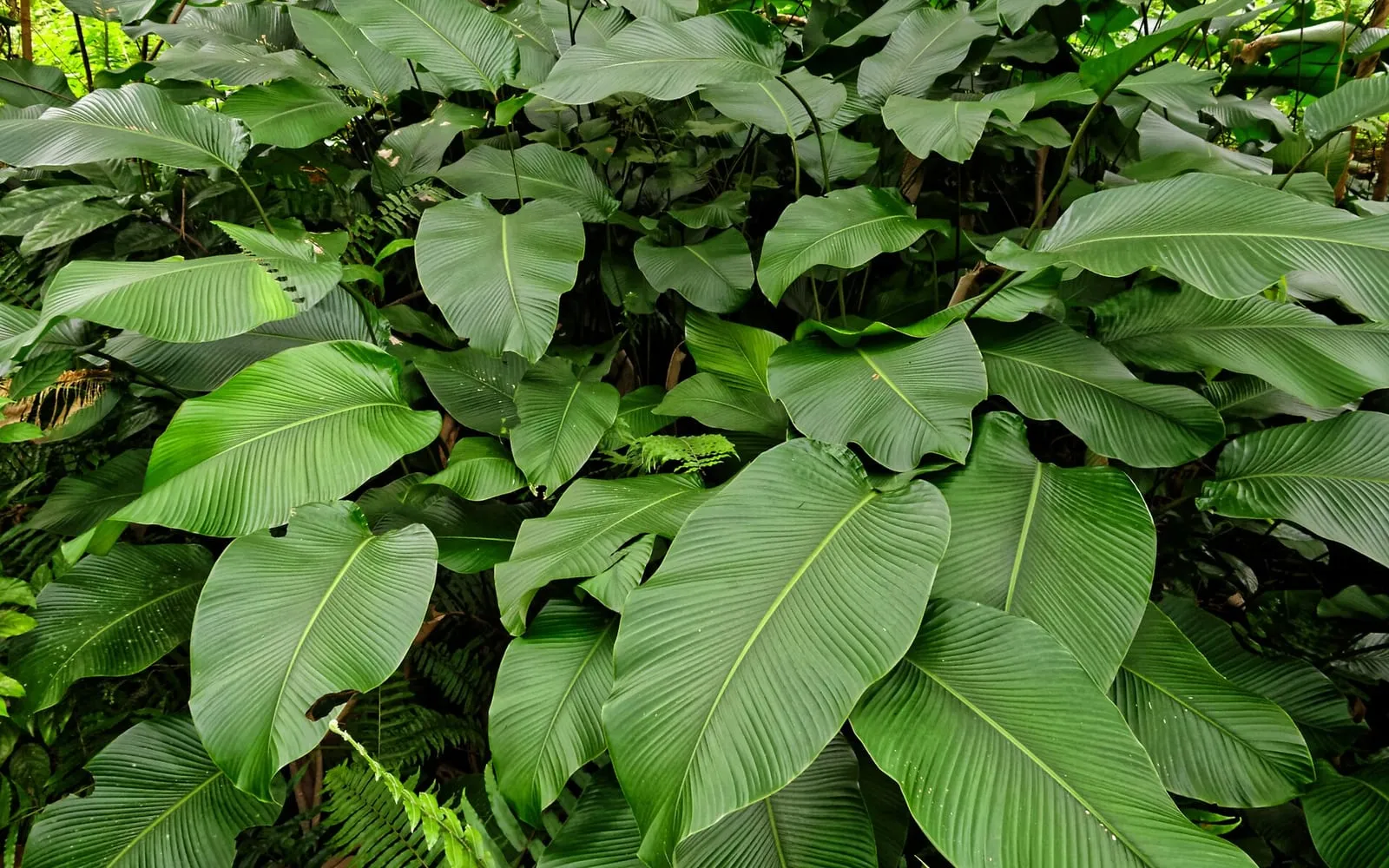
Megaphrynium macrostachyum is one of the larger herbs of the African rainforest understorey. A thick, creeping rhizome produces long stalks, each with a single broad blade that can match a small banana or canna leaf for size. Left undisturbed, a stand widens season on season until it covers a broad patch, casting shade dense enough to suppress many smaller plants below. Look for it in forest clearings, along stream margins and over the shaded floor of lowland forest through central and west Africa. Where it takes hold it can dominate the ground layer, with leaves overlapping into a near-continuous cover above the soil.
Where the name comes from
The species name macrostachyum means “large-spiked”, referring to the substantial flower spike that appears low down among the leaf bases. Megaphrynium identifies it as a big member of the group. Neither word suggests decorated foliage, which fits the plant: people grow it for size and clean, bold leaf shape rather than pattern.
Large leaves
A leaf rises almost straight up on its own tall stalk from the soil, then the blade unfurls and spreads at the top. Where stalk meets blade sits a short swollen segment, the pulvinus, and it lets the leaf swivel to face the available light. That hinge, shared across the family, also controls the leaf’s daily movement. The blades are firm and glossy, able to shed the weight of tropical rain, and a mature colony casts enough shade to keep the soil beneath it cool and moist. A single blade reaches around 60 cm long and 30 cm across, and the plant grows wild from Guinea and Sierra Leone in the west, across the Congo basin, to Sudan and Uganda in the east.
Moving with the day
Towards evening the leaves tilt on the pulvinus, and by first light they have opened back out. The cycle goes by the name nyctinasty. Cells crowded into the hinge move water back and forth, and the change in pressure lifts or drops the blade. A leaf that has stopped moving altogether is usually too cold or too dry.
Its role in the forest and the market
This is one of the main wrapping-leaf plants of central Africa. The broad, tough blades are cut in bulk to parcel food for market, to wrap and steam cooked dishes, and to thatch and cover simple roofs. Across large areas the plant forms the ground layer of what ecologists call Marantaceae forest, with stands thick enough for forest elephants and gorillas to feed and shelter within them. The wild climate stays warm all year, wet, and shaded under a tall canopy, and it never turns to frost.
Fitting it into a room
Bright, filtered light of the kind found a step back from a large window suits it, or the soft light behind a thin curtain on a brighter aspect. Direct sun through the glass burns holes and pale patches into the big blades. Deep shade slows it and draws the stalks out thin. Because the leaves stand tall and wide, give it floor space and headroom; this is a plant for a conservatory corner or a heated glasshouse far more than a crowded windowsill.
How to water it
Wet the compost when its surface has dried down a few centimetres, drenching the whole rootball and pouring off whatever gathers under the pot. Standing in cold, waterlogged compost rots the fleshy roots faster than anything else. Hard mains water spots and streaks the broad leaves with lime, so rainwater or filtered water keeps them clean. Through the darker months, when growth nearly stops, water sparingly and let the mix dry further between drinks.
Warmth, moisture and air
Steady warmth suits it, and it must not drop below roughly 13 deg C or sit in a cold draught. Because the leaf surface is so large, dry indoor air pulls moisture from the margins and browns them, so raise the humidity with a wide gravel tray, a group of plants or a nearby humidifier. Good air movement without a chilling draught reduces fungal trouble around the crowded leaf bases.
Compost, feeding and dividing
Grow it in a loose, peat-free mix bulked with bark, coir and perlite so water drains quickly through the vigorous root system. Feed with a balanced liquid fertiliser at half strength every two or three weeks from spring to early autumn, then stop. This is a strong grower, so it usually needs moving to a bigger pot before many other houseplants would. Increase it by splitting the rhizome in spring, giving each division a length of rhizome, live roots and at least one leaf or bud.
Signs of trouble
A wilting plant over sour, sodden compost usually has roots damaged by cold, wet conditions; let it dry and improve the drainage. Crisp brown leaf margins follow dry air or a hard-water build-up. In warm, dry spells spider mites stipple the undersides and spin fine webs, and mealybugs settle as white tufts where the stalks clasp the rhizome. Rinse the plant, raise the humidity, and dab the pests off with cotton wool moistened with dilute surgical spirit.
Safety around pets and children
Records do not list this plant or its family among the seriously toxic plants, and its close kin are noted as safe around cats and dogs. A chewed scrap of leaf is unlikely to cause worse than a short-lived stomach upset.
Questions growers ask
How big does it get? Larger than most houseplants. The single leaves can reach the size of a banana leaf, so plan for floor space instead of a shelf.
Why do the leaves have brown, dry edges? Dry air or lime-rich water, or both. Raise the humidity and switch to rainwater.
Can I really wrap food in the leaves? Across central Africa people do exactly that. The tough blades hold up well to heat and handling.
How do I make more plants? Divide the rhizome in spring, keeping roots and a leaf on each piece.
Large-Spiked Megaphrynium Prayer Plant problem guides
Not sure what is wrong? See the common houseplant pests guide.