
Houseplant
Long-Stalked Begonia
Begonia longipetiolata
Also known as Begonia longipetiolata
How to grow Begonia longipetiolata, the long-stalked begonia, an African forest begonia with unusually long red-tinged leaf stalks.
At a glance
- Difficulty
- Easy
- Water
- When the top few centimetres of mix have dried
- Light
- Bright indirect light to light shade
- Temperature
- Warm; keep above about 13 deg C
- Humidity
- Average to high
- Hardiness
- USDA 10-12, RHS H1b, hardy to 13 C
- Type
- Perennial
- Height
- 30-50 cm
- Native to
- tropical Africa
A tender tropical foliage plant from tropical Africa, growing in warm, humid, shaded to filtered light. It needs warmth, humidity and bright indirect light, and it cannot take frost or chill. It is safest above about 13 deg C, and cold, wet compost or dry air spoils it.
Hardiness zones describe winter cold alone. Summer heat, humidity, rainfall and the length of the growing season decide as much, so treat the range as the outer limit rather than as a recommendation.
Harmful if eaten
- Harm from
- Eating it and handling it
- Affects
- People, cats, dogs and horses
Begonia longipetiolata, the long-stalked begonia, is toxic to cats, dogs and horses. All parts contain soluble calcium oxalate crystals, most concentrated in the underground tubers or rhizomes. Chewing the plant can burn the mouth and cause drooling and vomiting, and the sap can irritate skin. Reactions are usually mild. Keep it out of reach of pets and small children, and wash your hands after cutting stems.
Sources: ASPCA toxic and non-toxic plants, RHS potentially harmful garden plants
About the plant
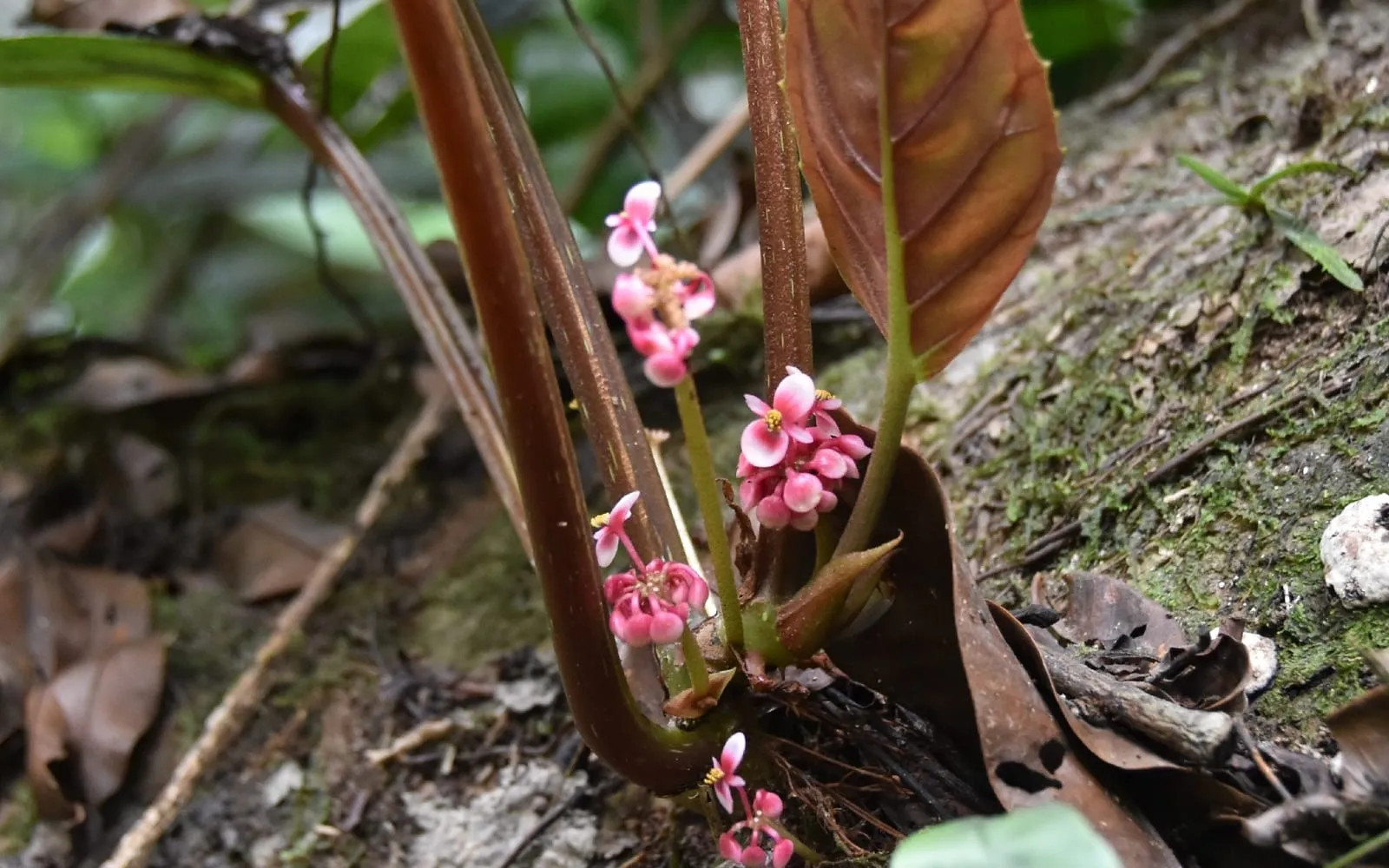
Begonia longipetiolata is an African member of the genus, named for its unusually long leaf stalks. Those stalks hold the blades well out from the base of the plant. It grows in the warm, moist forests of tropical Africa, a region that has given cultivation far fewer begonias than the Americas or Asia, so this plant is seen more often in collections than on a garden-centre bench. Softly hairy and fresh green, it forms a loose, open rosette of leaves on long red-tinged stalks. It needs the same shaded, humid, frost-free care as its better-known relatives.
Leaves and flowers
The blades are broad, lopsided and gently toothed, mid green and covered in fine hairs. Each leaf sits at the tip of a long, slender, fleshy stalk. From the base the plant sends up its foliage in a spreading tuft instead of in tall canes. Sprays of small pale flowers, white or faintly pink, open above the leaves in the warmer months. They follow the family pattern of separate male and female flowers on the one plant. Unlike the familiar begonias that ripen a dry, papery winged capsule, this is one of the African begonias that sets a soft, fleshy fruit, a trait of its group thought to suit dispersal by birds or ants.
Name and classification
Ernst Gilg described the species in 1904. It grows in the lowland rainforest of west central Africa, with records from Gabon, including the Monts de Cristal. It sits in section Tetraphila, one of the four African groups whose members carry fleshy fruits rather than the dry capsules of most begonias. Its place in the genus has shifted more than once. Engler treated it as a form of Begonia squamulosa in 1921, and Arends reinstated it as a distinct species in 1992. Later molecular work found its position among its relatives harder to settle than that of most of its kin.
Its African home
In the wild it grows on shaded, humid forest floors and damp banks in tropical Africa, in warmth, steady moisture and light filtered by the trees overhead. Give it even warmth without cold spells, moist air around the soft leaves, and bright light that never strikes the foliage directly.
Light for it
Bright, indirect light suits the long-stalked begonia well. An east-facing window, or a place a little back from a brighter one, keeps the leaves fresh and helps stop the stalks stretching too far. Direct summer sun through glass scorches the thin, hairy blades. Too little light exaggerates the already long stalks into weak, floppy growth that cannot hold the leaves up. Turn the pot occasionally so the spreading tuft grows evenly.
How to water it
Water once the top few centimetres of the compost feel dry, soaking the root ball and pouring off whatever gathers below. Through the growing season it likes to stay evenly moist, and the long-stalked leaves wilt fast if it dries out too far. In winter, when growth slows, water much less and let more of the pot dry between drinks. Cold, sodden compost rots the roots and collapses the stalks, so water less in cool weather.
Warmth and moist air
Keep it in steady warmth and above about 13 deg C, sheltered from cold draughts. Because the leaves are thin and hairy, dry indoor air browns their edges quickly, so humidity matters. Stand the pot on damp gravel, group it with other foliage plants, or keep it in a naturally moist room. Some gentle air movement stops damp air sitting still among the leaf bases.
Feeding
Feed every two to three weeks through spring and summer with a balanced liquid fertiliser at half strength. That keeps the leaves broad and green without forcing soft, weak growth on the long stalks. A leafy plant like this benefits from steady, moderate feeding instead of occasional heavy doses. Stop over winter and start again only when new leaves unfurl in spring.
Propagation
Take stem or basal cuttings in spring and summer, trimming a healthy shoot below a joint and rooting it in warm, damp, open compost under cover. It should root in a few weeks. A whole leaf, complete with a length of its long stalk, will also root if set into damp compost and kept humid. Divide a large, crowded plant at repotting in spring, potting each piece separately. Fresh seed sown on damp compost germinates in warmth, though seedlings are slow.
Health and troubles
Warm, humid and shaded, this begonia stays healthy. Spider mites appear when the air dries out, speckling the leaves and webbing the joints. Higher humidity and a gentle rinse help keep them down. Mealybugs may lodge where the long stalks meet the base and can be wiped off with dilute alcohol. Grey mould can spot leaves left cold and wet in still air. Long stalks that flop and cannot support their leaves usually mean too little light, so move the plant to a brighter but still shaded spot.
Season by season
Spring brings fresh growth. Take cuttings, divide crowded plants and resume feeding.
Summer brings full leaf and flower. Keep the compost evenly moist, feed and hold the humidity up.
Autumn slows the plant as light fades. Ease off water and stop feeding.
Winter is a warm rest. Keep it above chilling cold, water sparingly and let the pot dry more between drinks.
Common questions
Why are the leaf stalks so long and floppy? Long stalks are natural to it, but very weak, drooping ones mean too little light. Move it somewhere brighter, out of direct sun.
Does it want direct sun? No. Bright but filtered light keeps it in good order. Direct sun scorches the thin leaves.
When should I water? When the top few centimetres have dried, keeping it evenly moist in growth and much drier in winter.
How do I make more? Root a stem or basal cutting in warm, damp compost, or root a leaf with its stalk attached.
Is it harmful to pets? Mildly. The ASPCA lists begonias as toxic to cats, dogs and horses, because the insoluble oxalate crystals burn the mouth and cause drooling and vomiting. Keep it out of reach of pets that chew.
Long-Stalked Begonia problem guides
Not sure what is wrong? See the common houseplant pests guide.