
Outdoor plant
Common Duckweed
Lemna minor
Also known as Lesser duckweed
How to grow, or control, common duckweed, Lemna minor. Why it spreads so fast, what keeps it in check, and what it is good for.
At a glance
- Difficulty
- Easy
- Water
- Floats on open water; no watering required
- Light
- Full sun to partial shade
- Hardiness
- USDA 3-11, RHS H7, hardy to -30 C
- Type
- Free-floating aquatic perennial
- Height
- Each frond is 2-5 mm across
- Native to
- Europe, Asia, Africa, North America
Extremely hardy and found on still fresh water across most of the temperate and tropical world. It overwinters as dormant turions that sink to the pond floor when the surface freezes and rise again to resume floating growth the following spring, so cold is rarely what limits it. Warm, nutrient-rich water is what makes it multiply fast enough to become a problem rather than a minor feature.
Hardiness zones describe winter cold alone. Summer heat, humidity, rainfall and the length of the growing season decide as much, so treat the range as the outer limit rather than as a recommendation.
Not known to be toxic
Duckweed has no toxicity listing from the RHS or the ASPCA and is eaten as a normal part of the diet by fish, waterfowl and some grazing livestock. It is also grown deliberately as a high-protein feed crop for fish and poultry in parts of the world. The concern with duckweed is never toxicity; it is that an uncontrolled mat can cover a whole pond surface and cut off the light and oxygen everything beneath it needs.
Source: RHS
About
Common duckweed is one of the smallest flowering plants in the world, each individual frond only a few millimetres across, yet a pond left unmanaged can be entirely blanketed by it within weeks in summer. It is grown deliberately in some ponds for the cover and food it offers fish and wildlife, and removed just as deliberately from others where a clear water surface matters more.
Whether it belongs in a particular pond depends on the pond. It grows with almost no encouragement wherever still fresh water and a little warmth are available. It can suit a wildlife pond; it usually does not suit a formal pool or a koi pond.
Appearance and character
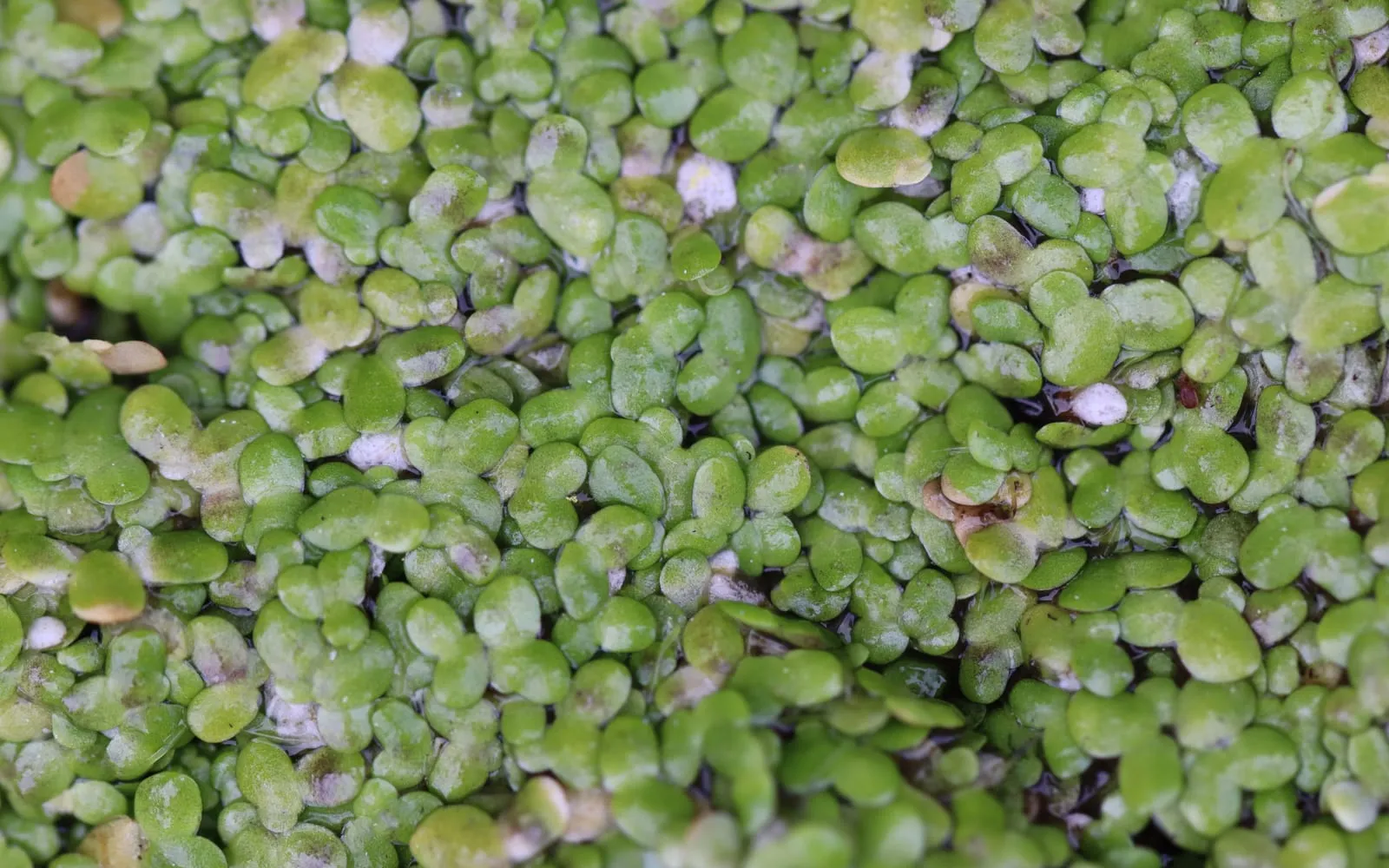
Each plant is a single tiny oval frond, pale to mid-green, with one or a few short roots trailing beneath it into the water. Fronds bud new fronds from their edge, and the two often stay attached briefly before separating, which is how a handful of plants can become a solid green carpet in a matter of weeks under warm, nutrient-rich conditions.
Flowers exist but are almost never seen; they are microscopic and produced rarely, and the plant spreads almost entirely by this constant vegetative budding rather than by seed.
Where it is from
Still fresh water nearly worldwide: ponds, ditches, canals and slow backwaters across Europe, Asia, Africa and North America, and introduced well beyond its native range through the movement of waterfowl, which carry fragments on their feathers and feet between water bodies.
It thrives specifically in nutrient-rich water, which is also the condition that leads to algal blooms, and the two often appear in the same ponds for the same underlying reason: too much nitrogen and phosphorus entering the water from runoff, fish waste or decaying organic matter.
How it grows
A free-floating perennial that reproduces almost entirely by budding new fronds from existing ones, doubling its coverage in as little as two to four days under warm, nutrient-rich summer conditions. This is among the fastest reproduction rates of any flowering plant, and it is the reason a light scattering of duckweed can become a solid mat covering an entire pond surface within a single warm month.
In cold weather the plant produces dense, starch-filled turions that sink to the pond floor and remain dormant until spring, when they rise back to the surface and resume normal floating growth.
Through the seasons
Spring overwintered turions rise to the surface and resume growth as the water warms, with visible coverage increasing through April and May.
Summer is when growth is fastest and most likely to become excessive, particularly in warm, nutrient-rich water with little surface movement.
Autumn growth slows as the water cools, and some fronds begin forming the dense turions that will overwinter on the pond floor.
Winter most of the population survives as dormant turions rather than floating fronds, invisible on the surface until spring.
Care difficulty
Easy in the sense that it needs no encouragement whatsoever to grow. The actual skill most pond keepers need is the opposite of cultivation: keeping its spread within bounds so it does not blanket the whole surface and starve everything below it of light and oxygen.
Watering
None needed. The plant floats freely on the surface of still or very slow-moving fresh water and takes up everything it needs directly from that water, with no soil, pot or planting depth involved at all.
Warning signs, diseases and pests
There is essentially no pest or disease that seriously damages duckweed. If anything, the challenge runs the other way. Fish, ducks and other waterfowl graze it readily, and a pond with a healthy population of either often keeps duckweed in check without any intervention from the gardener. Koi in particular can strip a pond nearly bare of it within days, which is one of the more common ways a deliberately introduced patch disappears again soon after planting.
The warning sign to watch for is coverage rather than damage. A mat that has spread to cover most of the surface blocks light to submerged plants and reduces the oxygen exchange the water needs, particularly overnight when photosynthesis stops but respiration continues. A pond that has gone entirely green on top for more than a couple of weeks is worth thinning regardless of how attractive fish find it.
Growing environment
Full sun to partial shade both support strong growth, and warm, still, nutrient-rich water is what drives the fastest multiplication. Reducing the nutrient load entering a pond, whether from fish feed, fertiliser runoff or decaying leaves, is the most effective long-term way to keep coverage manageable without constant physical removal.
Feeding
No feeding is appropriate or useful. Adding fertiliser to water already prone to duckweed cover almost always makes the problem worse rather than producing healthier plants, since this species grows fastest in the nutrient-rich conditions a fertiliser addition creates.
Troubleshooting
Duckweed has covered the entire pond surface. Skim off the excess by hand or with a net, ideally removing at least half the coverage at a time so some clear water and light remain. Reducing nutrient input, such as overfeeding fish, is the more lasting fix.
It keeps coming back after being removed. A few fronds or turions left behind, or nutrient-rich water encouraging fast regrowth, are the usual causes. Combine repeated removal with addressing the nutrient source.
It arrived in a pond where none was planted. Duckweed commonly hitches a ride on waterfowl feathers, aquatic plants bought from another source, or even garden tools moved between ponds, and needs no deliberate introduction to establish.
Fish or plants beneath a thick mat look unhealthy. Suspect reduced light and oxygen from prolonged heavy coverage. Clear a significant portion of the mat promptly and monitor water oxygen levels if fish are affected.
You want duckweed for a wildlife pond but it never establishes. A few fronds are often enough to start a colony given warm, still, reasonably fertile water, so a patch that fails to spread usually points to a pond that is too cold, too shaded, or too vigorously skimmed by fish and waterfowl to let it get a foothold. Introduce a larger starting patch in a sheltered, sunnier corner and give it a full season before judging whether it has taken.