
Outdoor plant
Mossy Saxifrage
Saxifraga x arendsii
Also known as Arends' saxifrage, Mossy rockfoil
How to grow mossy saxifrage, Saxifraga x arendsii. Why its cushion habit is a mountain survival shape rather than a garden trick, its dislike of summer baking, and keeping the mat tight for years.
At a glance
- Difficulty
- Easy
- Water
- Regular watering through spring and summer, allowing the surface to dry slightly between waterings
- Light
- Full sun to partial shade
- Temperature
- Cool temperate; struggles in prolonged summer heat above 25 deg C
- Humidity
- Average outdoor humidity; dislikes hot, dry air against the foliage
- Hardiness
- USDA 4-7, RHS H5, hardy to -15 C
- Type
- Hardy evergreen perennial
- Height
- 5-15 cm
- Native to
- Europe
The zone range covers winter cold well but says nothing about summer heat, and heat is the more common cause of failure. Above roughly 25 deg C the cushion scorches and thins from the centre outward, which is why the plant performs better at altitude or on a north or east-facing slope than the zone number alone would suggest.
Hardiness zones describe winter cold alone. Summer heat, humidity, rainfall and the length of the growing season decide as much, so treat the range as the outer limit rather than as a recommendation.
Not known to be toxic
Mossy saxifrage carries no toxicity listing from the RHS or the ASPCA and is not associated with skin irritation or digestive upset in any documented case. It is regularly planted at the edge of paths and in beds accessible to pets and children without concern.
About
Mossy saxifrage is a group of garden hybrids bred from several European mountain saxifrages, most significantly Saxifraga rosacea and Saxifraga moschata, by the German nurseryman Georg Arends in the early twentieth century, which is where the “arendsii” in its name comes from. The result is a dense, moss-like cushion of tiny evergreen leaves that covers itself in small, cup-shaped flowers in white, pink or deep red for several weeks in late spring, held just clear of the foliage on thin stems.
It is one of the least fussy true alpines available to a rockery gardener, tolerant of ordinary garden soil in a way that scree specialists like lewisia are not, and it spreads steadily rather than aggressively, filling gaps between paving and larger rocks without swamping neighbouring plants. Its main limitation is heat rather than cold: the cushion that keeps it alive on an exposed mountainside also traps warmth against the foliage in a hot, still summer, and that combination damages it more often than frost does.
Appearance and character
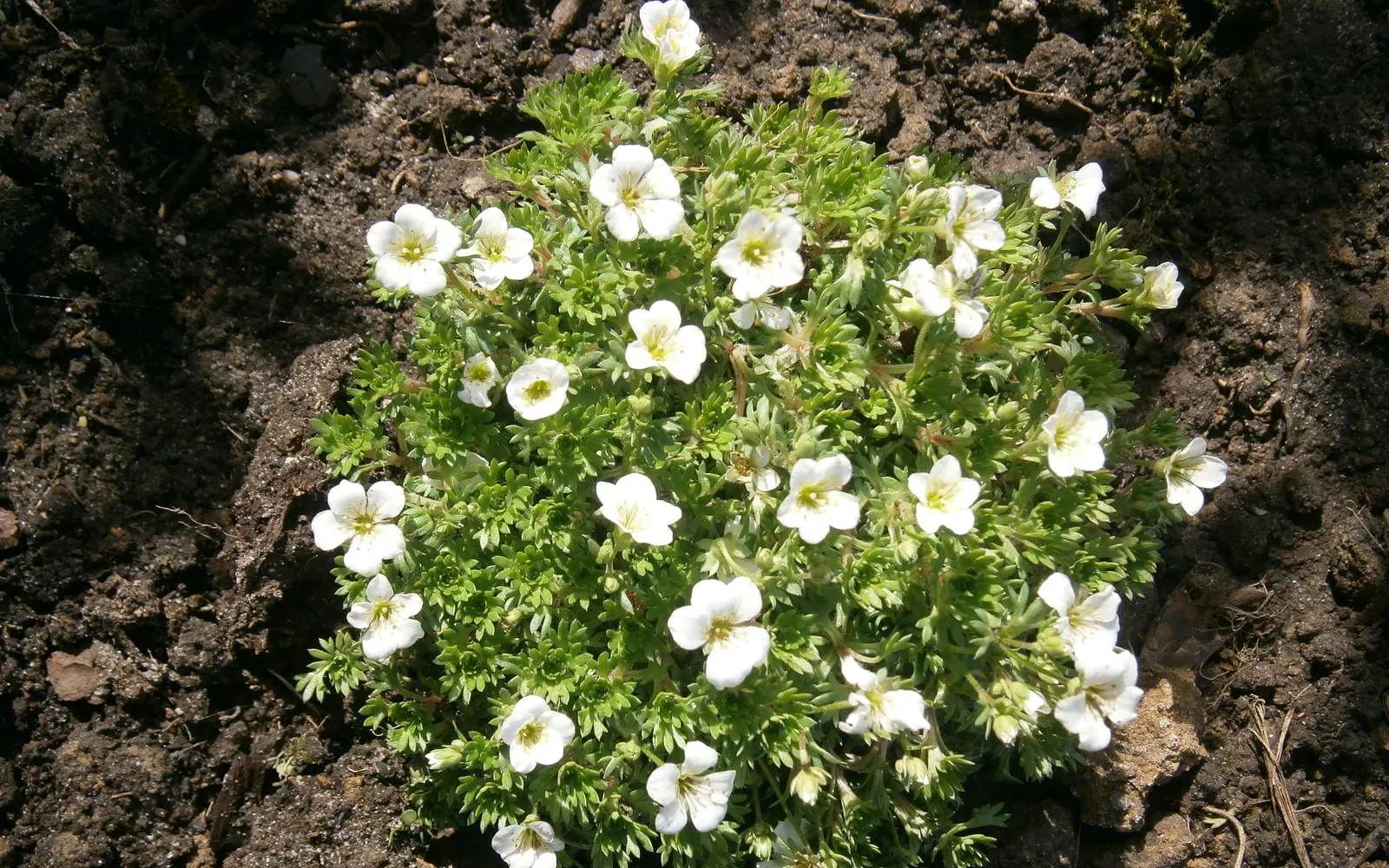
The foliage forms a low, dense carpet of small, deeply lobed rosettes packed so tightly together that from a short distance the mat looks more like moss than like individual leaves, which is the source of both its common name and its garden use as a living mulch between paving slabs. Each rosette is only a centimetre or two across, but a single plant produces hundreds of them, knitting together into a solid patch 20 to 30 cm wide within two or three seasons.
In late spring the mat disappears almost entirely under a haze of small, five-petalled flowers on wiry stems 5 to 15 cm tall, in shades running from pure white through soft pink to a saturated crimson red depending on the cultivar. The display lasts several weeks and is dense enough to be the main event in a rockery for that period, after which the plant reverts to its quiet green and bronze-tinted foliage for the rest of the year.
Where it is from
The parent species behind the arendsii hybrids grow scattered through mountain ranges across Europe, from the Pyrenees through the Alps and into the Carpathians, typically rooting into rock crevices, shaded ledges and the thin soil at the base of cliffs rather than on fully exposed, sun-baked scree. That habitat, cooler and slightly moister than a classic alpine talus slope, is why mossy saxifrage tolerates ordinary rockery soil and even light shade better than most plants in this category, and why it struggles more with heat than plants adapted to drier, more exposed ground.
The cushion growth habit shared by nearly every true alpine, including this one, is a direct response to conditions above the tree line: wind that would shred an upright stem passes over a low, dense mat with far less resistance, and the tightly packed leaves trap a thin layer of still, slightly warmer air that protects the growing points from extreme cold and drying wind. It is a survival shape carried over from a harsh native habitat rather than a form bred deliberately for garden appeal, and the same shape happens to make an excellent ground cover at low altitude.
How it grows
Growth proceeds outward from the crown as a slow, steady spread of new rosettes rather than as a single dominant stem, so the plant thickens and widens rather than climbing or trailing. Roots are fine and fibrous, spreading through the top few centimetres of soil, and the plant relies on that soil staying reliably moist through the growing season rather than on deep drought reserves the way a true scree plant does.
Individual rosettes are relatively short-lived, dying back naturally after flowering and being replaced from the edges, which keeps the mat renewing itself as long as growing conditions stay reasonable. Where conditions are poor, particularly where summer heat sits on the cushion for weeks at a time, the centre of an established mat can die out while the edges keep growing, leaving a ring shape that needs lifting and replanting to correct.
Through the seasons
Spring is the main flowering season, usually running from April into May depending on climate, when the whole cushion is briefly hidden under flowers. This is also the best time to plant new mossy saxifrage, giving it a full growing season to establish a root system before its first winter.
Summer is the plant’s most vulnerable period rather than its most active one. Once flowering finishes the mat needs consistent moisture and, in warmer climates, some shade from the most intense afternoon sun to stop the foliage scorching. A mulch of fine grit around, but not over, the crown helps keep the root zone cool and moist without burying the foliage.
Autumn brings a return to steady, unstressed growth as temperatures drop, and it is a good second window for planting or dividing an overgrown mat, giving new divisions time to root before the ground turns cold.
Winter is handled without difficulty down to around minus 15 deg C once the plant is established; the evergreen cushion stays green through the coldest months and needs no covering in a typical temperate winter. Standing water on top of the mat after heavy rain on poorly-drained ground is the greater winter risk, and it can rot the crowns even though the plant tolerates hard frost easily.
Care difficulty
Mossy saxifrage is one of the easier true alpines to keep, largely because it does not demand the razor-sharp drainage that species like lewisia or the true scree saxifrages need. A gardener who gives it humus-rich soil, reasonably consistent moisture and some relief from the hottest afternoon sun will find it reliable and long-lived, and it tolerates being walked past and brushed against, which is more than can be said for a spiny cushion plant.
The main skill involved is reading its heat stress correctly. A gardener who assumes it needs the same lean, dry, baking conditions as a classic rockery succulent will overexpose it and watch the centre of the mat die out over a hot summer, when the actual fix is more shade and more consistent watering, not less.
Watering
Water regularly through spring and summer so the root zone stays evenly moist, checking the soil beneath the mat rather than judging by the surface, since the dense foliage sheds light rain and can look dry on top while the soil underneath is still damp. Cut back sharply in winter, when the plant needs very little supplemental water and excess moisture pooling on the crown is a bigger risk than drought.
A position that gets morning sun and afternoon shade needs less frequent watering than one in full, exposed sun all day, and matching the watering schedule to the actual microclimate of the planting position matters more with this species than following a fixed interval.
Warning signs, diseases and pests
Vine weevil is the pest most likely to cause serious damage, with adult beetles notching the leaf edges at night, doing cosmetic harm, while their grubs feed on the roots below ground and can kill a whole patch without any warning above soil level until the mat suddenly collapses. Slugs and snails graze on the soft new growth after rain, particularly on young plants before the mat has thickened enough to resist them, and aphids occasionally cluster on the flower stems in spring without causing lasting harm.
Root rot, distinct from vine weevil damage, follows waterlogging rather than pest activity and shows as a section of the mat turning brown and mushy at the base while the rest stays healthy. It is avoidable almost entirely by planting in soil that drains rather than by any treatment once it has started, since by the time rot is visible the affected section is not recoverable.
Growing environment
Full sun suits mossy saxifrage in a cool climate, but in warmer regions it performs better with light or dappled shade for part of the day, particularly through the hottest hours of summer afternoons. A north or east-facing rockery slope, or the shaded side of a larger rock, often gives better results than the open, south-facing exposure that suits sun-loving alpines like basket-of-gold.
Soil should be humus-rich rather than the sharp grit and stone mix used for true scree plants, since this species comes from shaded mountain ledges rather than fully exposed talus. A neutral to slightly alkaline pH suits it best, and working leaf mould or garden compost into the planting area before setting the mat in place gives it the organic matter it needs to hold moisture without becoming waterlogged.
Feeding
Mossy saxifrage needs very little supplemental feeding in reasonable garden soil, and heavy feeding tends to produce soft, lush growth that is more prone to rot and less resistant to summer heat stress than a plant grown lean. A single light application of a balanced liquid fertiliser in early spring, as new growth begins, is enough for most plantings, and it can be skipped entirely where the soil already holds reasonable organic matter.
Avoid feeding after flowering finishes, since the plant is heading into its more vulnerable summer period at that point and soft new growth is the least equipped tissue to cope with heat stress.
Troubleshooting
The centre of the mat has died out, leaving a ring of live growth around a bare patch. This is the classic sign of summer heat and drought stress on the crown rather than winter damage. Lift the dead centre, work some fresh humus-rich soil into the gap, and replant a healthy piece from the edge of the ring, then improve shade or watering for the following summer.
Flowers were sparse this spring compared with previous years. Overcrowding, low light, or a summer of stress the year before all reduce the following spring’s flower count. Dividing an overgrown mat every three or four years and making sure the plant gets several hours of direct or bright dappled light usually restores flowering.
The foliage looks scorched and brown at the edges in midsummer. This is heat and sun damage rather than disease, most common on south-facing plantings in warm climates. Move the affected clump to a position with afternoon shade if scorching recurs each year, and increase watering frequency during hot spells.
Notched, ragged edges have appeared on the leaves overnight. This is adult vine weevil feeding, which is cosmetic on its own but often signals grubs feeding on the roots below. Check for C-shaped white grubs in the surrounding soil and treat with a biological nematode drench in late summer or autumn when soil temperatures are still warm enough for the nematodes to be active.
A patch of the mat has turned soft, brown and slimy rather than crisp and brown. This is crown or root rot following waterlogging, usually after a spell of heavy rain on poorly-drained ground. Remove the affected section entirely, improve drainage in that spot before replanting, and avoid mulching directly over the crown in future.
The plant has stopped spreading and looks tired after several years in the same spot. Established mats naturally decline as the centre ages and soil around the roots becomes depleted and compacted. Lift and divide the whole patch in autumn or early spring, replanting vigorous outer pieces into refreshed soil and discarding the tired centre.
Slug damage keeps appearing on new growth after rain. Young mats without much bulk are more vulnerable than established ones. Clear hiding places such as leaf litter and loose stones near the plant, water in the morning rather than the evening so the foliage is not damp overnight, and use a pet-safe ferric phosphate slug control around vulnerable young plantings if damage is severe.