
Houseplant
Night-Blooming Cereus
Selenicereus grandiflorus
Also known as Queen of the night
How to grow night-blooming cereus, Selenicereus grandiflorus, as a climbing cactus. Its huge one-night flowers, and why it needs something to climb.
At a glance
- Difficulty
- Moderate
- Water
- Regular watering in summer, reduced in winter
- Light
- Bright indirect light to partial shade
- Temperature
- Above 10 deg C
- Hardiness
- USDA 10-12, RHS H2, hardy to 5 C
- Type
- Evergreen perennial climbing cactus
- Height
- 2-6 m given support
- Native to
- Caribbean, Mexico, Central America
Frost-tender and grown as a container specimen across almost the entire temperate world, since it is damaged by cold well before freezing point. It flowers most reliably with a warm, bright summer and a slightly cooler, drier winter rest, a seasonal contrast that encourages the flower buds a following summer depends on.
Hardiness zones describe winter cold alone. Summer heat, humidity, rainfall and the length of the growing season decide as much, so treat the range as the outer limit rather than as a recommendation.
Not known to be toxic
Night-blooming cereus has no toxicity listing from the RHS or the ASPCA and is considered safe around pets and children. It has a long history of use in traditional herbal preparations for the heart in some cultures, though that use is unrelated to any toxicity concern and is not a recommendation to use the plant medicinally.
Source: RHS
About
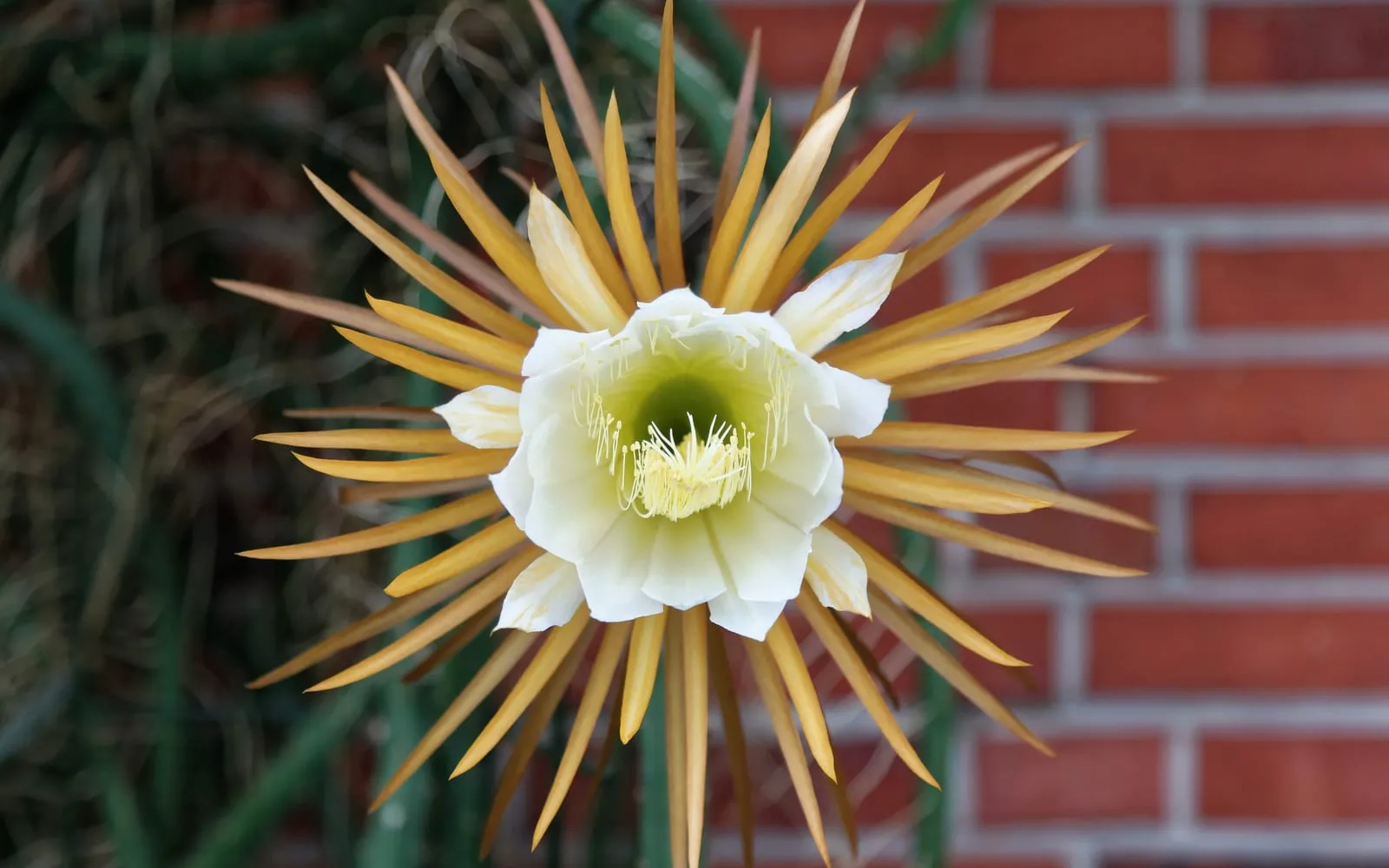
Night-blooming cereus is grown for one of the most striking single events in ornamental horticulture: an enormous, intensely fragrant white flower, often 15-30 cm across, that opens after dark on a summer evening and withers by the following morning, never to reopen. A mature plant may produce several of these flowers across a season, sometimes more than one on the same night, and enthusiasts often gather to watch a bud they have been tracking for days finally unfurl.
Unlike the compact, self-supporting cacti most people picture, this species is a sprawling, vining climber, using small aerial roots along its long, ribbed stems to cling to a support in the way an ivy or a climbing hydrangea would, and it needs something to scramble up or along to look and flower its best.
Appearance and character
Long, thin, ribbed stems trail and climb using short aerial roots produced along their length, forming an increasingly tangled, vine-like mass over years if left to its own devices, or a more controlled climbing feature if trained against a support. Stems carry small clusters of short spines at intervals rather than the dense, fearsome armament of many other cacti.
The flowers are the plant’s defining feature: enormous, funnel-shaped and white, with a ring of narrow outer petals often tinged brown or yellow surrounding the pure white inner ones, opening in the evening and lasting only a single night before collapsing by the next morning, an event many growers plan an evening around once buds signal an imminent flowering.
Where it is from
Tropical forest edges and rocky ground across the Caribbean, Mexico and Central America, where it grows as an epiphyte or scrambles over rocks and other vegetation using its aerial roots for support, in a climate with warm, humid summers and a cooler, drier season.
That seasonal contrast between a warm wet season and a cooler dry one is part of why an artificial winter rest, cooler and drier than summer conditions, tends to encourage more reliable flowering the following season in cultivation.
How it grows
An evergreen perennial that extends continuously from the tips of its long, ribbed stems, climbing or trailing using aerial roots produced along their length wherever they meet a suitable support. Growth is fairly fast given warmth, light and a support to climb, and an established plant can cover a considerable trellis or wall area within a few years.
Flower buds typically form on growth from the previous season rather than on brand new stems, so a plant that is cut back hard every year may produce fewer flowers than one allowed to build up a framework of older stems over time.
Through the seasons
Spring growth resumes as light and temperature increase, with new stem extension from established growth.
Summer is the main flowering season, with buds developing and opening into their single-night blooms, sometimes in a synchronised flush of several flowers at once. Feed monthly through this period.
Autumn growth slows as light and temperature drop; reduce watering and feeding accordingly.
Winter keep the plant cooler and drier than in summer, though not cold enough to risk frost damage, to encourage the following season’s flower buds.
Care difficulty
Moderate. The plant survives fairly casual care, but flowering reliably takes attention to the seasonal contrast between a warm, bright summer and a cooler, drier winter rest, a detail easy to overlook if it is kept in constant warmth year round with no seasonal change at all.
Watering
Water regularly through the growing season, allowing the compost to dry somewhat between waterings, then reduce watering significantly over winter to support the cooler, drier rest this species benefits from for reliable flowering the following summer.
Warning signs, diseases and pests
Mealybug and scale insects can colonise stems, particularly in the grooves between ribs, and are treated with careful manual removal or a horticultural oil spray for heavier infestations. Spider mites occasionally appear in warm, dry indoor air, showing as fine speckling along the stems.
A plant that grows vigorously but never flowers is one of the more common frustrations with this species, and is usually down to a lack of the seasonal cool, dry winter rest that triggers bud formation, rather than any pest or disease; providing a real, if modest, winter contrast in temperature and watering often resolves it within a season or two.
Soft, discoloured stem sections generally indicate rot from overly wet compost, particularly during winter, and are addressed by cutting back to healthy tissue and reducing watering going forward.
Growing environment
Bright indirect light to partial shade suits it well, reflecting its origin at forest edges rather than in full open sun. A support to climb, whether a trellis, wall or another sturdy structure, lets the plant develop the framework of older growth that flowers most reliably, and free-draining, humus-rich cactus compost suits its epiphytic, forest-edge origins better than a very lean, mineral desert cactus mix.
Feeding
A low-nitrogen cactus or flowering plant fertiliser, applied monthly through spring and summer, supports strong growth and flowering. Stop feeding through the cooler winter rest period, when the plant is not actively growing.
Troubleshooting
The plant grows well but has never flowered. The most common issue with this species. Provide a distinctly cooler, drier winter rest, since this seasonal contrast is usually what triggers reliable bud formation the following summer.
Stem sections have turned soft and discoloured. Suspect rot from overly wet compost, particularly in winter. Cut back to healthy tissue and reduce watering.
The plant has become a tangled mass with no clear structure. Provide a trellis or similar support and train the main stems onto it while they are young and flexible, since an established, unsupported tangle is harder to train later.
A flower bud appeared to develop for days and then failed to open. This can happen if the bud is damaged, if conditions are unusually cool, or occasionally without an obvious cause. A healthy, well-established plant typically still produces further buds through the same season.
Night-Blooming Cereus problem guides
Not sure what is wrong? See the common houseplant pests guide.