
Houseplant
Night-Scented Lily
Alocasia odora
Also known as Alocasia odora
Grow Alocasia odora, the giant elephant's ear whose arum flowers carry a night fragrance, for bold glossy leaves in a warm, humid room.
At a glance
- Difficulty
- Easy
- Water
- When the top few centimetres of mix have dried
- Light
- Bright indirect light to light shade
- Temperature
- Warm; keep above about 7 deg C
- Humidity
- Average to high
- Hardiness
- USDA 9b-11, RHS H2, hardy to 2 C
- Type
- Perennial
- Height
- Up to 3 m
- Native to
- eastern and Southeast Asia
A tender subtropical foliage plant from eastern and Southeast Asia, growing in warm, humid, shaded to filtered light. It needs warmth, humidity and bright indirect light, and it takes at most a brief, very light frost. It is safest above about 7 deg C, and cold, wet compost or dry air spoils it.
Hardiness zones describe winter cold alone. Summer heat, humidity, rainfall and the length of the growing season decide as much, so treat the range as the outer limit rather than as a recommendation.
Toxic if eaten
- Do not eat
- All parts, which contain calcium oxalate crystals
- Harm from
- Eating it and handling it
- Affects
- People, cats and dogs
Like other members of the arum family, the night-scented lily holds tiny calcium oxalate needles in every part. Chewing a leaf or stem can push them into the soft tissue of the mouth, causing burning, swelling, drooling and vomiting in a pet that swallows any; the sap can irritate skin and eyes. The ASPCA lists this group among the plants that harm cats and dogs. Keep the night-scented lily away from anything that chews, and wash off any sap.
Sources: ASPCA toxic and non-toxic plants, RHS potentially harmful garden plants
About
Alocasia odora is a giant elephant’s ear, one of the tropical aroids grown for its large foliage rather than its flowers. The common name night-scented lily is misleading, since the plant is not a lily and its flowers are not the main reason to grow it. It does, however, produce an arum-type flower that can smell sweet after dark, which is what the species name odora records.
Indoors it is grown for scale. A well-fed plant builds a clump of large, upright, glossy leaves that can fill a warm, bright corner.
Appearance and character
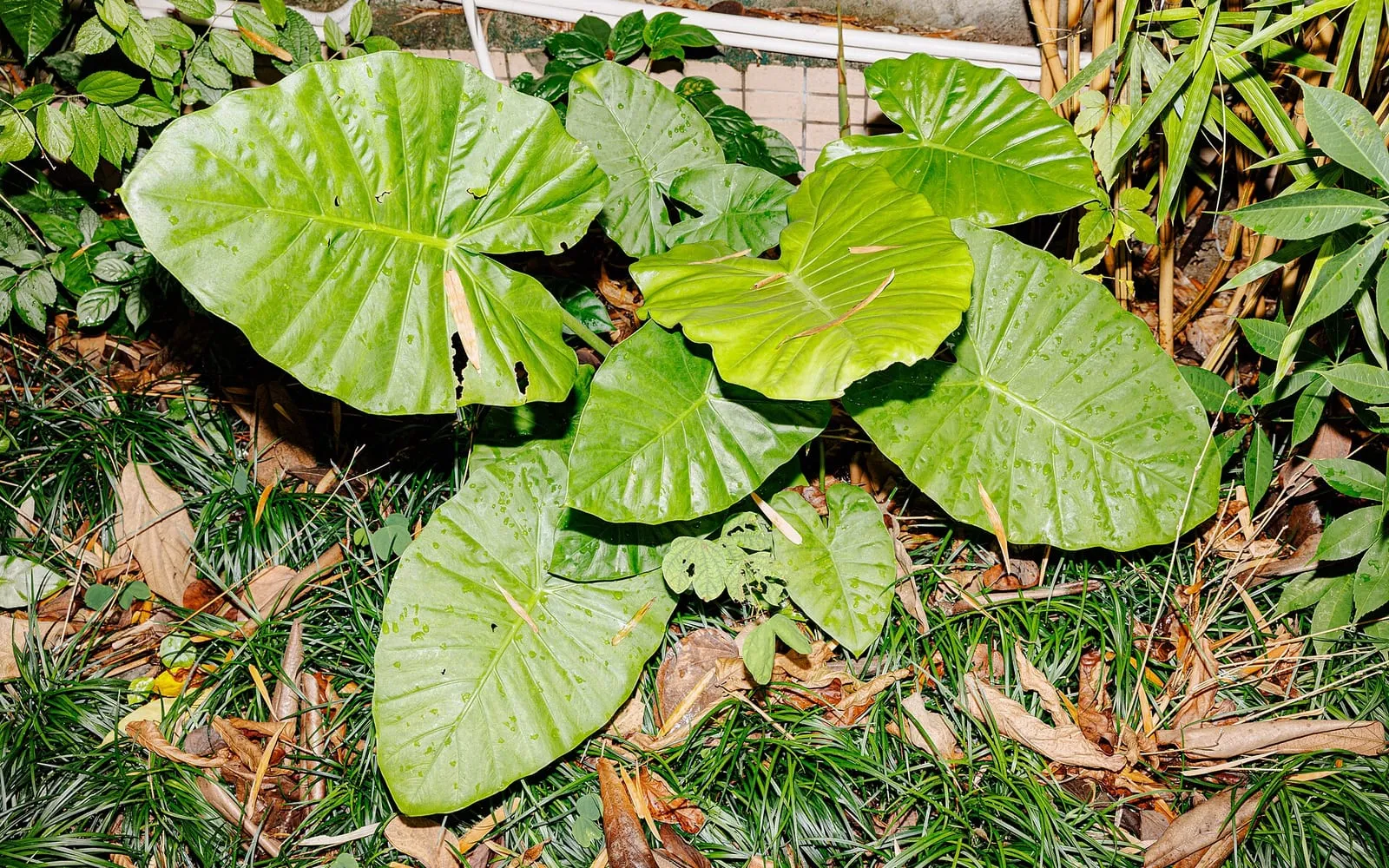
The leaves are the main feature. Each leaf is broad and arrow-to-heart shaped on a long, ribbed stalk, deep matt green with a slightly quilted surface and prominent veins. The leaves are held upright and outward, so the plant fills space vertically as much as sideways. Mature specimens can carry leaves that span a good part of a metre in ideal warmth.
The plant grows from a thick, fleshy rhizome that can form a short trunk-like base over time. When it flowers, it produces a typical aroid bloom: a pale spathe wrapped around a central spadix, sweetly scented in the evening. Many houseplants never flower, and that is not a problem.
Where it is from
The species is native to eastern and Southeast Asia, from southern China, Taiwan and the Ryukyu Islands of Japan through Indochina and into the Philippines. It grows in warm, humid forest margins and clearings, in the dappled light beneath a broken canopy and in rich, moist, leaf-littered ground.
That origin explains what it needs in cultivation. Give it steady warmth, high humidity, filtered light instead of harsh sun, and soil that stays moist but never stagnant. It has no tolerance for frost and does badly in cold, so it lives indoors outside the tropics.
How it grows
Grow it in a rich but open, free-draining potting mix, ideally one lightened with bark or perlite so water passes through while the roots stay damp. Choose a pot only a little larger than the rootball, since a vast pot of wet compost around a small plant encourages rot.
New leaves unfurl from the growing point through the warm months, each larger than the last on a plant that is well fed and humid. It multiplies by offsets, small pups that appear around the base of the rhizome and can be separated with their own roots to make new plants. In a cool winter it may pause or drop a leaf or two, resuming when warmth returns.
Through the seasons
Spring starts strong growth as light and warmth increase. New leaves begin to appear in quick succession, so resume regular feeding.
Summer is the peak growing season, when the plant makes its biggest leaves given warmth, humidity and bright, filtered light.
Autumn slows growth as light fades, and watering and feeding should ease back to match.
Winter is a quieter spell, and in a cool room the plant may rest or shed a leaf; keep it warm, on the dry side, and out of cold draughts.
Care difficulty
With warmth, humidity and careful watering it is an easy foliage plant. Most failures come from avoidable conditions. Cold, waterlogged compost rots the rhizome, and dry indoor air browns the leaf edges and encourages spider mites. Keep it warm, humid and evenly moist, but never leave it standing in water.
Watering
Water when the top few centimetres of the mix have begun to dry, giving enough to moisten the whole rootball and letting the excess drain away freely. The plant likes to stay damp in growth, but sitting in a saucer of water is the fastest route to root rot.
Cut back through winter, when growth slows and the plant uses far less, and let the surface dry a little more between waterings. Tepid water suits it better than cold straight from the tap.
Warning signs, diseases and pests
Yellowing lower leaves and a soft base point to overwatering or cold, wet compost. Ease off the water, warm the plant and check that the rhizome is firm. Brown, crisp leaf edges mean the air is too dry. Group plants, stand the pot on a damp pebble tray or run a humidifier.
Spider mites and mealybugs move in when the air is warm and dry, showing as fine webbing or white waxy tufts in the leaf joints. Wipe them off with a damp cloth or a cotton bud dipped in dilute alcohol and raise the humidity to discourage their return.
Growing environment
Bright, indirect light suits it best, such as a position near an east or north window or set back from a brighter one, since direct midday sun scorches the leaves. Steady warmth and humidity above the average of a centrally heated room bring out the largest, healthiest foliage.
Keep it away from cold glass, draughts and heat sources that dry the air. A warm bathroom or kitchen can suit it, as can a grouped display of plants that share humidity.
Feeding
Feed with a dilute balanced liquid fertiliser every few weeks through spring and summer, when the plant is in active growth and building large leaves. A steady, moderate feed supports the leaf size the plant is grown for.
Stop feeding in autumn and winter while growth is slow, since a resting plant cannot use the nutrients and a build-up of unused feed can scorch the roots.
Troubleshooting
Is it really a lily? No. Alocasia odora is an aroid, a relative of the arum and peace lily, and the common name refers only to the night fragrance of its uncommon arum-type flower.
Why are the leaf edges going brown? Dry indoor air is the usual cause. Raise the humidity and keep the compost evenly moist.
A lower leaf yellowed and died. Is that a problem? A single old leaf yellowing is normal, especially in winter, but several at once with a soft base points to cold or overwatering.
How do I make more plants? Separate the offsets that form around the base, each with a few roots, and pot them up individually in warm conditions.
Is it dangerous to pets and children? Yes. Every part holds calcium oxalate crystals that burn the mouth and cause drooling and vomiting, so keep it out of reach of anything that might chew it and wash off any sap on skin.
Night-Scented Lily problem guides
Not sure what is wrong? See the common houseplant pests guide.