
Houseplant
Military Orchid
Orchis militaris
Also known as Orchis militaris
How to grow Orchis militaris, the military orchid, a European orchid whose flowers look like a uniformed soldier and which survives at few British sites.
At a glance
- Difficulty
- Difficult
- Water
- Rain only outdoors; it needs no extra water
- Light
- Full sun to light shade
- Temperature
- Fully hardy; needs a cold winter and a warm, dry summer dormancy
- Humidity
- Average
- Hardiness
- USDA 5-8, RHS H6, hardy to -20 C
- Type
- Deciduous tuberous perennial, dormant from high summer
- Height
- 20-50 cm
- Native to
- Europe, western and central Asia
A hardy tuberous orchid of warm, dry, lime-rich grassland and scrub across Europe and western and central Asia. It takes hard winter frost easily and dislikes mild, wet winters and deep shade. It flowers in May and early June, then dies back to its tubers by high summer. It depends on a soil fungus, so it does not suit a pot or a garden border.
Hardiness zones describe winter cold alone. Summer heat, humidity, rainfall and the length of the growing season decide as much, so treat the range as the outer limit rather than as a recommendation.
Not known to be toxic
Orchis militaris, the military orchid, is not recorded among the seriously toxic plants, and related plants in its group are not listed as toxic by the ASPCA or the RHS. A pet or child that chewed a leaf would be unlikely to have more than a possible mild stomach upset.
Sources: ASPCA toxic and non-toxic plants, RHS potentially harmful garden plants
The soldier in the helmet
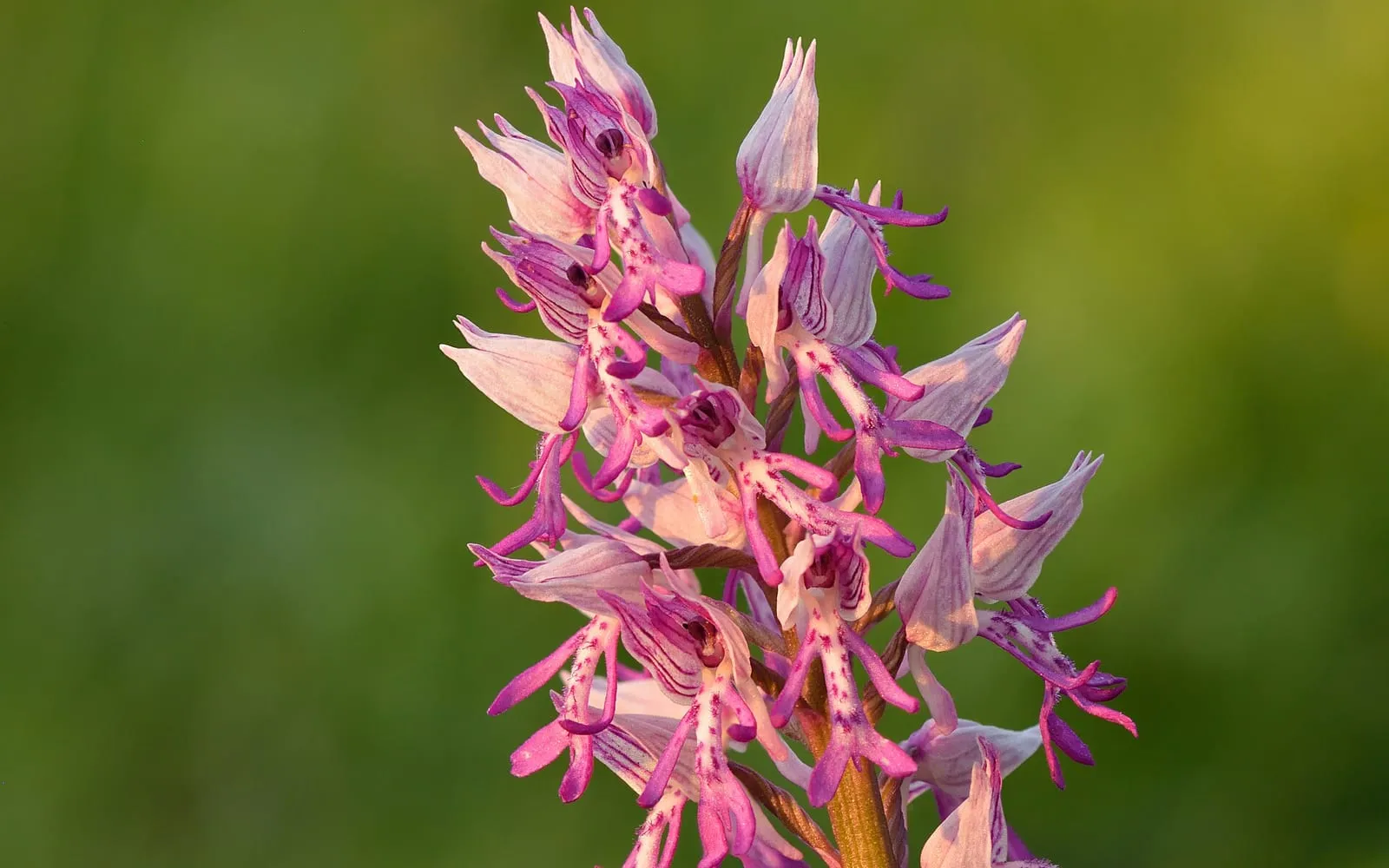
The name Orchis militaris comes from the flower’s likeness to a figure in uniform. The sepals and upper petals close over the top into a grey-pink helmet, and the lip beneath divides into two slender “arms” and two longer “legs”, tipped with a small point that suggests a bayonet or a cap tassel. Ranged up a conical spike, the blooms give the whole head a soft ashen-lilac colour. The species occurs across Europe and into western Asia. In Britain it was long thought lost, then rediscovered at a Buckinghamshire site in 1947. It now survives at only a couple of protected localities.
Field marks
Broad, shining, pale green leaves gather at the base without any spotting, and the flowering stem rises stiffly through them. Each flower’s hood is pale on the outside and streaked with darker rose-purple veins inside, while the dangling lip is whitish-pink and flecked with tiny tufts of reddish hairs down the centre. The “limbs” of the figure are narrow and pinched, which separates a military orchid from the plumper-lipped lady orchid where the two overlap. A well-grown spike is a dense, many-flowered cone rather than a loose column.
Preferred ground
This is a plant of warm, dry chalk and limestone. It grows at the edges of open woodland, in scrub, on grassy banks and in old quarries, always on lime-rich soil and usually where the ground bakes in summer sun. It responds poorly to both deep shade and rank competition, so it does best where grazing, cutting or a thin stony soil keeps rival vegetation short. Across central and southern Europe it is far more frequent than at the cool, damp northern limit, where a run of poor summers can stop it flowering for years.
Deception at the flower
Bees and other insects pollinate the military orchid, drawn by the patterned lip that mimics a nectar-bearing bloom. The spur is dry, so the insect gets no reward but may carry off pollen packets stuck to its body. This reward-free strategy keeps the number of fertilised flowers low. A single ripened pod can still split to release a cloud of tiny, light seeds. They drift on air currents, which is how the species can sometimes appear at a new site miles from any known colony.
Cultivation prospects
The seeds have no food reserve to fuel germination, and in nature they must be colonised by a specific soil fungus that sustains the young plant underground for years before a leaf emerges. Because that fungal partner cannot be transplanted, lifting a wild military orchid is both unlawful and futile. The tuber dies once cut off from the network it fed on. Propagation from seed needs sterile flasks, precise nutrient media and years of patience, work carried out by a few dedicated botanic gardens and nurseries. A garden owner who wants the plant must buy laboratory-raised stock and accept that even that may struggle.
Legal standing
Given its extreme scarcity in Britain, the military orchid is one of the plants listed on Schedule 8 of the Wildlife and Countryside Act 1981. It is an offence to pick, uproot or destroy it, not merely to dig it up. Its main sites are managed as reserves with restricted access. Elsewhere in its range it is protected by national legislation, and the CITES convention governs international trade in every orchid. Its near-extinction and recovery show how much one unploughed, sunlit bank can matter for a rare orchid colony.
The story of its rediscovery
For much of the twentieth century the military orchid was treated as extinct in Britain, with its old sites lost or overgrown. Then in 1947 a colony was found on a Buckinghamshire hillside, followed a few years later by another in Suffolk. Both finds sat on warm, chalky ground that had escaped ploughing, and the discovery showed how a single unimproved bank can shelter a species through decades of neglect. The sites were quickly protected, and the rediscovery became one of the best-known episodes in British botany.
Life below the surface
The military orchid spends most of the year as a pair of tubers underground, one feeding the current season and one storing food for the next, like its Orchis relatives. Leaves appear in early spring, the spike follows in May, and by high summer the plant has set seed and withered back to its tubers. A seedling raised from dust-fine seed spends several years underground, fed by its fungus, before it makes its first leaf, and several more before it flowers. A colony grows and recovers very slowly. This is why the loss of a site is so serious and its restoration so hard.
Warmth at the edge of the range
The military orchid is far more frequent across the warm chalk of central and southern Europe than at its cool British limit, where dull, wet summers can stop it flowering for years at a stretch. Its preference for sun-baked, free-draining lime matches that pattern: this is a plant of warm, dry grassland that only just reaches the cooler north. As summers warm, botanists watch to see whether it will become more secure in the north or whether scrub, shading and changing land use will keep it rare.
Questions readers ask
Is it legal to visit the sites? The best-known colony sits on a nature reserve with managed access; visitors are asked to keep to paths and never touch the plants.
Why did it disappear and then return? Changes in woodland and grassland management shaded out old colonies, and the 1947 find showed that seed or dormant plants had persisted where conditions stayed right.
Can I tell it from the lady orchid? The military orchid’s lip limbs are narrow and evenly pink, while the lady orchid’s lip is broader with a darker, more sharply contrasting hood.
How many flowers on a spike? A strong plant carries roughly 20 to 40 blooms in a tight cone.
When does it bloom? Mainly in May and early June.
Military Orchid problem guides
Not sure what is wrong? See the common houseplant pests guide.