
Houseplant
Burnt Orchid
Neotinea ustulata
Also known as Neotinea ustulata
How to grow Neotinea ustulata, the burnt orchid, a chalk grassland species whose dark maroon bud tips look singed and whose seedlings take a decade to leaf.
At a glance
- Difficulty
- Difficult
- Water
- Rain alone in the wild
- Light
- Full sun in short turf
- Temperature
- Fully hardy; needs a cold winter rest
- Humidity
- Average
- Hardiness
- USDA 5-8, RHS H6, hardy to -15 C
- Type
- Perennial
- Height
- 10-30 cm
- Native to
- Europe, western Asia
A tuberous orchid of chalk and limestone grassland in Europe and western Asia that dies back in winter and needs the cold rest. It depends on a soil fungus and on short, unfertilised turf, and it cannot be grown in a pot or a heated room.
Hardiness zones describe winter cold alone. Summer heat, humidity, rainfall and the length of the growing season decide as much, so treat the range as the outer limit rather than as a recommendation.
Not known to be toxic
Neotinea ustulata, the burnt orchid, is not listed as toxic by the ASPCA or the RHS, and no harmful compound is recorded for it. A pet or child that chewed a leaf would be unlikely to be badly harmed beyond a possible mild stomach upset.
Sources: ASPCA toxic and non-toxic plants, RHS potentially harmful garden plants
Why it looks scorched
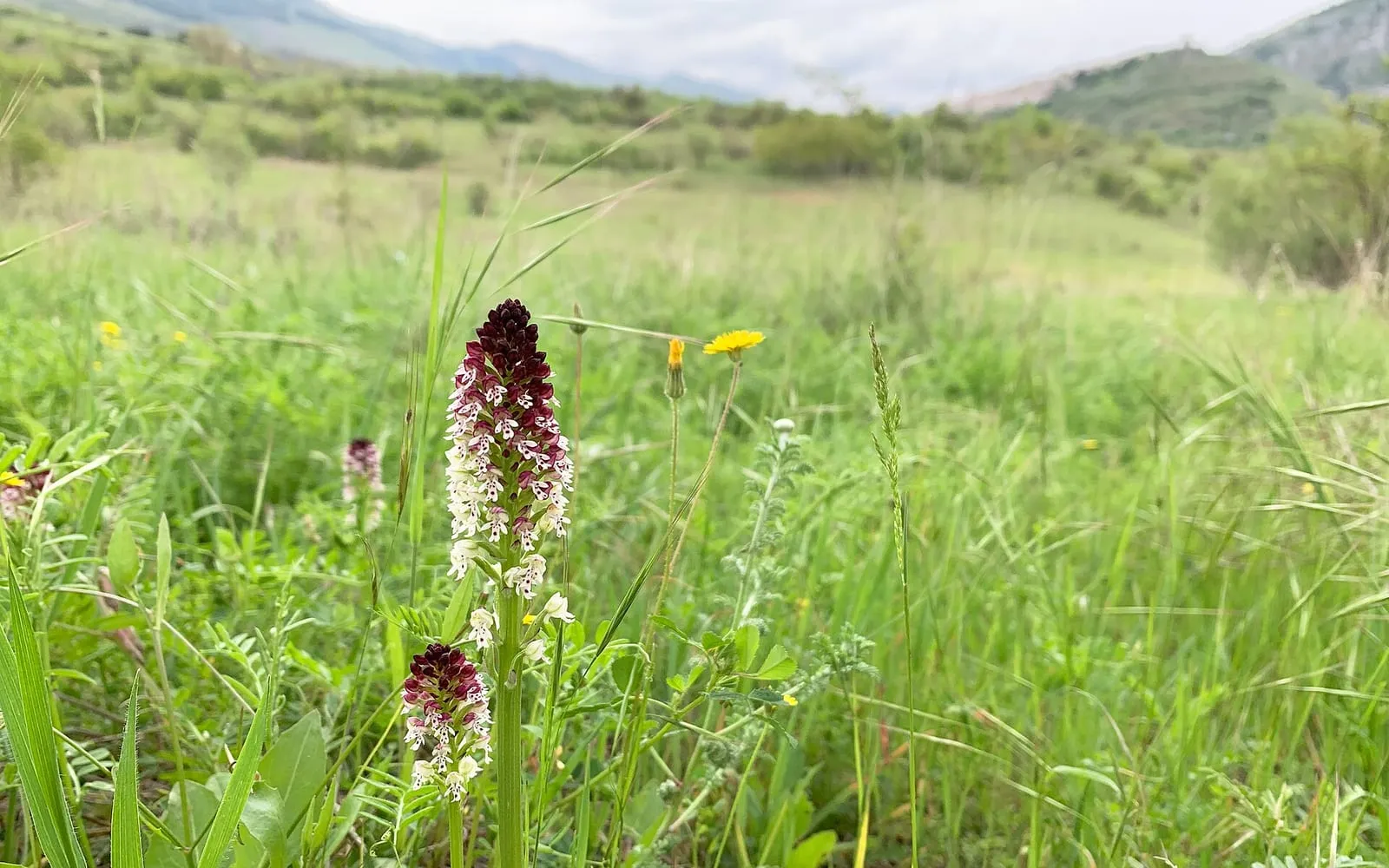
Neotinea ustulata takes both its English and Latin names from the top of its flower spike, where the tightly closed dark maroon buds cluster so densely that the head appears singed, as though a flame had passed over it. As the lower flowers open they reveal a different face: a white lip spotted with crimson-purple dots below a compact dark hood, so a spike in full bloom shades from burnt-brown at the tip to white-and-red beneath. It is a small, neat orchid of Europe and western Asia, seldom taller than a hand-span, and one of the surest signs of old, unimproved turf.
Identification
A little rosette of blunt, greyish-green, unmarked leaves sits close to the ground, and the flowering stem is short and slender. The individual blooms are tiny, tidy and crowded, each with a deep reddish-brown to blackish hood formed by the incurved sepals, and a three-lobed white lip peppered with fine purple spots and carrying two small side lobes and a longer notched central one. The scent is light and honeyed. Two seasonal races exist: an early-flowering form that blooms in late spring, and a late-flowering form that comes into flower in high summer, each keyed to different pollinators and grassland cycles.
Where to look
The burnt orchid grows in short, species-rich grassland over chalk and limestone, the kind maintained for centuries by sheep grazing and never touched by the plough, fertiliser or herbicide. It grows among the fine grasses and low herbs of downland, on sunny banks and in old pastures, always where the sward stays open and low. Because it needs that continuity, it is a classic indicator of ancient grassland, and its loss from a site usually shows that the land has been improved or abandoned to scrub.
A slow starter
This orchid develops very slowly. From seed, a plant may spend a decade or more underground, fed by a soil fungus, before it produces a single leaf, and several years more before it flowers. That slow pace means a colony cannot recover quickly once damaged, and a lost population is effectively gone for a human lifetime. Small bees and flies pollinate the flowers, moving pollen between the crowded heads as they forage.
The case against digging one up
Everything about the burnt orchid’s life cycle argues against moving it. Its dust-like seeds carry no reserves and depend on the right fungus to germinate; its underground years leave it wholly reliant on that partnership; and the fungus stays behind in the turf when a plant is lifted. A transplanted tuber usually dies after the move. Even skilled growers rarely raise the species, since flask culture of the seed is difficult and the resulting seedlings perform poorly in pots. For gardeners, this is a plant to protect in place rather than cultivate.
Protection and decline
The burnt orchid has retreated sharply as old downland has been ploughed, fertilised or left to grow rank, and it is treated as a plant of high conservation concern across much of its range. In Britain no wild plant may be uprooted without the landowner’s permission under the Wildlife and Countryside Act 1981, and the surviving downland colonies depend on continued grazing to keep the turf short. National laws protect it elsewhere in Europe, and CITES regulates trade in all orchids. Keeping its habitat grazed and unfertilised helps it more than trying to grow it in a nursery.
Two races in one species
Botanists long puzzled over burnt orchid plants that flowered in high summer, weeks after the main spring show, and these are now recognised as a distinct late-flowering race. The spring form opens in May and June, sets seed early, and dies back before the summer drought bites; the summer form flowers in July and August and keeps its leaves longer. The two differ subtly in stature and in the timing of their pollinators, and they rarely interbreed because their flowering seasons barely overlap. A downland with both forms can carry burnt orchid flowers across half the year.
A sign of ancient grassland
Because the burnt orchid takes so long to establish and cannot tolerate fertiliser, ploughing or rank growth, ecologists read its presence as a sign that a piece of turf has been grazed continuously and left unimproved for a very long time. Grasslands that support it tend to be rich in other slow-colonising plants and in the insects that depend on them. When the orchid vanishes from a site, it usually shows that the management has changed, and getting it back is close to impossible within a human lifetime, so surviving colonies are treated as irreplaceable.
Small, and easily missed
For all its two-tone spike, the burnt orchid is one of the smallest downland orchids, often no taller than the surrounding grass, and its flowers are tiny. Walkers pass it constantly without noticing, and it is easiest to find on close-grazed turf where the sward is short enough to let its dark heads stand clear. Its small size is part of why grazing matters so much: let the grass grow long and the little spikes are both shaded out and hidden, and the colony declines before most people notice.
Questions people raise
Why is the top of the spike so much darker? The unopened buds are packed with dark pigment, and they open from the bottom upward, so the still-closed tip stays reddish-brown and “burnt” while the lower flowers turn white and spotted.
What are the two flowering forms? One race flowers in late spring and another in mid to late summer; they differ slightly in shape and in the insects that visit them.
How long before a seedling flowers? Often more than ten years from germination, because the plant spends its early life underground.
Is it safe to pick the flowers? Picking depletes a slow-recovering colony and, where the plant is legally protected, may be an offence, so leave it standing.
What soil does it need? Thin, lime-rich grassland soil kept short by grazing; it cannot cope with rich, rank or acid ground.
Burnt Orchid problem guides
Not sure what is wrong? See the common houseplant pests guide.