
Houseplant
Metallic Disa
Disa atricapilla
Also known as Disa atricapilla
How to grow Disa atricapilla, the metallic disa, a Cape fynbos orchid with white flowers fringed with near-black hairs like stitched thread.
At a glance
- Difficulty
- Difficult
- Water
- Evenly moist in growth; ease off for any rest
- Light
- Bright indirect light
- Temperature
- Cool, bright and frost-free in the winter growing season; dry and warm in the summer rest
- Humidity
- Average, with good air movement
- Hardiness
- USDA 9-10, RHS H2, hardy to 2 C
- Type
- Perennial
- Height
- 15-30 cm
- Native to
- South Africa
A fynbos orchid of the south-western Cape, where winters are cool and wet and summers hot and dry. It grows through the cool wet months and retreats to a dormant tuber for the dry summer, so it needs cool, bright, frost-free winters and a dry summer rest instead of warmth all year. It flowers in November and December, usually after a fire, and few growers keep it long.
Hardiness zones describe winter cold alone. Summer heat, humidity, rainfall and the length of the growing season decide as much, so treat the range as the outer limit rather than as a recommendation.
Not known to be toxic
Disa atricapilla, the metallic disa, is not recorded among the seriously toxic plants, and related plants in its group are not listed as toxic by the ASPCA or the RHS. A pet or child that chewed a leaf would be unlikely to have more than a possible mild stomach upset.
Sources: ASPCA toxic and non-toxic plants, RHS potentially harmful garden plants
About
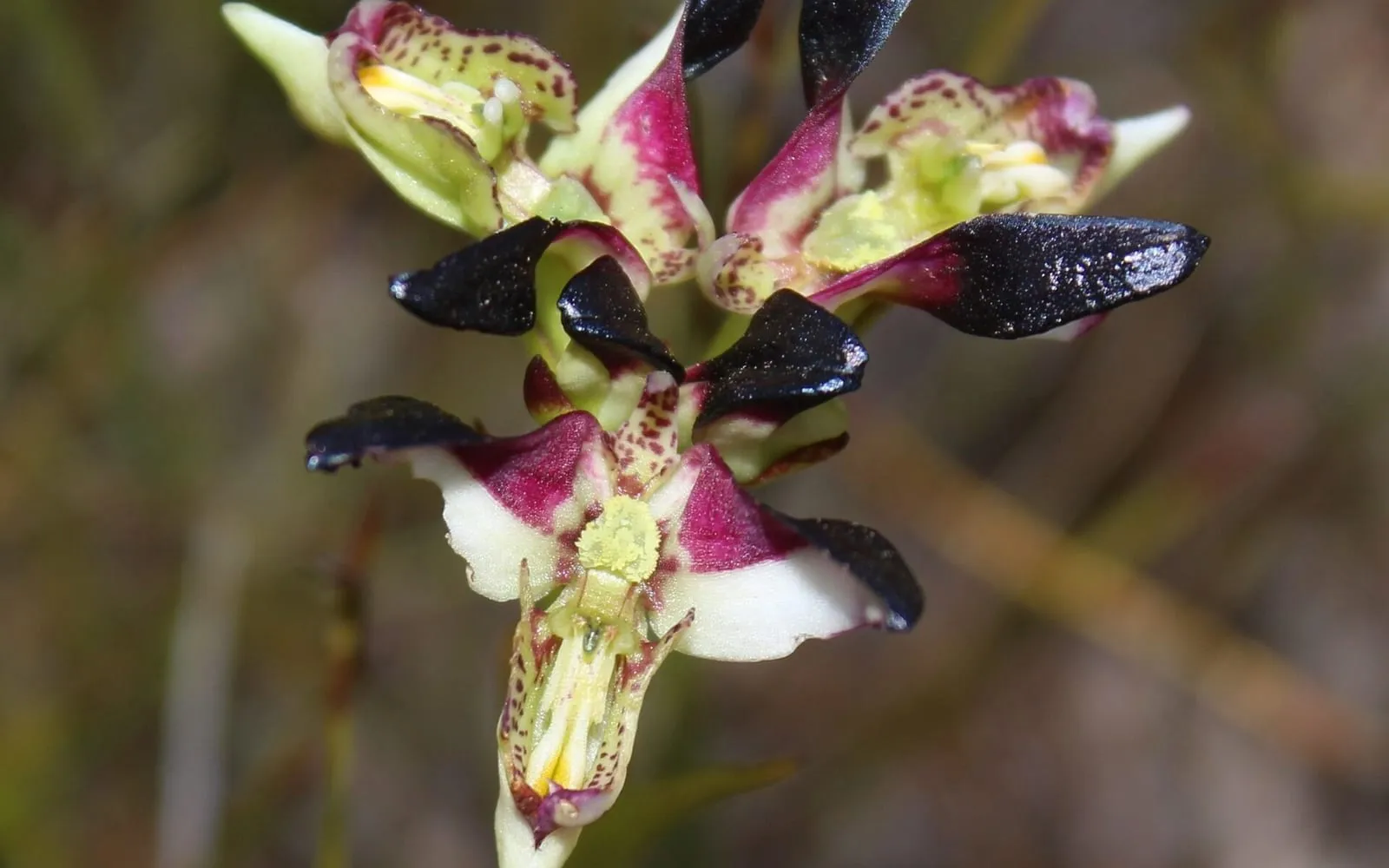
Disa atricapilla is a small fynbos orchid of the southwestern Cape. Its species name means black-haired and points to its most obvious feature. The white flowers have a dense fringe of dark, almost black hairs and matching spots along the lateral sepals. That contrast between white petals and dark markings gives rise to its English name. It is a ground-growing tuberous species, one of a group of Cape disas pollinated by long-tongued or biting flies drawn to the patterned flowers. Few growers ever handle it, and it is normal for this species to be difficult in cultivation.
Appearance and character
The flowers are the main reason to notice this plant. A slender stem carries a few blooms, each dominated by two spreading lateral sepals of clean white, fringed and blotched with dark purple-black bristly hairs. A hooded upper sepal and small inner parts complete the bloom. At close range, the flowers look like white petals edged with black thread, unusual among orchids and easy to recognise once seen. Below the flowers sits a low group of narrow green leaves, easily lost among grasses and low shrubs until the patterned spike appears.
Where it is from
The species is native to South Africa and restricted to the fynbos of the southwestern Cape. It grows on damp sandstone slopes and flats that stay moist through the cool, wet winter and dry hard over summer. That Mediterranean-type cycle, with a wet cool growing season and a hot dry rest, governs its growth. Its patterned flowers are adapted to particular fly pollinators of the region, and its narrow natural range makes it one of the more localised species in a genus already rich in Cape endemics.
How it grows
The plant lives from a small underground tuber that is remade each year. Cool wet weather brings roots and leaves, and the plant uses that growth to rebuild the tuber. A flower spike follows in November and December, usually after a bushfire has cleared the fynbos, before the whole plant retreats below ground for the dry season. Natural increase is slow and comes from the occasional offset tuber. Seed is dust-like and relies on soil fungi to germinate. That fungal dependence, together with the exact seasonal cycle, is why growers rarely raise it from seed outside dedicated laboratory work.
Through the seasons
Autumn rains end the summer rest and start new roots and leaves, so this is when a potted plant is watered back into life.
Winter is the leafy growing season under cool bright conditions, when the tuber is rebuilt for the year ahead.
Spring brings the patterned flower spike as light strengthens and the medium begins to dry between waterings.
Summer is the dormant season. The leaves die back, watering almost stops, and the tuber rests through heat and drought.
Care difficulty
For anyone other than a committed grower of Cape terrestrials, this is a plant to leave in the wild. It needs cool, bright winter growth, very sharp drainage, soft mineral-free water and a thoroughly dry summer dormancy. Warm, stagnant wetness rots the tuber quickly. The practical constraint is that the plant is narrowly adapted and slow to propagate, so material is scarce and mistakes are costly. Reproduce the Cape seasons precisely and it can be kept for a while; treat it as an ordinary orchid and it will not last.
Watering
Match watering to the growing cycle. Start when autumn cool and moisture return, keeping the gritty lean medium evenly damp but never waterlogged through winter growth. Use rainwater or reverse-osmosis water, because the fine roots are quickly harmed by the dissolved salts in hard tap water. Reduce watering as the leaves age in late spring, then withhold almost all moisture once the plant dies down for summer. Give only the occasional trace of water if needed to stop the resting tuber drying to dust.
Warning signs, diseases and pests
Mushy tubers and dark collapsing roots signal a pot kept too wet, most dangerously in summer. Move the plant into drier, coarser conditions. Pale stretched leaves and no flowers usually mean too little light or a rest that never happened. Under glass, aphids crowd the soft young spike, mealybugs and scale hide at the leaf bases, and spider mites arrive in hot dry air. Remove small numbers by hand, use a gentle appropriate treatment on stubborn colonies, and keep air moving to discourage them.
Growing environment
Give the brightest cool position available through winter, short of burning it against hot glass, with steady ventilation to reduce fungal problems. A cold greenhouse or a cool bright frost-free room matches its mountain winters far better than a warm living space. Build the compost around coarse sand and fine grit with a little fibre so that water drains through quickly, and keep the pot off heated surfaces so the roots stay cool while it grows.
Feeding
Feed very little. The sandstone fynbos soils it inhabits are poor, so a highly dilute balanced feed once or twice during active winter growth is more than enough. Stronger or more frequent feeding leaves salt residues that scorch the roots and encourages soft, rot-prone tissue. Give no feed at all during the summer rest, when the dormant tuber is not taking up nutrients.
Troubleshooting
What makes the flowers look black-fringed? The dark bristly hairs and spots along the white lateral sepals are natural and give the species both its Latin and its common name.
Has a summer-dormant plant died? Not if the tuber stays firm. This is its normal rest, so keep it dry and cool and wait for autumn moisture.
What water should I use? Rainwater or reverse-osmosis water; hard tap water harms the roots through salt build-up.
How is it propagated? Mainly by slow tuber offset, since seed depends on specific fungi and seldom germinates in ordinary pots.
Is it harmful to pets? No serious toxicity is on record for the genus, but stop pets chewing the leaves to be safe.
Metallic Disa problem guides
Not sure what is wrong? See the common houseplant pests guide.