
Houseplant
Blue Disa
Disa graminifolia
Also known as Disa graminifolia
How to grow Disa graminifolia, the blue disa, a Cape mountain orchid with grass-like leaves and violet-blue flowers from a small tuber.
At a glance
- Difficulty
- Difficult
- Water
- Evenly moist in growth; ease off for any rest
- Light
- Bright, cool and airy
- Temperature
- Cool; frost-free, away from warm roots
- Humidity
- Average to high, with moving air
- Hardiness
- USDA 9-11, RHS H2, hardy to 2 C
- Type
- Perennial
- Height
- 15-40 cm
- Native to
- South Africa
A terrestrial orchid of the moist sandstone slopes and seeps of the Cape mountains, where winters are cool and wet and summers warm and dry. It needs cool, bright, frost-free conditions, constant root aeration and clean, mineral-free water, so a warm, humid room suits it badly. The winter cold figure is an estimate.
Hardiness zones describe winter cold alone. Summer heat, humidity, rainfall and the length of the growing season decide as much, so treat the range as the outer limit rather than as a recommendation.
Not known to be toxic
Disa graminifolia, the blue disa, is not recorded among the seriously toxic plants, and related plants in its group are not listed as toxic by the ASPCA or the RHS. A pet or child that chewed a leaf would be unlikely to be badly harmed beyond a possible mild stomach upset.
Sources: ASPCA toxic and non-toxic plants, RHS potentially harmful garden plants
About
Disa graminifolia is one of the blue-flowered orchids of the Cape, valued among South African wildflower enthusiasts for a colour that few terrestrial orchids anywhere can match. Its species name means grass-leaved, and that leaf shape, together with the violet-blue blooms, sets it apart from most of its relatives. The plant grows from a small underground tuber on the mountains of the southwestern and southern Cape, and the strap-like leaves and flowers rarely appear at the same time. By the time the flower spike opens in late summer and autumn, the grassy foliage of the previous growing season has usually withered away, so the blooms often rise from bare ground. This guide is written mainly to help identify the species and understand its wild rhythm, since it is a challenging plant to sustain in an ordinary collection.
Appearance and character
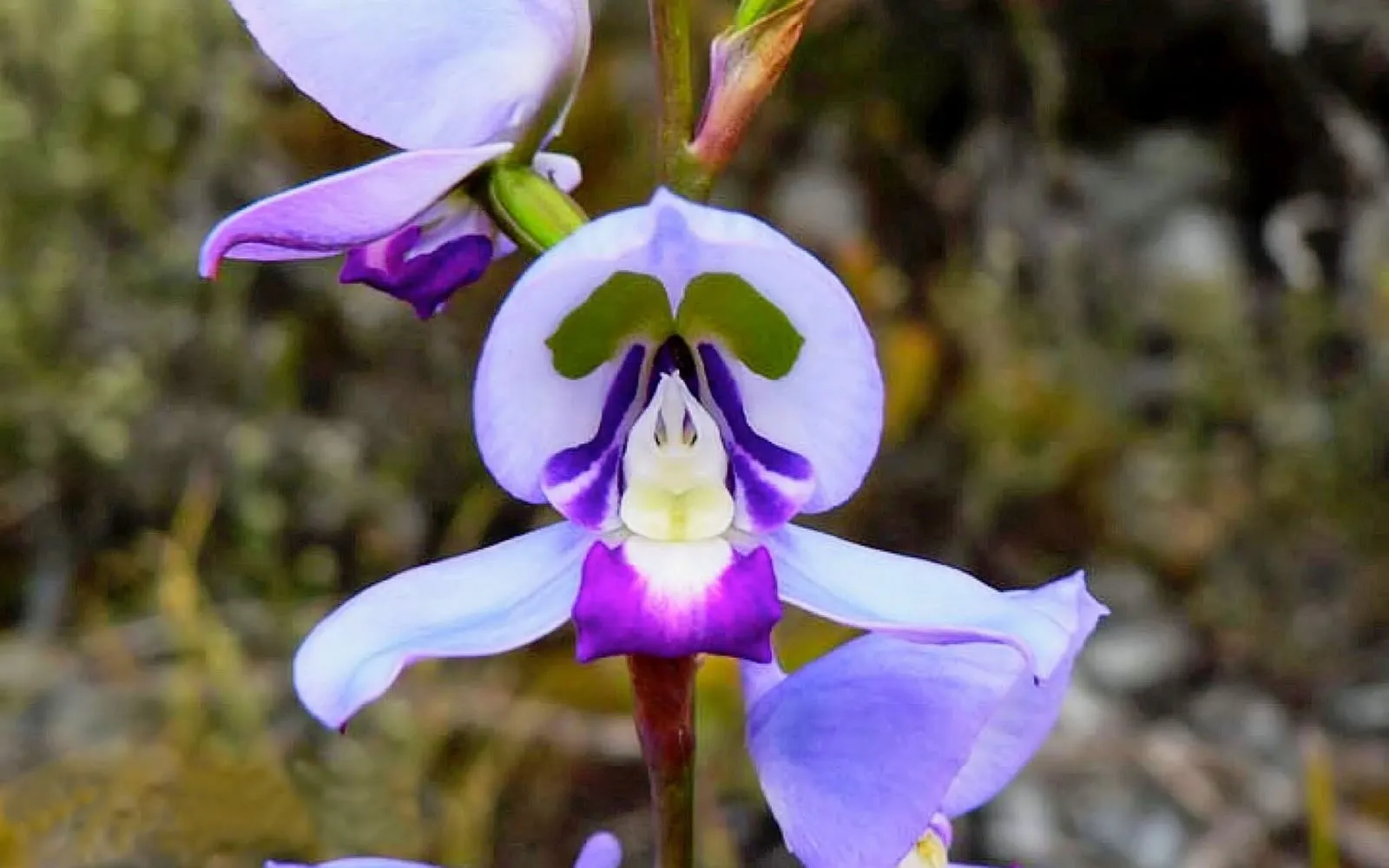
The flowering stem stands well clear of the ground and bears a loose head of several blooms in shades of lilac, mauve and clear violet-blue, sometimes with fine darker veining. The uppermost sepal forms a hood with a slender backward-pointing spur, the two side sepals spread out to the sides, and the small petals and lip give the flower the look of an orchid. Away from flowering the plant is far less obvious. A tuft of narrow, almost reed-like green leaves lies among fynbos grasses, easily passed over until the spike gives it away.
Where it is from
This orchid is native to South Africa, where it favours permanently or seasonally moist ground on sandstone slopes, often near seepage lines and along the damp margins of streams in the mountains behind Cape Town and eastward. The climate there brings cool wet winters and warm dry summers, and the plant is adapted to a substrate that stays moist through the cool months while draining freely, never becoming a stagnant bog. Its association with running or trickling water is a clue that its roots need oxygen as much as moisture, a trait it shares with the red Disa uniflora of the same region.
How it grows
Growth begins with the return of autumn and winter rain, when leaves expand and the tuber fattens on the season’s photosynthesis. As summer approaches, the leaves fade, and the plant uses its stored energy to make a flowering stem that blooms once the foliage has largely gone. After seed is set, the plant rests as a dormant tuber. Wild germination relies on partnerships with soil fungi, and vegetative increase is slow, so numbers build gradually. A grower attempting it should think in terms of clean cool water moving through a very open medium, mimicking an aerated seep.
Through the seasons
Winter is the leafy growing season. Cool bright conditions and steady moisture through a free-draining medium build the tuber that everything else depends on.
Spring sees the foliage begin to age as day length and warmth increase, and watering can be trimmed a little.
Summer into early autumn is when the flower spike rises, often from a plant whose leaves have already died down. Keep the roots moist but well aerated while the spike develops.
Late autumn returns the plant to growth as fresh leaves emerge and the annual cycle turns over again.
Care difficulty
This is a difficult orchid away from its native seeps. It needs pure soft water, constant root aeration, coolness, and bright light, and losing any one of those conditions can kill it. Warm stagnant conditions rot the roots quickly, hard water damages it over weeks, and heat during the wrong season disrupts the leaf-then-flower sequence. Even accomplished growers of the streamside disas treat the blue-flowered kinds as a step harder. Treat this page as a portrait of what the plant needs instead of a recipe that guarantees success indoors.
Watering
The watering regime follows the running water of its habitat. Through the winter growing season the medium is kept thoroughly and continuously moist with rainwater or another mineral-free source, ideally with fresh water passing through instead of sitting still. Some growers stand pots in shallow trays of soft water during active growth to imitate a seep, then remove that reservoir as the foliage ages. Reduce the flow as the leaves die back, keep the roots merely damp while the flower spike matures, and never let dissolved salts accumulate, since they damage the plant slowly.
Warning signs, diseases and pests
Roots going brown and hollow, or a tuber turning soft, signal stagnation, warmth or a medium that has broken down and lost its air spaces. Repot into fresh open material. Leaf tips scorching and weak growth often come from hard water or feed salts. Under cover, aphids gather on the soft developing spike, while mealybugs and scale hide among leaf bases and spider mites appear in dry warm air. Deal with these promptly by hand or with a gentle appropriate treatment, and improve airflow, which discourages most of them.
Growing environment
Aim for cool and bright with generous ventilation: a cold or barely heated greenhouse, or a cool bright sheltered spot, matches its mountain origin far better than a warm living room. The compost should be a lean, sharply draining mix of coarse sand, fine grit and a little chopped fibre or perlite, packed loosely so water runs straight through. Because it dislikes warm roots, keep the pot off heated surfaces and out of stuffy corners, with steady moving air around the leaves.
Feeding
Very little feeding is needed. The mountain seeps it grows in are nutrient-poor, flushed constantly by clean water, so at most a highly dilute balanced fertiliser once or twice through the winter growth is enough. Overfeeding builds up the salts that damage the roots, and it produces soft tissue prone to rot. During the flowering and resting phases, withhold feed entirely and rely on the reserves already in the tuber.
Troubleshooting
Where are the leaves when it flowers? Often gone. In this species the foliage of the growing season usually withers before the flower spike opens, so bare-stemmed blooming is expected.
Why did my plant rot? Almost always stagnant, warm or salt-laden water at the roots. It needs clean, cool, moving, mineral-free water and constant aeration.
Can I use tap water? Only if it is very soft. Hard water harms it, so rainwater or reverse-osmosis water is safer.
How is it propagated? Slowly, by tuber increase; seed depends on specific fungi and seldom germinates without them.
Is it toxic? The genus has no record of serious harm. Even so, discourage pets from chewing the leaves.
Blue Disa problem guides
Not sure what is wrong? See the common houseplant pests guide.